Virtual Private Network (VPN)
A virtual private network (VPN) is a secure tunnel created between two endpoints connected via an unsecure transport network.
- facilitates remote access
Use Cases
- allows you to remotely connect to a network in a secure, encrypted manner
- to access the internal resources of their organization
- device acts as though it is connected to the organization’s internal network
- send sensitive traffic over insecure networks
- Use VPNs to protect or anonymize the traffic you’re sending over untrusted connections
- Keep ISP from logging the contents of traffic
- stop people on same network from eavesdropping
- obscure geographical location
- by-pass location-based blocking
- hide traffic and IP addresses when using peer-to-peer (P2P) file sharing services
How it Works
- client and server concept
- create a connection using
- a VPN client application on one end
- and a VPN concentrator on the other end
- aka remote access server (RAS)
- accepts connections from Internet
- client uses the VPN client application to authenticate to the VPN concentrator
- once connection is established,
- all traffic exchanged from the network interface connected to the VPN flows through the encrypted VPN tunnel
- remote computer becomes part of the local network
- still restricted by the bandwidth available over the Internet connection
- tunneling encapsulates one protocol within another to ensure transmission is secure
Example
The VPN described above is for remote access to the LAN by teleworkers and roaming users.
- VPNs can also be used
- to connect sites over public networks
- such as linking branch offices to a head office
- or within a local network as an additional security mechanism
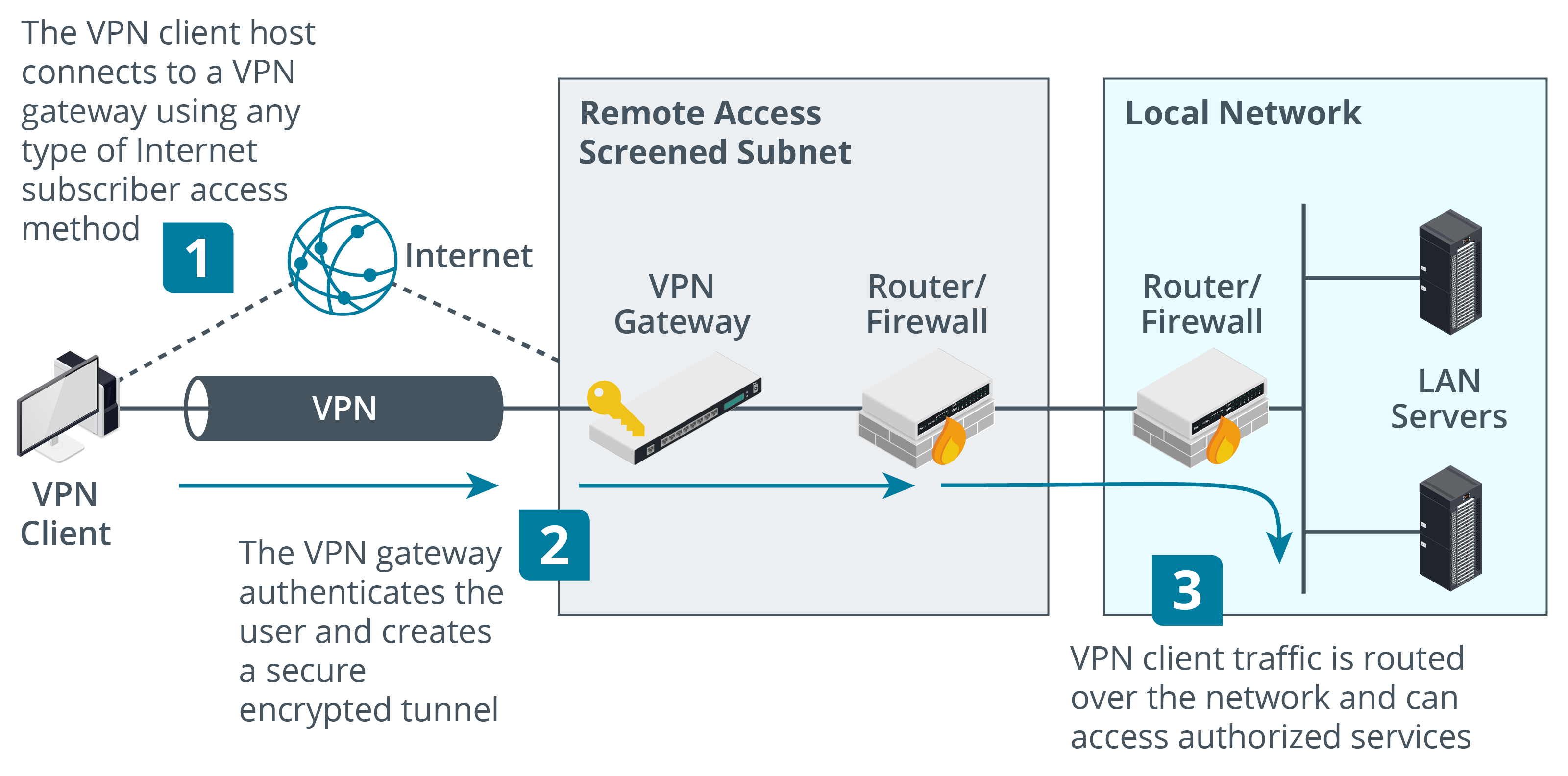
Tunneling
A tunnel is an encrypted connection between two points.
- requires a protocol that can create a secure tunnel for private communications through the Internet
- hosts are on the same logical network but connected via different physical networks
- encapsulates the packet for the local network within a public network packet
- local network packet is encrypted
- When the packet is delivered
- remote access server strips the public packet headers
- extracts and decrypts the local packet
- forwards it over the local network
- encapsulates the packet for the local network within a public network packet
- types:
- full-tunnel VPN
- all network traffic leaving the connected device is routed through the VPN tunnel
- split-tunnel VPN
- only traffic destined for the corporate network is sent through the VPN tunnel
- other traffic is routed directly over the Internet from the client’s network
- full-tunnel VPN
Tunneling Protocols
A VPN protocol determines how the tunnel is created.
- Each protocol provides a different solution to privacy requirements
- Point-to-Point Protocol (PPP)
- Generic Routing Encapsulation (GRE)
- Internet Protocol Security (IPSec)
- Transport Layer Security (TLS) Tunneling
- Layer 2 Tunneling Protocol (L2TP)
- is a mechanism for setting up VPN tunnels at the data link layer
- does not provide encryption by default
- is typically used in conjunction with IPSec at the network layer
- can be used in dissimilar layer 3 (L3) networks
- created by Cisco
Types of VPNs
Info
A third topology is a host-to-host tunnel. This is a means of securing traffic between two computers where the private network is not trusted.