Symmetric Encryption
Symmetric encryption is a two-way encryption scheme in which encryption and decryption are both performed by the same key.
- aka private key cryptography
- used for confidentiality
- used for encrypting large amounts of data
- is very fast
- secret key must be kept to authorized persons only
- to use, both entities need to exchange the key using a secure channel
- this key exchange is the main problem
Structure of Symmetric Key Cryptosystem
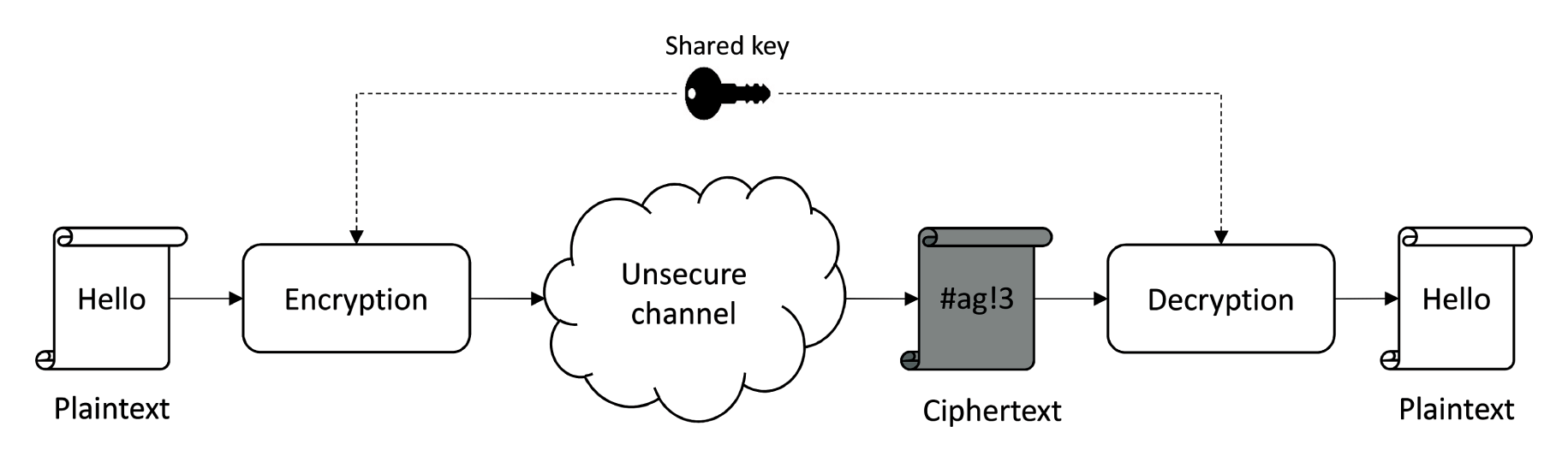
2 Challenges of Symmetric Cryptography
- Key establishment/exchange
- agreement on a secret symmetric key requires to make use of secure channel or a specific key-agreement protocol.
- Trust
- since both parties use the same key, there is an implicit requirement that they trust each other
- not practical to provide security when parties do not belong to the same circle
Advantages over asymmetric key cryptography:
- significantly faster
- use shorter keys for the same security strength
- based on simple bit operations
- while asymmetric is based on mathematical notions
Key Exchange
Key exchange is the process of sharing the key between the sender and receiver.
- constitutes an entire section in cryptography
- # of keys required:
- for a group of
people - need
keys - because each member shares a key with each of the other
members
- because each member shares a key with each of the other
- for a group of
- Sharing a single key among all users of the system is a weakness
2 Types of Ciphers
Symmetric Key Algorithms
- Common symmetric key algorithms:
- Other well-known symmetric ciphers include:
- Block
- Twofish
- Serpent
- Blowfish
- CAST5
- RC6
- IDEA
- Stream
- RC4
- ORYX
- SEAL
- Block
3 Differences Between AES and 3DES
- 3DES is three rounds of DES, while AES uses a newer and completely different algorithm
- AES uses longer and stronger keys than 3DES, as well as a longer block length, making AES harder to attack
- 3DES is slower than AES