Block Cipher
Block cipher is an encryption algorithm that takes a predetermined number of bits (binary digits), known as a block, and encrypts that block.
- take the input plaintext and break it into a fixed-length series of symbols (block) and then encrypt and decrypt the block as if it was a single symbol
- blocks typically have 64 bits
- majority of encryption algorithms in use are block ciphers
- more versatile
- more resource intensive and complex
- more susceptible to errors
- works better with messages whose sizes are fixed, known in advance, or reported in protocol headers
- used in:
- symmetric algorithms
- asymmetric algorithms
- the entire padded block is treated as a number, which then has some algebraic function applied to it to produce a ciphertext
- cryptographic hash functions
- pseudorandom number generators (PRNG)
- message authentication codes (MAC)
- block ciphers often use Feistel Functions
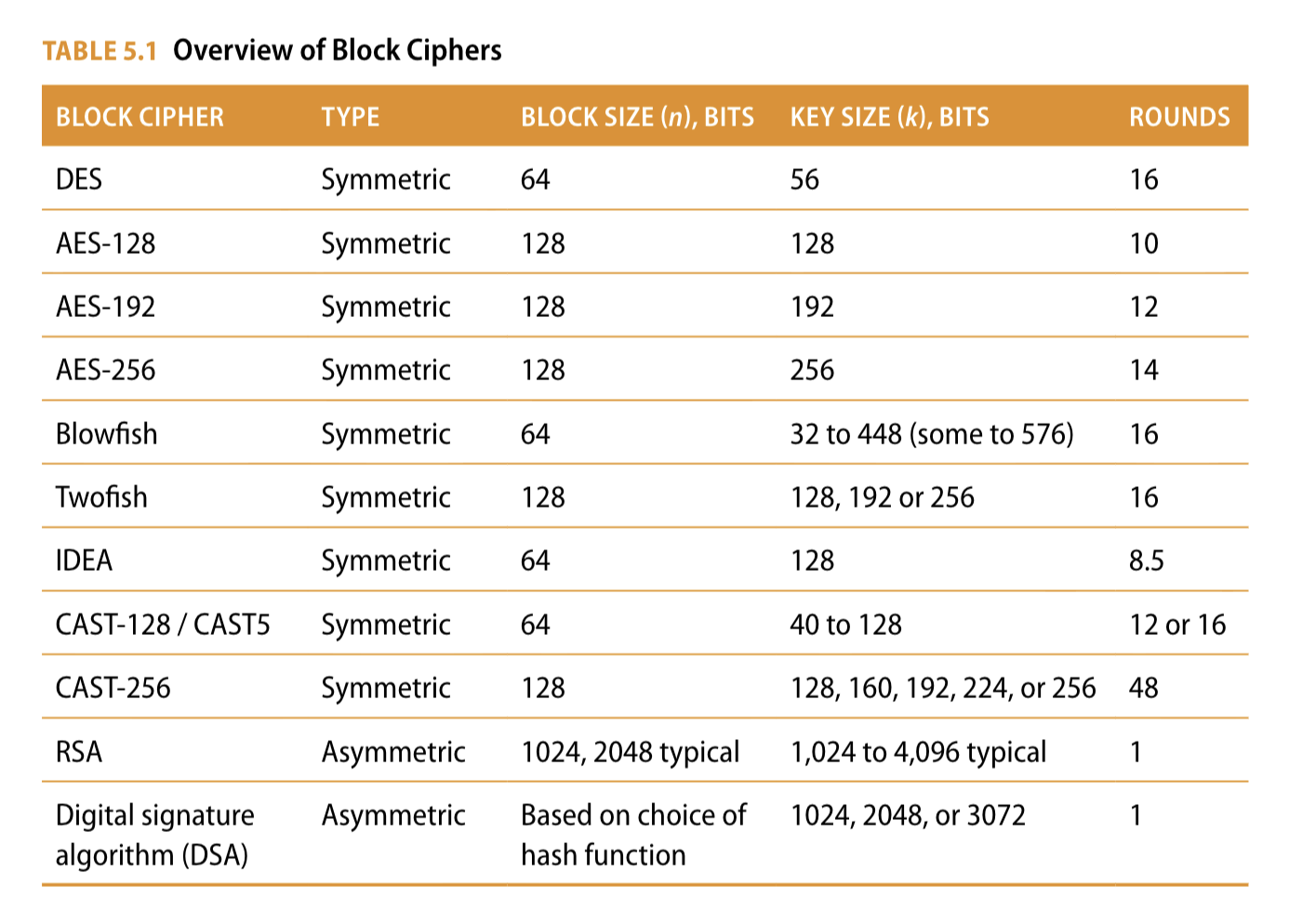
Construction of Block Ciphers
Padding
- all block ciphers work on fixed-length blocks of plaintext
- these blocks must be padded out to the fixed block size of the algorithm
- can be done by adding bytes to the end of the short blocks, along with a counter value that indicates how much padding was used
- if the plaintext is a multiple of the block size,
- then a final block that just contains padding must have been added
- the added padding byte thus must be removed
Block Mode
Block mode defines the specific processes and operations that the cipher uses.
- aka mode of operation
- specifies how a block cipher applies a single-block operation to a plaintext larger than the block cipher’s block size
Electronic Code Book (ECB)
- once the message has been padded to the cipher’s block size, it can be encrypted
- easiest, least secure method is the Electronic Code Book (ECB)
- In ECB mode,
- each block of plaintext is processed independently by the cipher
- each block is processed or encrypted using the same key
- using the same key to encrypt each block brings a significant:
- advantage:
- greatly simplifies the process
- encryption can be done in parallel
- disadvantage:
- while may be adequate for messages that are no greater than the block size, for longer messages, identical blocks of plaintext will produce identical blocks of ciphertext
- advantage:
- does not use an initialization vector (IV)
Cipher Block and Feedback Chaining
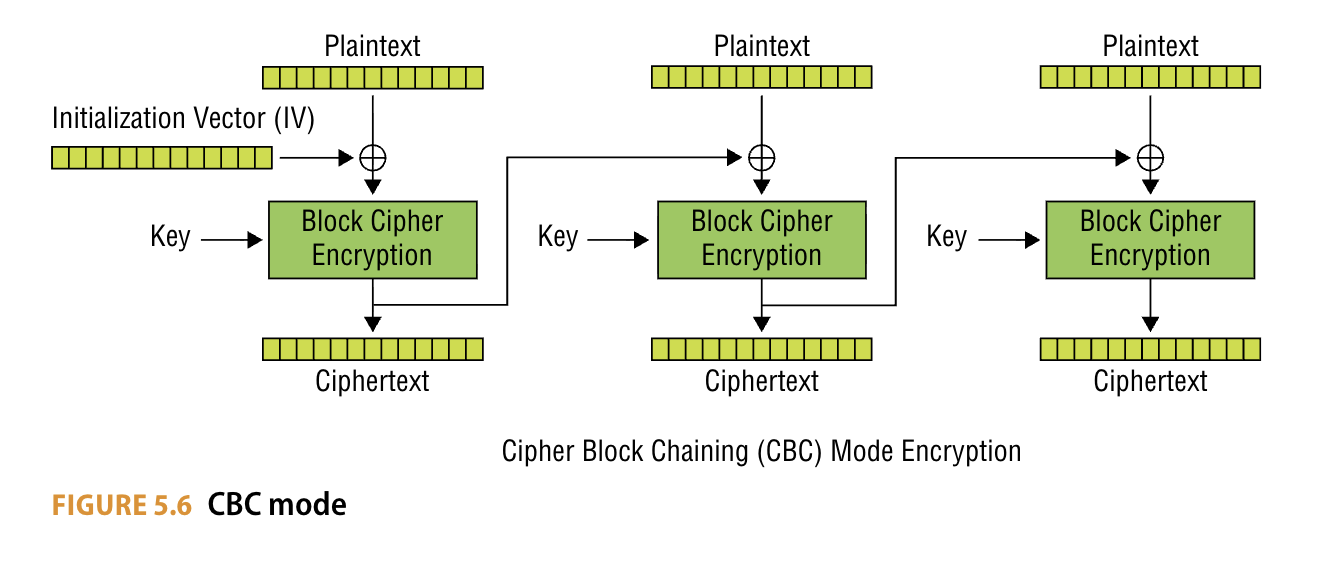
With Cipher Block Chaining (CBC),
- the first block of data is
ed with a block of random data called the initialization vector (IV) - to create a unique ciphertext block each time the encryption is performed
- IV is a randomly generated sequence of bits equal cipher’s block size
- every subsequent block of plaintext is XORed with the previous block of ciphertext before being encrypted
- thus ciphertext blocks are ‘chained’ together
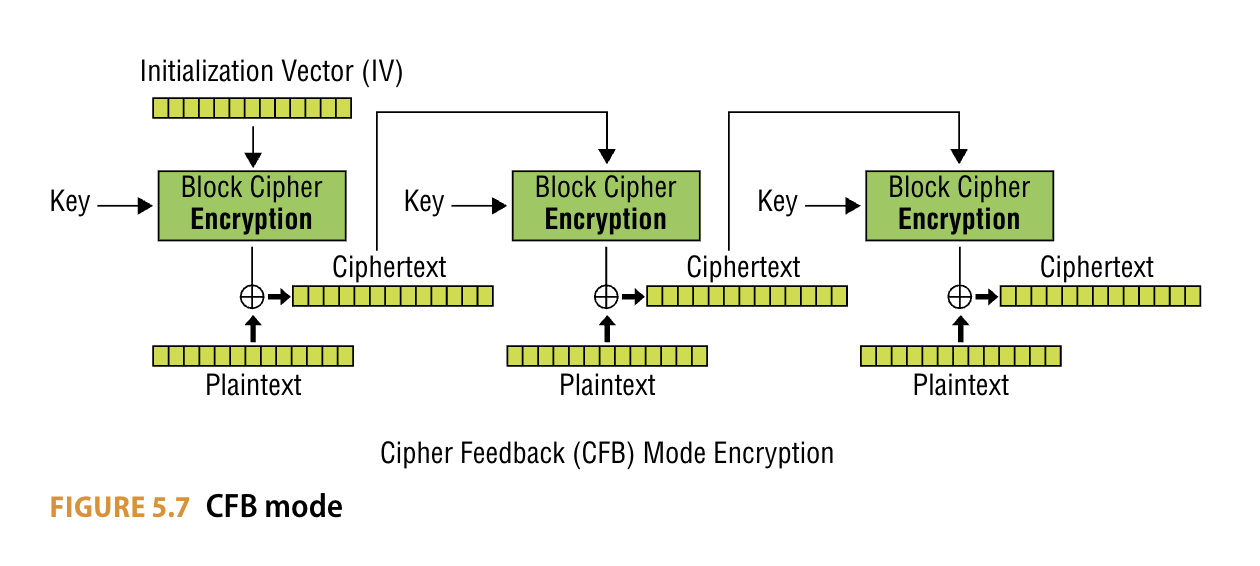
With Cipher Feedback (CFB) mode,
- the IV is encrypted and then XORed with the first block of the plaintext,
- producing the first block of ciphertext
- then that block is encrypted, and the result is XORed with the next block of plaintext,
- producing the next block of ciphertext
Weakness of both CBC and CFB
- with both CBC and CFB, the encryption of block
depends on the encryption of block
- so neither is amenable to the parallel encryption of data
- affects speed and throughput
- both modes can be decrypted in parallel, though
- Also, random access is complicated by the need to decrypt block
before one can decrypt the desired block - Errors can propagate from one ciphertext block to the next
Difference Between CBC and CFB
- With CBC,
- a one-bit change in the IV will result in the same change in the same bit in the first block of decrypted ciphertext
- so attacker could potentially tamper with the IV to introduce changes to the first block of the message
- so necessary to ensure the integrity of the IV
- With CFB,
- a one-bit change in the IV will result in random errors in the decrypted message
- thus not an effective method of tampering with the message
- With CBC,
- the decryption of messages requires the use of the block cipher in decryption mode
- With CFB,
- the block cipher is used in the encryption mode for both encryption and decryption
- can result in a simpler implementation
- the block cipher is used in the encryption mode for both encryption and decryption
Output Feedback (OFB)
In Output Feedback (OFB) mode a block cipher generates keystream blocks which are XORed with the plaintext blocks to create the ciphertext blocks.
- Chaining dependencies do not exist in OFB mode
- each block is created independently of plaintext and ciphertext blocks
- encryption and decryption processes are the same
- errors do not propagate
Counter Mode
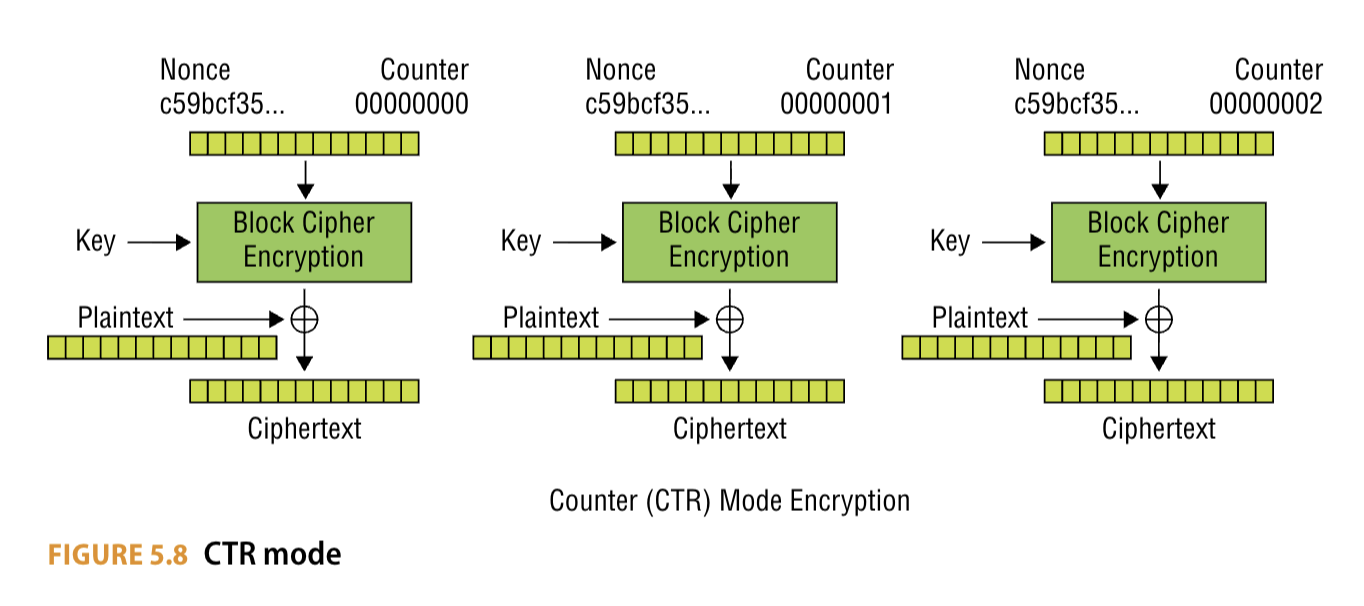
Counter (CTR) mode operates as a stream cipher.
- data sender and receiver use a synchronized counter which computes a new shared value each time a ciphertext block is exchanged
- has a positional dependency because a ciphertext block depends on the position of the current plaintext block
- since ciphertext blocks do not depend on other blocks,
- errors do not propagate
- addresses weakness 2 by not using previous blocks of the plaintext (CBC) or ciphertext (CFB) in producing the ciphertext.
- uses an IV combined with a counter value
- thus one can both:
- parallelize the encryption process
- and decrypt a single block of the ciphertext
- thus one can both:
- uses an IV combined with a counter value
- includes a nonce value
- is a unique, randomly generated value
- is inserted into each block cipher encryption round
- similar to how a salt value is used in hashes
- is intended to prevent replay attacks
Initialization Vector (IV)
- all modes other than ECB, need an IV which either must:
- be communicated to the receiver
- or the message must be prefixed by a throw-away block of data
- since decryption of an CBC or CFB stream of data without knowing the IV will only cause problems for the first block
- IV does not need to be secret, but it must be unpredictable