Data Encryption Standard (DES)
Data Encryption Standard (DES) is a symmetric block cipher which encrypts data in 64-bit blocks.
- aka Data Encryption Algorithm (DEA)
- developed by IBM in early 1970s
- US gov standard until 1990s
- DES is a Feistel cipher
- uses a 56-bit key
- the length of key determines the strength of the algorithm
- was compromised and is no longer used
- succeeded by triple DES
Basic Concepts
- Data is divided into 64-bit blocks
- the data is then manipulated by 16 separate steps of encryption
- involve substitutions, bit-shifting, and logical operations using a 56-bit key
- data is then further scrambled using a swapping algorithm
- data is then transposed one last time
Key Schedule Algorithm
- the key schedule algorithm is used to generate subkeys
- to generate keys for each round:
- 56-bit key is split into two 28-bit halves
- halves are circularly shifted after each round by 1 or 2 bits
- 48-bits from the first two halves are selected and permuted to form the round key (subkey)
- means there is a different key for each round
- is derived from the previous round key
Substitution Boxes
- DES uses eight S-boxes
- are substitution boxes that are lookup tables
- each S-box has a table that determines what to substitute the bits passed into it for
- each item passed into the box is substituted with the item that matches it in the lookup table
- each s-box takes in 6 bits produces 4 bits
- the middle 4 bits of the 6-bit input are used to lookup the 4-bit replacement
- 8 S-boxes taken together map 48 bits to 32 bits
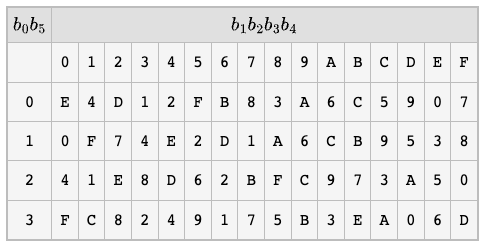
- each can be viewed as an array of 4 rows and 16 columns, with one nibble (4‐bit value) stored in each of the 64 positions
- each of its four rows is a permutation of the hexadecimal digits
- each of its four rows is a permutation of the hexadecimal digits
- each can be viewed as an array of 4 rows and 16 columns, with one nibble (4‐bit value) stored in each of the 64 positions
DES S-box 1 (in Hexadecimal)
- six-bit input to S-box is denoted
- first and last input bits are used to index the row
- while the middle four bits index the column
- output is in hex
Round F Function
- the round
function works as follows: - Expand the 32-bit half that was input to 48-bits
- done by replicating some bits
- XOR the resultant 48 bits with the 48-bit round key
- Split the result into eight 6-bit sections
- pass each portion through a different S-box
- each s-box produces a 4-bit output, giving 32 output bits
- transpose the output bits
- Expand the 32-bit half that was input to 48-bits
- above is done for each round
- DES has 16 rounds
- only reason DES is not secure is the short key
- 56-bit key is not long enough to prevent a brute force attack
- has a key space of
- the total number of possible keys
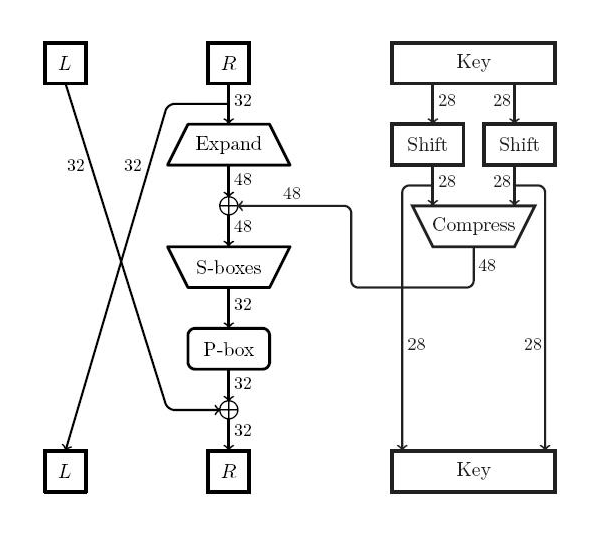
One Round of DES
- Each number indicates the number of bits
- DES round function
can be written as
is the P-box permutation is the S-boxes substitution is the expansion permutation is the right half is the subkey/round key - the new left half is simply the old right half
- the expansion permutation expands its input from 32 to 48 bits, and the subkey is then XORed with the result
- permutes the 32 input bits of input, with the expansion from 32 to 48 bits achieved by repeating some of the input bits in the output
- plays an important role in diffusion within a block
- The 48-bit output of the expansion (XOR) step is fed into the S-boxes, which serve to compress the result down to 32-bits
- 32-bit output is then passed through the P-box permutation
- Finally, the 32-bit output of the P-box is XORed with the old left half to obtain the new right half
- S-boxes (and XOR of subkey) serve to provide confusion
Vulnerabilities
- 3 main attacks:
- brute-force attack
- given a pair of plaintext and ciphertext blocks (
), the adversary needs to test, in the worst case, keys to find a key such that
- given a pair of plaintext and ciphertext blocks (
- differential cryptanalysis
- linear analysis
- brute-force attack