Feistel Function
A Feistel cipher is a general cipher design principle, not a specific cipher.
- aka Feistel network or Feistel cipher
- forms the basis for many block ciphers
- invented by Horst Feistel
- designed block ciphers for the US Air Force and IBM
- any block cipher that is based on Feistel works in essentially the same manner
- differences occur in the round function
- round function means a function performed with each iteration (round)
- details of round function can vary with different implementations
- usually simple functions to maintain efficiency
- uses S-boxes and P-boxes
- S-boxes perform substitutions
- notional substitution is an S-box that does a table lookup
- P-boxes perform permutations
- S-boxes perform substitutions
How It Works
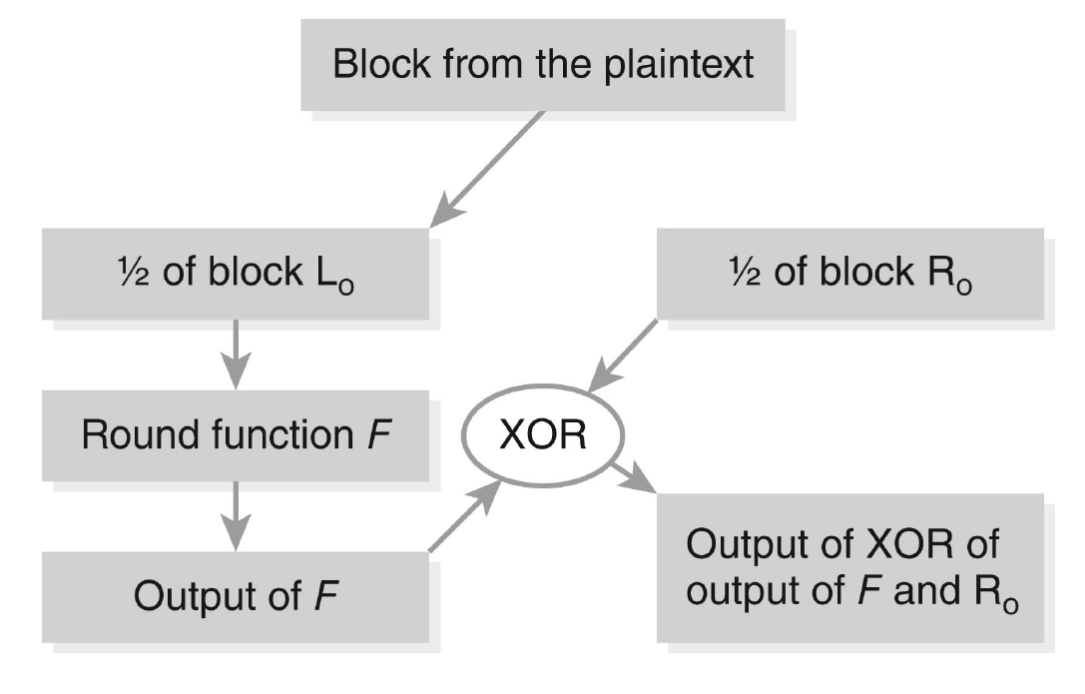
Simple
- starts by splitting the block of plaintext data
(often 64-bits) into two parts ( and ) - usually split equally
- round function
is applied to one of the halves - output of each function
and the remaining half of the data are run through the exclusive OR (XOR) function - i.e.,
then the result with - Binary Operations
- i.e.,
- then the halves are transposed
- i.e., positions switched
- repeated a given number of times
Detailed
- plaintext block
is split into left and right halves ( and ) - for each round
, new left and right halves are computed according to the rules: - new left half is the old right half
- where
is the subkey for round - subkey is derived from key
according to a specified key schedule algorithm - new right half is the old left half XORed with a function of the old right half and the subkey
- where
- ciphertext block
is the output of the final round
- Can decrypt regardless of the specific round function
- with XOR we can run the process backwards
- for
, we compute:
- Final result of decryption process is plaintext
- any round function
will work in a Feistel cipher, provided the output of produces the correct number of bits - no requirement that
itself be reversible - but not all possible
will be secure - the security boils down to the round function
and the key schedule - key schedule is usually not a major issue
- the security boils down to the round function
- no requirement that
Drawback
- half the bits are unaffected each round
- can be viewed as a source of inefficiency
- as a result, many recent block ciphers are not Feistel ciphers
- e.g. AES