Digital Certificate
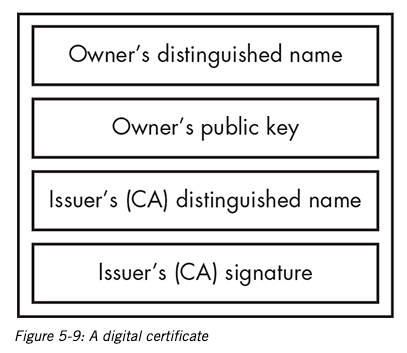
A digital certificate is identification and authentication information issued by a certificate authority (CA) as a guarantee that a key pair is valid for a particular subject.
- often used as a form of electronic identification for that person
- contains
- public key
- information about the subject and certificate issuer
- digitally signed to prove that it was issued to the subject by a particular CA
- in case of digital signatures, someone might have falsified the keys used to sign the message
- maybe keys did not belong to the original sender
- subject can be:
- human user
- computer server
Formats
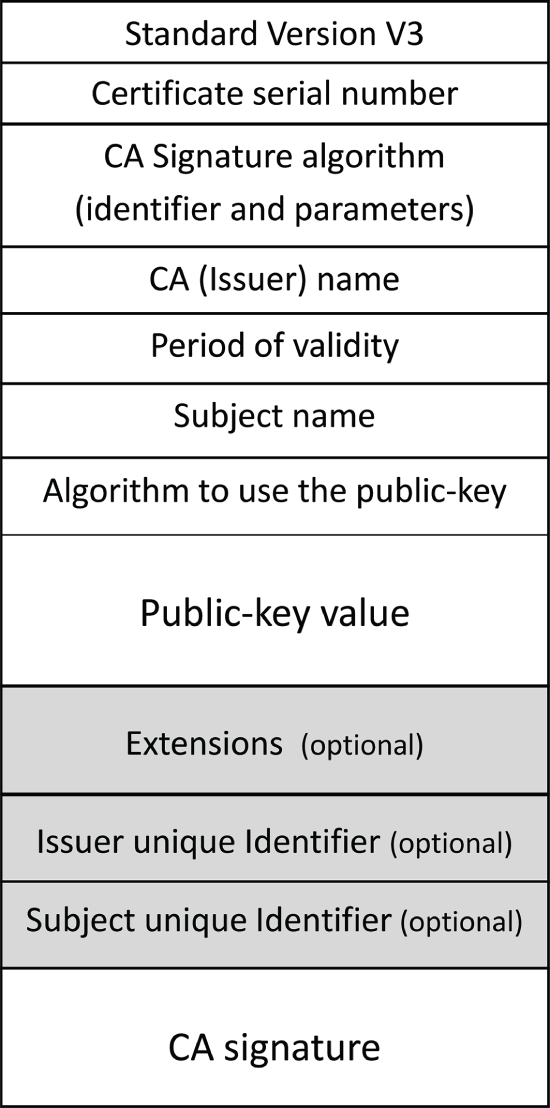
The X.509 standard defines the format of a public key certificate.
- approved by the International Telecommunications Union
- standardized by the Internet Engineering Task Force RFC 5280
- consists of key-value pairs
- multiple formats:
- Privacy Enhanced Mail (PEM) ASCII format
- defines methods for encoding binary data using Base64
- is a binary-to-text encoding scheme that represents binary data in ASCII string format
- filename extension is
.pem,.crt, or.cer
- defines methods for encoding binary data using Base64
- Distinguished Encoding Rules (DER) binary format
- is a subset of the Abstract Syntax Notation One (ASN.1)
- is a platform-independent encoding format
- ensures that the contents of a certificate can only be encoded one way
- filename extension is
.deror.cer
- is a subset of the Abstract Syntax Notation One (ASN.1)
- Personal Information Exchange (PFX) binary format
- PFX file is a password protected archive file format that contains the certificate and corresponding private key
- used by a server to import a certificate and private key from a single file
- filename extension is
.pfx
- Public Key Cryptography Standards #7 (PKCS #7) and PKCS #12 binary formats
- these formats define a standard syntax for storing encrypted and signed data
- stored in DER binary or PEM ASCII formats
- filename extensions are
.p7band.p12 - created by RSA to promote the use of public key infrastructure
- Privacy Enhanced Mail (PEM) ASCII format
X.509 Certificate Format Fields
How it Works
- Create a certificate:
- create by taking the public key and identifying information, such as name and address, and having them signed by certificate authority
- Public key infrastructure (PKI) is the infrastructure that handles certificates on a large scale
Subject Name Attributes
- common name (CN) attribute is used to identify the FQDN of the server
- usage grew by custom rather than design
- can contain various information
- thus now deprecated of validating subject identity
The subject alternative name (SAN) is an extension field in a digital certificate allowing a host to be identified by multiple host names/subdomains.
- supports different types of identifiers
- e.g., FQDN, IP addresses
- if cert is configured with SAN, browser validates this instead of CN
- allows a cert to represent different subdomains
- more secure, but need new cert for each one
- wildcard domain (
*.example.com) means the cert issued to the parent domain will be accepted as valid for all subdomains- for just a single level (
z.example.combut noty.z.example.com)
- for just a single level (
Info
It is still safer to put the FQDN in the CN as well, because not all browsers and implementations stay up to date with the standards.
Other Attributes
- Organization (O)
- Organizational Unit (OU)
- Locality (L)
- State (ST)
- Country (C)
- These are concatenated with the common name to form a Distinguished Name (DN)
Info
Different certificate types can be used for purposes other than server/computer identification.
- User accounts can be issued with email certificates
- in which case the SAN is an RFC 822 email address
- A code-signing certificate is used to verify the publisher or developer of software and scripts
- don’t use a SAN, but the CA must validate the organization and locate details to ensure accuracy and that a rogue developer is not attempting to impersonate a well-known software company
Types
- Web Server Certificate
- aka domain certificate or SSL/TLS certificate
- is a certificate that is used by a web server and a web client to establish a secure connection over a network
- 4 types:
- domain validation (DV) certificate
- only verifies the identity of a domain’s owner
- organization validation (OV) certificate
- granted to a company or institution
- CA checks the registration of the company, its address, its business, the applicant name, phone, authority, etc.
- provides assurance about who is behind the website
- domain extended validation (EV) certificate
- verifies the identity of a domain’s owner, the domain owner’s exclusive control over the domain, and the domain owner’s legal and physical existence
- highest standard for certification
- wildcard certificate
- validates a domain and all the domain’s subdomains
- subject alternative name (SAN) certificates
- used by multiple domains owned by the same domain owner
- aka unified communication certificate (UCC)
- domain validation (DV) certificate
- Root certificate
- is created and self-signed by a Certificate Authority (CA)
- self-signed means the certificate issuer and subject are the same
- Code signing certificate
- is used by a software developer to digitally sign software programs
- ensures integrity of a program
- Email certificate
- used by an email user to digitally sign emails
- Machine certificate
- aka computer certificate
- is issued to a hardware device
- used to authenticate a device on a network