Public Key Infrastructure (PKI)
Public key infrastructure (PKI) is a framework of certificate authorities, digital certificates, software, services, and other cryptographic components deployed for the purpose of validating subject identities.
- basic problem with public key cryptography is verifying identity of key holders
- PKI aims to solve this
- provides the mechanisms required to confidently identify the owners of public keys
- anyone issuing a public key should publish it in a digital certificate
- certificate’s validity is guaranteed by a certificate authority (CA)
- Trusted CAs are pre-established by recording their information within operating system certificate stores, within browsers, and by using special hardware storage components
- 2 main components
- certificate authorities
- issue and verify certificates
- registration authorities
- verify the identity of the individual associated with the certificate
- certificate authorities
- PKI can revoke certificates if:
- expired
- compromised
- or other reasons
- Revoked certificates are added to a revocation list
- a public list that holds all an organization’s revoked certificates for a time
How PKI Works
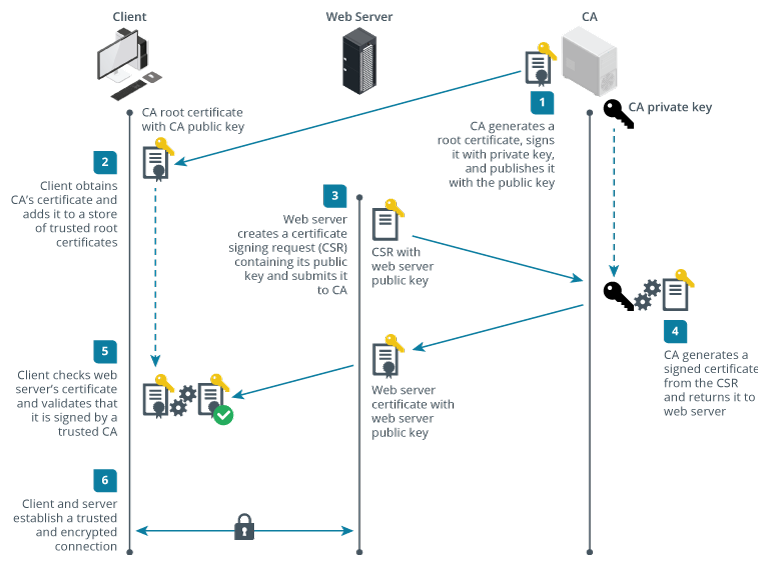
Components
- Certificate Authority (CA)
- issues, renews, revokes, and distributes digital certificates
- Registration Authority (RA)
- verifies the identity of a digital certificate applicant
- certificate applicant sends a certificate signing request (CSR) to an RA
- contains the applicants public key, name, organization, department, physical address, and email
- RA validates the applicant’s identity and approves or rejects the CSR
- if approved, RA forwards CSR to the CA for issuing of the applicant’s digital certificate
- Certificate Repository (CR)
- aka central directory
- stores the digital certificates issued by a CA
- contains the certificate revocation list (CSR)
- list of certificates the CA has revoked prior to its expiration
- Certificate Policy (CP)
- defines the structure of a PKI, describes the PKI’s entities and roles, and specifies a PKI’s procedures and operational requirements
- Certificate Practice Statement (CSP)
- describes how a CA issues, renews, revokes, and distributes certificates
- helps a certificate user to decide whether or not to trust a PKI’s certificates
Certificate Lifecycle
- Issuance
- certificate is issued by a CA after a certificate applicant’s identity is validated by an RA
- issued certificate is stored in a CR
- Revocation
- certificate is revoked by a CA before the end of the certificate’s validity period
- added to the CRL
- certificate is revoked by a CA before the end of the certificate’s validity period
- Suspension
- certificate’s validity is temporarily suspended by the CA
- validity may be re-established or may be fully revoked
- Expiration
- certificate is expired when the end of the validity period is reached
- CP defines the process of applying for a new certificate after expiration