Transport Layer Security (TLS)
Transport Layer Security (TLS) is a security protocol that uses certificates for authentication and encryption to protect web communications and other application protocols.
- was developed as an IETF standard to solve the issue of security
- works at:
- TCP/IP stack:
- as a layer between the Application and Transport layers
- OSI:
- Session layer
- TCP/IP stack:
- normally used to authenticate and encrypt TCP connections
- when used with an HTTP application,
- it is referred to as HTTP Secure (HTTPS)
- can secure other TCP application protocols:
- DNS, NTP, FTP, POP3/IMAP. SMTP, LDAP
Info
- TLS can be used with UDP
- called Datagram Transport Layer Security (DTLS)
- use mostly in VPN solutions
Background
- A critical problem for the provision of services is that TCP/IP application protocols were originally devised without any security mechanism
- no authentication of servers running the applications or of clients accessing them
- all data is sent in plaintext, no encryption
- services are thus highly vulnerable to spoofing, eavesdropping, and unauthorized modification
Implementation
- Implementing TLS:
- server is installed with a digital certificate issued by a trusted certificate authority (CA)
- certificate proves the server’s identity and validates the public/private key pair
- when a client connects to a secure service, a TLS handshake is performed:
- server provides its certificate to the client
- cryptographic data in the certificate proves the identity of the server
- assuming the client trusts the CA
- certificate contains the public key
- the server maintains the secret key
- if authentication is successful,
- the server and client set up an encrypted tunnel with
- the key pair in the digital certificate
- a chosen cryptographic cipher suite within the TLS protocol
- the server and client set up an encrypted tunnel with
- server is installed with a digital certificate issued by a trusted certificate authority (CA)
Info
latest versions of TLS can use a mechanism called Perfect Forward Secrecy (PFS)
- when configured, not even obtaining the server’s key allows decryption of captured packets
TLS Handshake
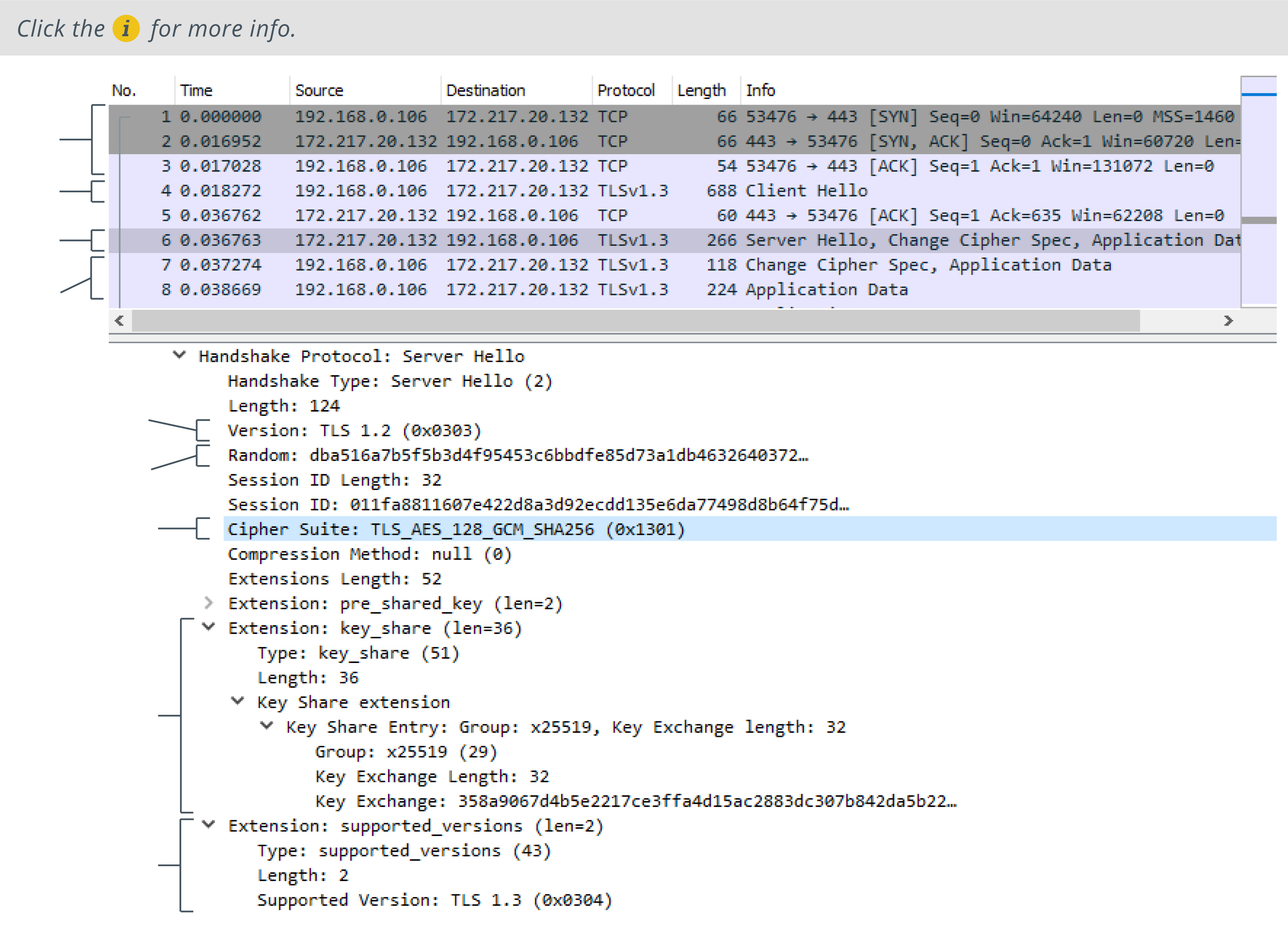
- handshake starts when the client requests a TLS connection to a server
- typically on port 443
- can use specific protocol like STARTTLS when using mail
- Client and server negotiate what cipher suite will be used for the session
- server authenticates its identity and provides the client with the server’s public encryption key
- usually by using a digital certificate
- client confirms the certificates validity
- session keys are generated
- using Diffie-Hellman key exchange or encryption a random number
- session key is used to symmetrically encrypt and decrypt all subsequent data exchanges during the session
TLS Versions
- TLS has been developed through many versions
- a server and client must agree on a compatible version
- many servers are configured to only allow TLSv1.3 or TLSv1.2
- older ones contain serious weaknesses
- TLS 1.3 removes the ability to perform downgrade attacks by preventing the use of unsecure features and algorithms
- is where an on-path attack tries to force the use of a weak cipher suite and SSL/TLS version
- are also changes to the handshake protocol to reduce the number of messages and speed up connections
- many servers are configured to only allow TLSv1.3 or TLSv1.2
- also must agree on a mutually supported cipher suite
Info
TLS was developed from an older protocol called Secure Sockets Layer (SSL)
- is now completely obsolete
Cipher Suite
a cipher suite is lists of cryptographic algorithms that a server and client can use to negotiate a secure connection.
- Prior to TLS 1.3,
- a cipher suite would be written in the following form:
ECDHE-RSA-AES128-GCM-SHA256
- means that the server can use:
- Elliptic Curve Diffie-Hellman Ephemeral mode for:
- session key agreement
- RSA signatures
- 128-bit AES-GCM (Galois Counter Mode) for:
- symmetric bulk encryption
- and 256-bit SHA for:
- HMAC functions
- Elliptic Curve Diffie-Hellman Ephemeral mode for:
- a cipher suite would be written in the following form:
- TLS 1.3
- uses simplified and shortened suites
TLS_AES_256_GCM_SHA384
- Only ephemeral key agreement is supported in 1.3
- signature type is supplied in the certificate
- cipher suite only lists:
- bulk encryption key strength
- mode of operation (AES_256_GCM)
- cryptographic hash algorithm (SHA384) used within the new hash key derivation function (HKDF)
- is the mechanism by which the shared secret established by D-H key agreement is used to derive symmetric session keys
- uses simplified and shortened suites