TLS 1.3 Protocols
TLS is composed of 4 subprotocols:
- handshake protocol
- client and webserver negotiate the version of TLS and the cryptographic algorithms to use
- establish a shared secret for symmetric encryption
- authenticate each other using public keys
- record protocol
- client and server encrypt and decrypt messages using the shared key and verify the integrity of received data
- alert protocol
- handles errors
- 0-RTT protocol
- enables the transmission of data without authentication when the client and server have pre-shared keys
Handshake Protocol
- client and server exchange
Hellomessages in order to:- select the cryptographic algorithm to use
- establish shared keying material
- authenticate the server to the client
- optionally, the client to the server
- first messages in TLS are
ClientHelloandServerHello- have same structure
- TLS versions
- Random nonce value
- Cipher suite
- Extensions
- Options (legacy compatibility)
- any TLS extension contains a list of items that are ordered according to the sender’s preferences
- a
ClientHellomessages with extensions indicates items supported by the client - a
ServerHellomessage extension indicates the item that will be used by the server of the options - e.g. client includes a list of ciphers, server includes the cipher it will use
- most used extensions:
- supported groups
- indicates the supported mathematical groups (i.e. finite fields and elliptic curves)
- Key share
- indicates the supported key exchange protocols
- pre-shared key extension
- indicates the pre-shared keys known to the client and server before starting the current handshake
- signature algorithms
- indicates the supported signature algorithms
- certificate authorities
- indicates which certificate authorities are supported
- used to indicate known trust anchors
- early data indication
- allows the client to send application data encrypted with the pre-shared symmetric key, without performing the authentication
- supported groups
- a
- have same structure
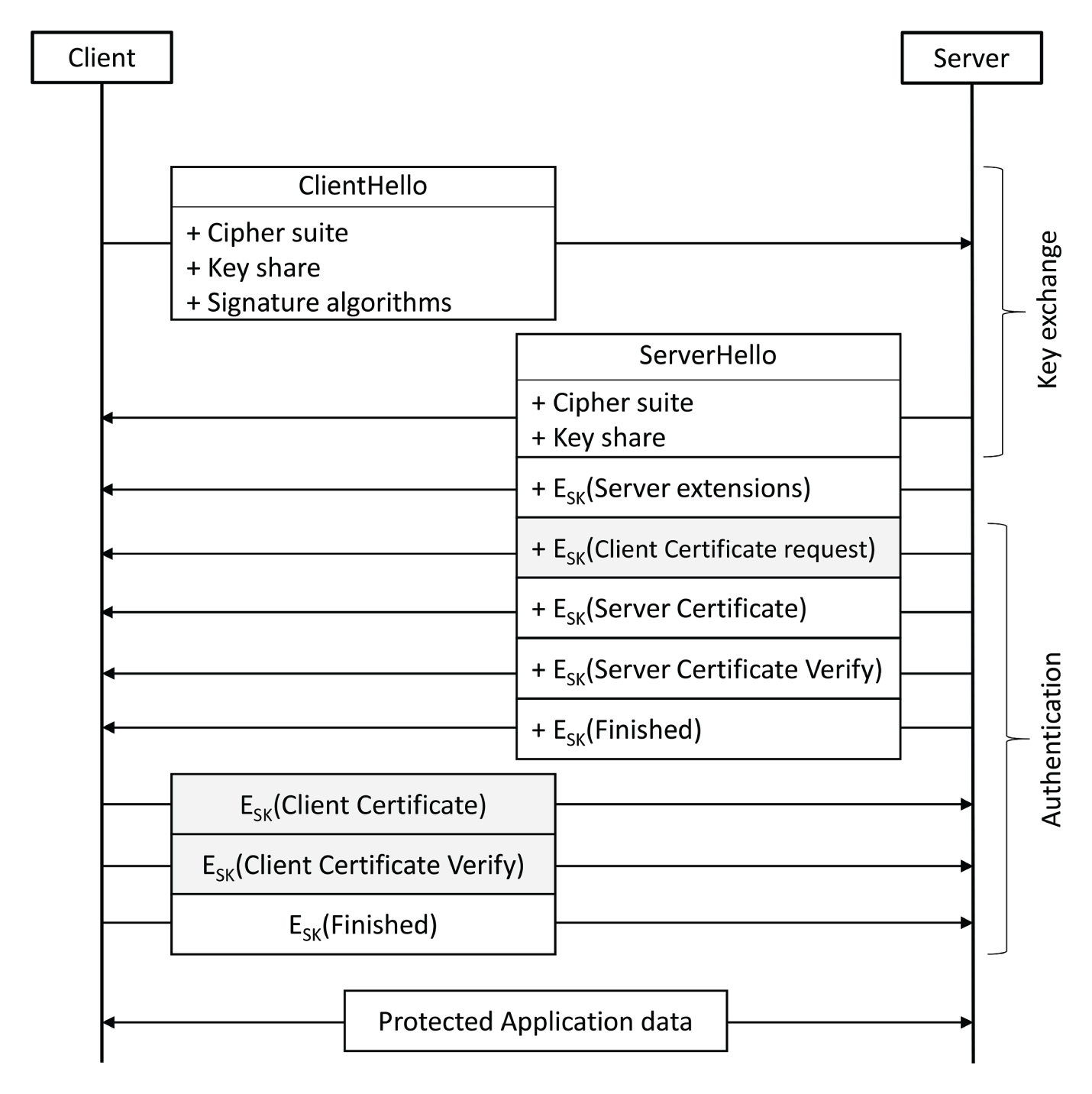
Full TLS Handshake
- gray box means that the authentication of the client is not mandatory
Hellomessage may be transmitted in a single record or split into multiple
Record Protocol
Record protocol is used to provide confidentiality and integrity of transmitted data.
- used to protect handshake, application data, and alert messages
- how it works
- record layer fragments data into records with a maximum length of
bytes - a record is encrypted and decrypted with an AEAD (Authenticated encryption with Associated data) algorithm
- agreed upon by client and server
- nonce is included in each encrypted record to prevent some attacks
- record layer fragments data into records with a maximum length of
- maximum of
full-length records may be encrypted on a given connection using AES-GCM - to keep the security of encryption below an acceptable margin
Alert Protocol
Alert protocol provides indication regarding errors and incapacities to establish or maintain a secure connection between parties.
- common alerts:
- not supported TLS version, Handshake failure, Uknown pre-shared key identifier
- Bad certificate, Unsupported certificate, Expired certificate, Revoked certificate, Unknown CA
- Bad record MAC, Record exceeding the limit size