History of Cryptography
Early Ciphers
The Caesar Cipher
One of the earliest forms of cryptography is the classic Caesar Cipher used by Julius Caesar.
The Caesar Cipher involves shifting each letter of the plaintext message by a certain number of spaces in the alphabet, historically 3.
- E.g., A = D, B = E, etc.
- Type of substitution cipher
- substitutes each letter in the alphabet with a different one
The Atbash Cipher
Atbash cipher simply involves reversing the alphabet.
- used by Hebrew scribes copying the book of Jeremiah
The ROT13 Cipher
- is a type of Caesar cipher
- simply rotate characters 13 spaces through the alphabet
The Scytale Cipher
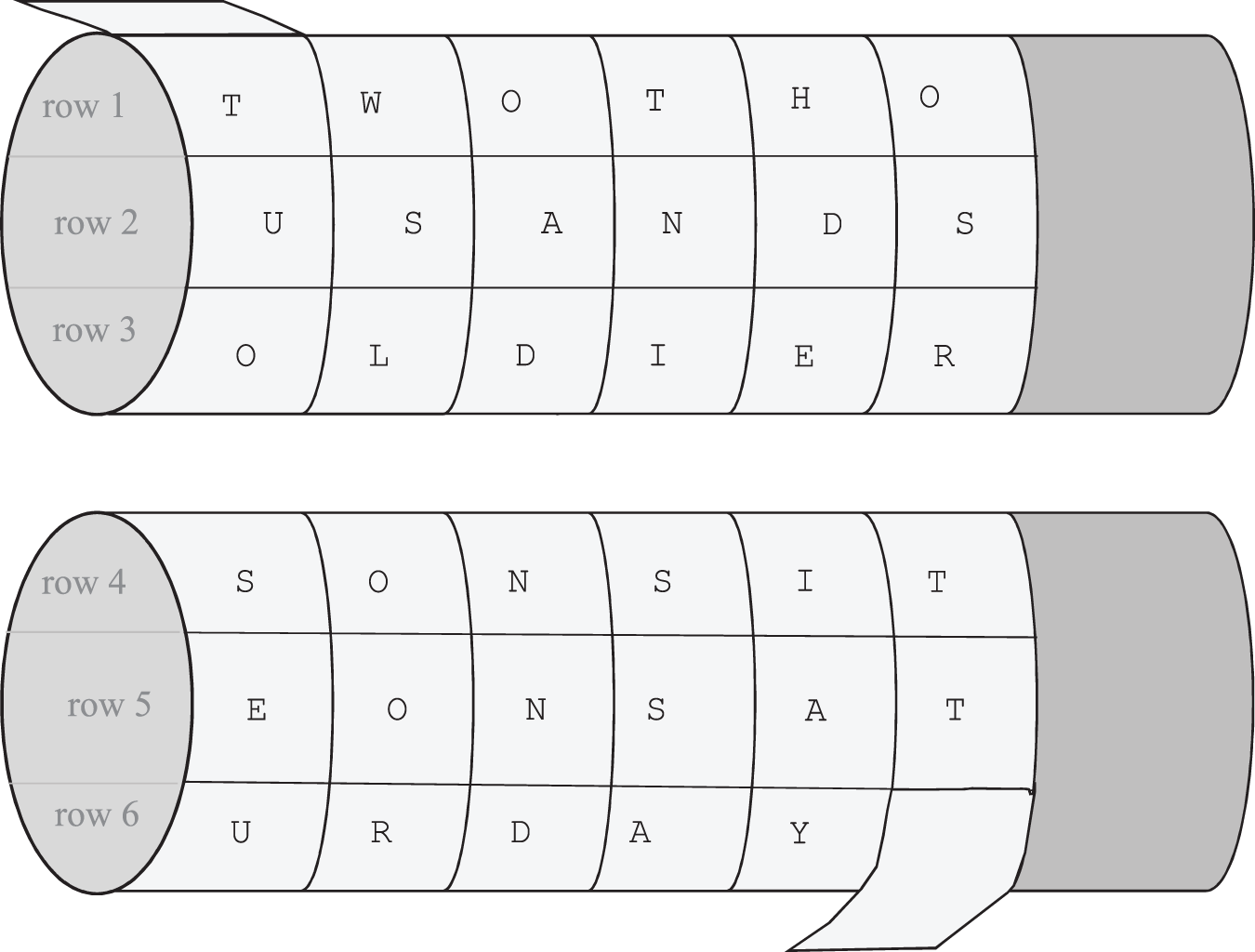
A scytale was a cylinder or baton used by the Greeks, specifically the Spartans.
- was used to encrypt messages
- turning the cylinder produced different ciphertexts
- first mentioned in 7th century BC by Greek poet Archilochus
- how it works
- recipient used a rod of the same diameter as the one used to create the message
- then wrapped a parchment around the baton to read the message
- to encrypt, simply write across a leather strip attached to the rod
- written in straight lines (rows)
- parchment was unrolled and represented the ciphertext
- to decrypt, just wrap the leather strip around the rod and read across
- the parchment was wrapped around the baton to recover the plaintext
- requires both parties to have the the same size rod and leather “key”
Greek Cylinder "Scytale" Cipher
Plaintext:
TWO THOUSAND SOLDIERS ONSITE ON SATURDAY
- spaces are removed before writing the plaintext on the parchment
Ciphertext:TUOSEUWSLOOROADNNDTNISSAHDEIAYOSRTT
The Playfair Cipher
- invented in 1854
- used in British military in WW1 and WW2
- how it works
- encrypts pairs of letters at a a time
- called digraphs
- uses a 5 x 5 table that contains a keyword or key phrase
- only need to memorize the keyword and 4 rules
- first, break the plaintext message into digraphs
- e.g., “attack at dawn” > “at ta ck at da wn”
- can pad a single remainder letter with z
- any 5 x 5 square of letters can be used
- fill in the keyword, then add in letters that did not appear in the keyword, in order
- I/J are combined
- replace any duplicate letters in the digraph with “x”
- e.g., “dollar” > “dolxar”
- use spelled out numbers and remove punctuation marks
- find the pairs of letters of plaintext in the table
- look at the rectangle formed by locating the first pair
- then take the opposite ends of the rectangle to create the ciphertext
- replace upper right corner with upper left, etc.
- encrypts pairs of letters at a a time
Multialphabet Substitution
- aka polyalphabetic cipher
- evolution of Caesar cipher
- uses multiple numbers for substitution
The Vigenere Cipher
- 1500s, Blaise de Vigenere made improvements to the Caesar Cipher
- type of multi-alphabet substitution cipher
- Is a method of encrypting alphabetic text by using a series of different mono-alphabet ciphers selected based on the letters of a keyword
- uses a 26x26 table to substitute letters
- so the same letter is not always replaced by the same other letter
- is the base concept in polyalphabetic ciphers
- so the same letter is not always replaced by the same other letter
The Enigma Machine
The Enigma Machine is an electromechanical rotor-based cipher system
- used by Germans In WW2
- is a multi-alphabet substitution cipher
- consisted of 26 possible alphabets
Cryptographic Machines
Jefferson Disk
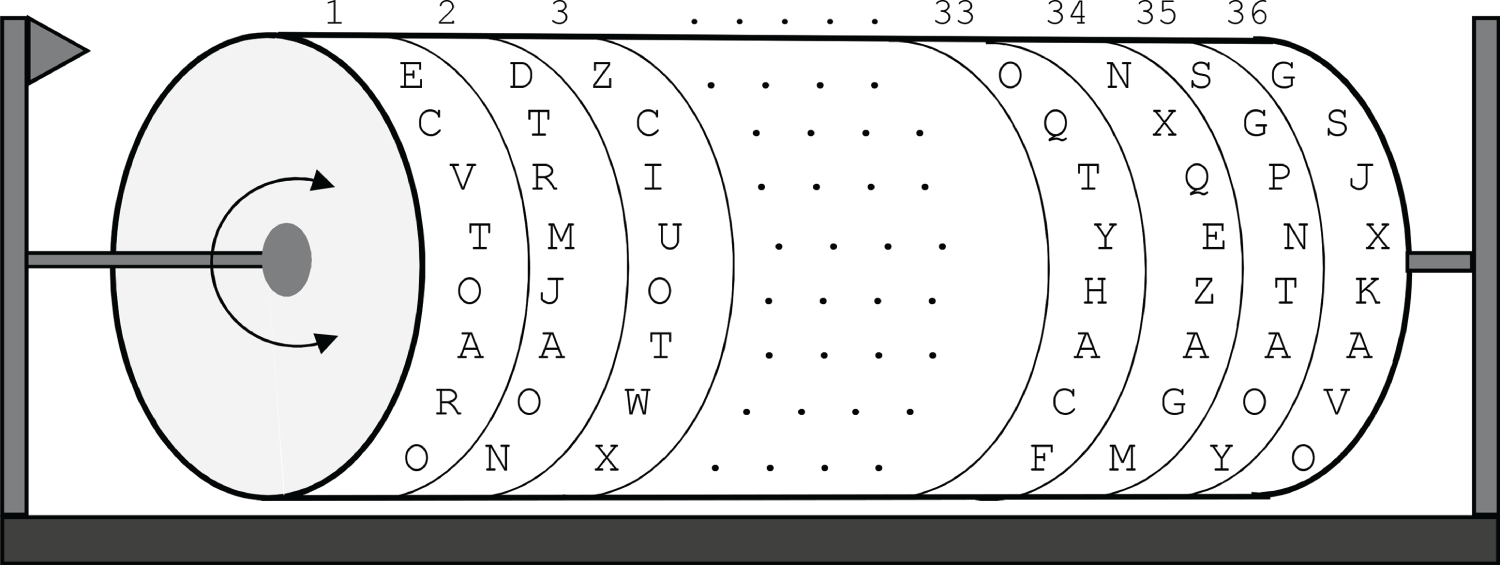
Jefferson Disk is a machine created by Thomas Jefferson composed of 36 disks, each marked with letters A-Z around its trim.
- aka Jefferson’s wheel cipher
- set the plaintext across the machine, then set a different row of letters as ciphertext
- higher security than Vignere cipher
- has more combinations to select keys
- 36 disks are stacked on top of each other around an axle
- 26 Latin letters are randomly inscribed on each disk
- disks are numbered; are removable and mounted in any order
- the order of the disks represents the secret key
- both sender and receiver have to have the same disk order
- the plaintext is split into 36-letter fragments
- to encrypt,
- the sender rotates each disk, so that the fragment appears on a horizontal row parallel to the rotation axis
- then chooses any row parallel to the plaintext row and sends it as a ciphertext
- to decrypt,
- rotate the disks so that the ciphertext appears
- then look for the row that contains the plaintext
- considered an ancestor to the Enigma machine
Jefferson's Disk
Kerckhoff’s Principles
Transitioning to Modern Day
These two technologies helped bridge the gap from older cryptographic methods to modern ones:
- Keyword Ciphers
- One-Time Pad
- aka Vernam’s Cipher
Prominent Steps in Modern Cryptography
- In the early 1970s, IBM developed Lucifer cipher, which became the Data Encryption Standard (DES) in 1976.
- In 1976, Whitfield Diffie and Martin Hellman introduced the principle of public-key cryptography.
- In 1977, Ronald Rivest, Adi Shamir, and Leonard Adleman came up with the RSA algorithm.
- In 1987, Neal Koblitz proposed elliptic curves to design public-key ciphers.
- In 1995, the first Secure Hash Algorithm (SHA1) was approved by the NIST.
- In 1998, Joan Daemen and Vincent Rijmen came up with the symmetric cipher Rijndael, which became AES in 2001.