DNS Name Resolution
DNS resolution is the process of translating a domain name into an IP address.
Initiating
- initiating DNS resolution:
- user presents an FQDN to an application program (e.g., web browser)
- client application (called stub resolver) checks its local cache for the mapping
- if no mapping is cached, it forwards the query to its local name server
- IP addresses of name servers that can act as resolvers are usually set in the TCP/IP configuration
Process
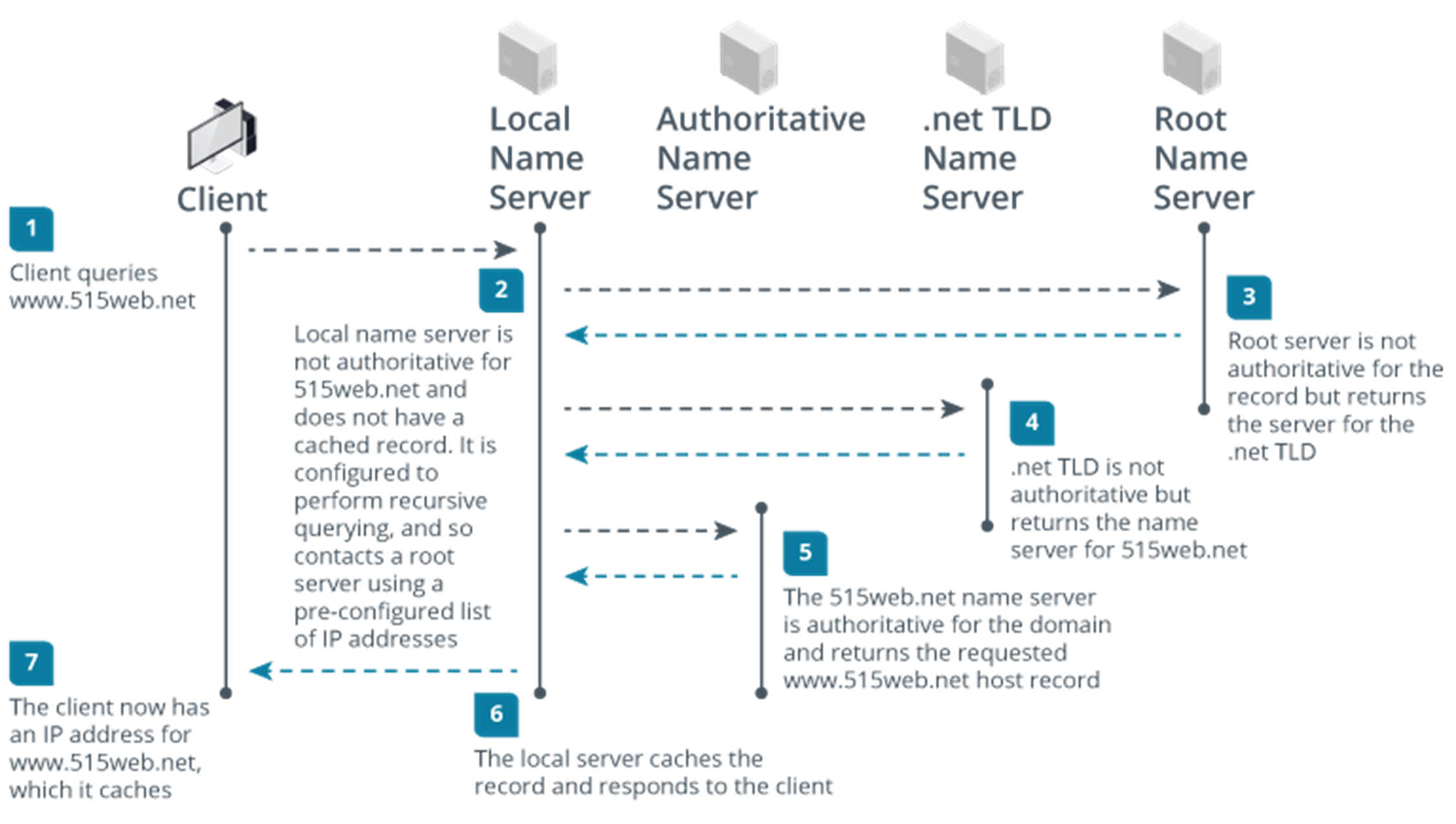
- most queries between name server are performed as iterative lookups
- means a name server responds to a query with either:
- the requested record
- or the address of a name server at a lower level in the hierarchy that is authoritative for the namespace
- makes no effort to try to make additional queries to locate information that it does not have
- means a name server responds to a query with either:
- at steps 4 and 5,
- root server and
.netname server simply pass the querying server the address of an authoritative name server - do not take on the task of resolving the original query
- root server and
- a recursive lookup means that if the queried server is not authoritative,
- it queries other name servers until it finds the requested record or times out
- name servers listed in a client’s TCP/IP config accept recursive queries
- this is the type of query performed by the
corp.515support.comname server
Info
- DNS server may be configured to:
- only perform recursive querying (a resolver)
- perform recursive querying and maintain zone records
- or only maintain zone records
- roles are usually split
- especially if the servers are open to the Internet
- most Internet-accessible DNS servers disable recursive queries
- recursive resolvers are typically only accessible by authorized clients
- subscribers within an ISP’s network or clients on a private LAN