Block Cipher Design
Block cipher is an encryption–decryption scheme where a block of plaintext is treated as a single block and is used to obtain a block of ciphertext with the same size.
How Block Ciphers Operate
Block-Based Ciphering
- Plaintext is divided into a series of fixed-length blocks (
)
- current standards use a block bit-length of 64 or 128
- An encryption key
(with a known length of 56, 128, 192, or 256 bits) - Encrypted blocks (
) are of fixed length
- same length as the plaintext blocks
- Decryption is the inverse operation
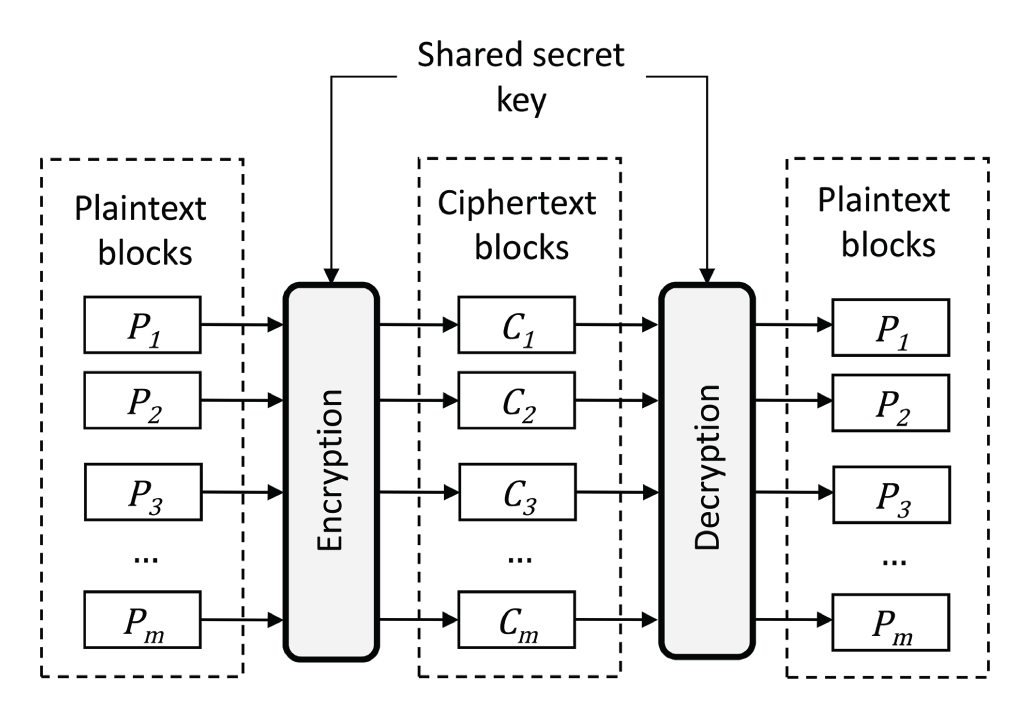
- block cipher is composed of two algorithms:
- encryption
- decryption
- encryption
- both use same secret key
- For any plaintext
, the following property holds: - encryption and decryption algorithms are based on iterated operations
Confusion and Diffusion Properties
- 2 fundamental properties of operation of secure ciphers
Confusion is a cipher operation where each bit of the ciphertext should depend on several bits of the key.
- thus the statistical relationship between the plaintext and the ciphertext should be hidden
Diffusion is a cipher operation where when a single bit is changed in the plaintext, several bits in the ciphertext should change and vice versa.
Avalanche effect is when changing a few bits in the plaintext results in a lot of changes in the ciphertext.
- small change in the key or plaintext should cause a drastic change in the ciphertext
Common techniques to achieve confusion and diffusion:
- substitution boxes
- permutations
- key expansion
Substitution Boxes
An substitution box (S-Box) is an array of
- contains elements of specific length
- e.g. AES has s-box of length 8 bits
- generally, the number of rows or columns is at most 16
- bit lengths of the elements of an S-box depends on each cipher
- element space of an S-Box is at most equal to that of the input space
- otherwise some elements are never used
S-Box Mapping
- the value to replace
is converted into two indexes, and - then, the content of the cell,
, is returned as the element to replace
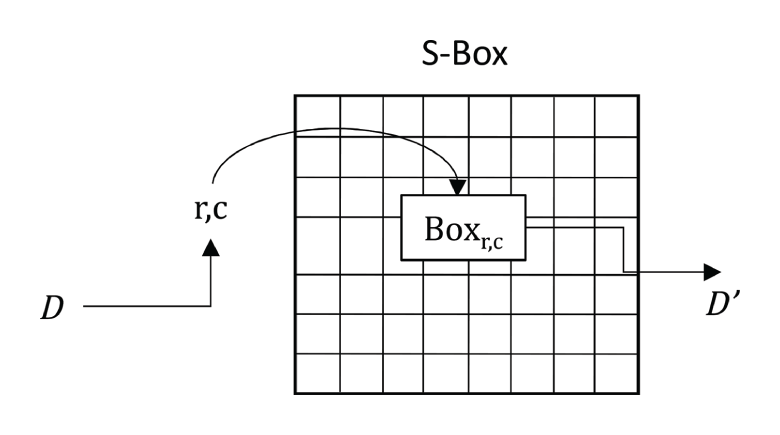
Properties expected to not compromise security and to enable decryption:
- Nonlinearity of S-Boxes
- S-Boxes include elements that appear as random sequences of elements
- so no relationship between elements could be inferred to design attacks
- Deterministic
- same input is always mapped to the same output
Permutation
Permutation is a function
- block ciphers use permutations to swap a part of a block with another, so that the diffusion is increased
- defined by permutation tables or with shifting and mixing
Key Expansion
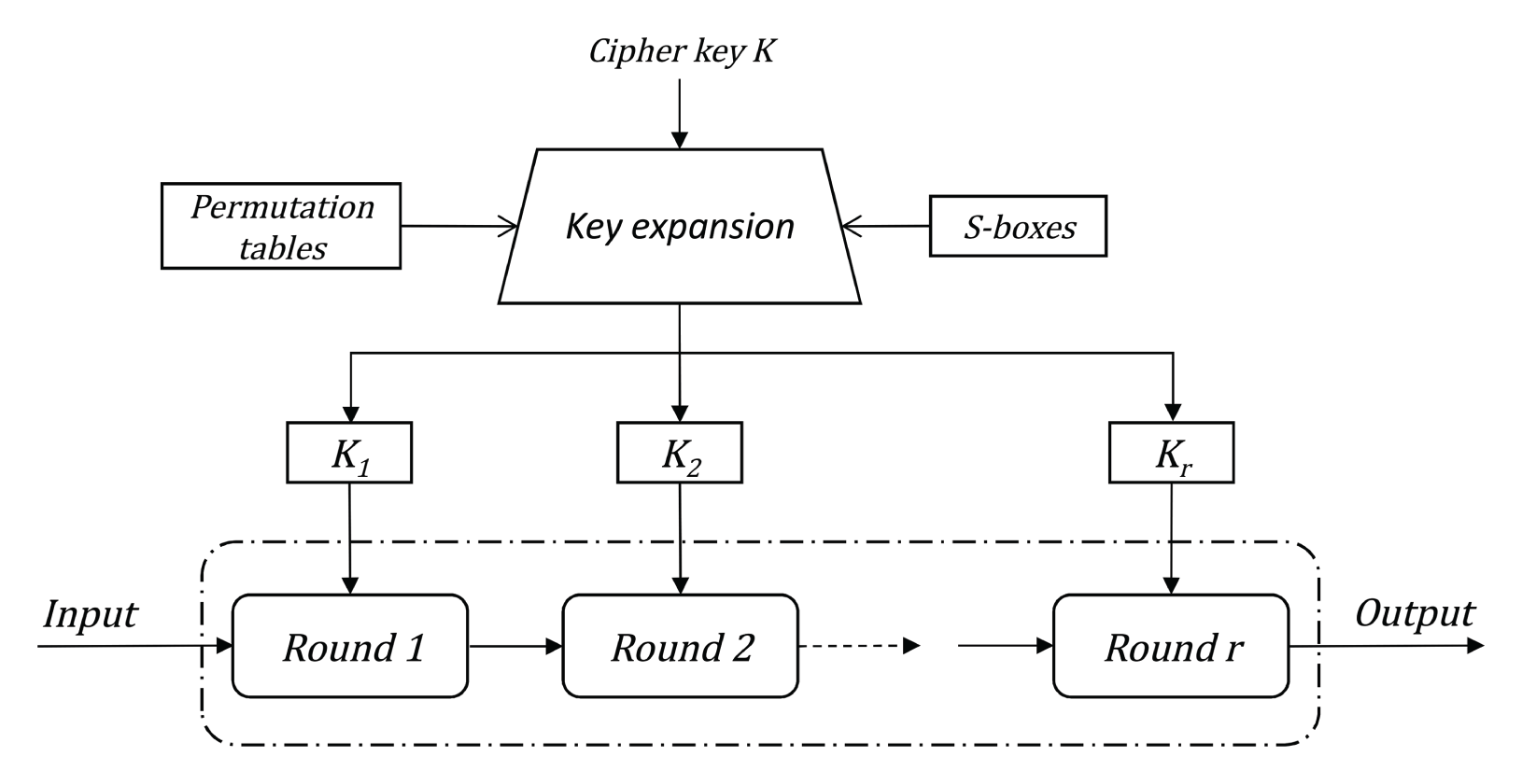
- block ciphers use multiple rounds of the same function (round function)
- to increase confusion, each round uses its own round key
- cipher uses
keys where = number of rounds
- cipher uses
Key expansion function is the component of block ciphers that generates the round keys from the initial key (called the cipher key).
- aka key schedule function
- makes use of permutations and s-boxes
Key Expansion
Feistel Structure
- block ciphers are based on Feistel network (aka Feistel structure)
- main component is the round function
- takes an input block and a round key and returns an output of the same length as the input block
- can be invertible or not
- number of rounds
is a setting parameter - often
depends on the tradeoff between desired security level and efficiency - latter is measured in terms of computation time or hardware implementation complexity
- often
- each round
makes use of a round key - performs a substitution and a permutation