SecOps Roles and Responsibilities
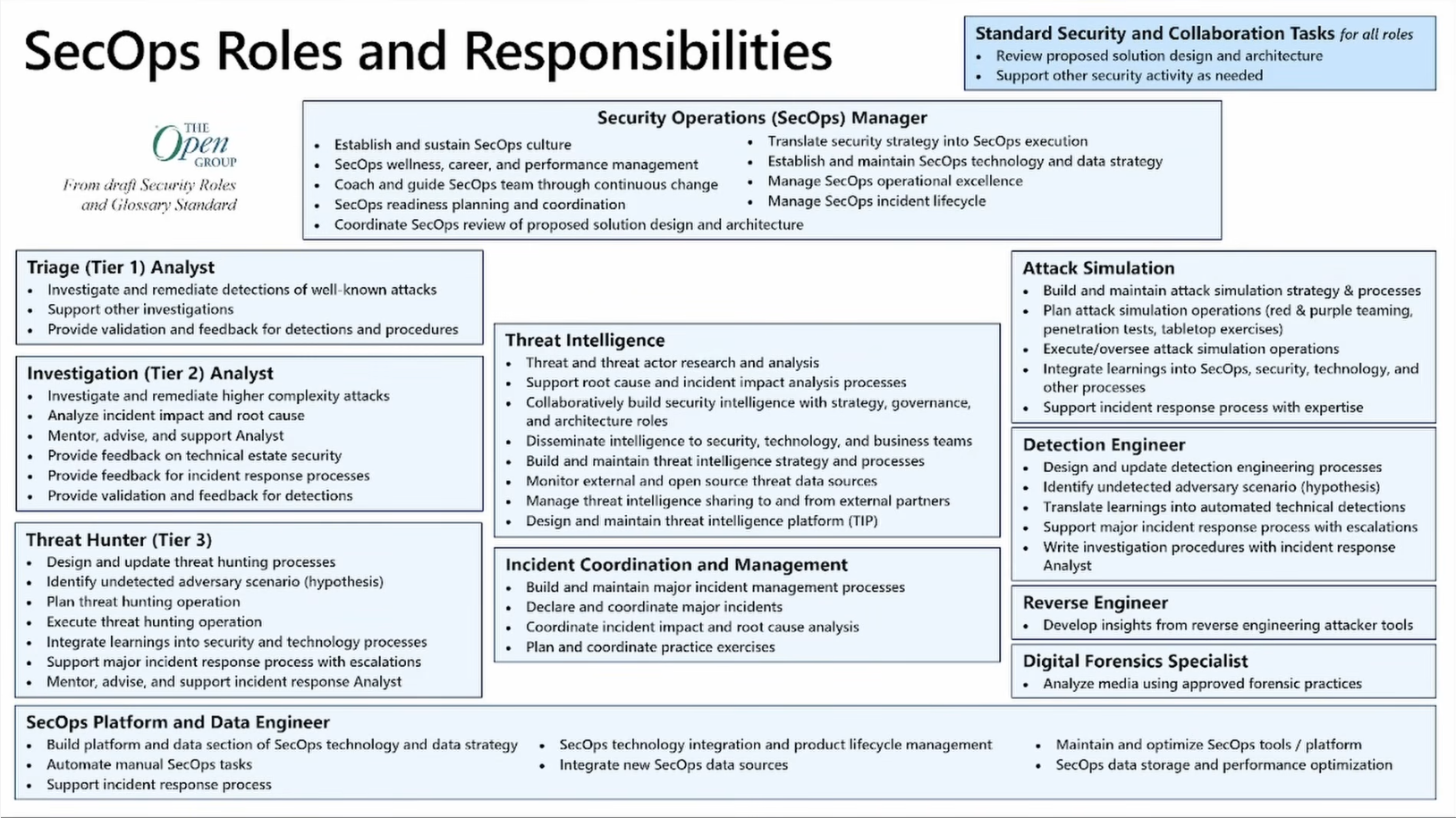
Standard Security and Collaboration Tasks
- Applies to all roles
- Review proposed solution design and architecture
- Support other security activity as needed
Security Operations (SecOps) Manager
- Establish and sustain SecOps culture
- SecOps wellness, career, and performance management
- Coach and guide SecOps team through continuous change
- SecOps readiness planning and coordination
- Coordinate SecOps review of proposed solution design and architecture
- Translate security strategy into SecOps execution
- Establish and Maintain SecOps technology and data strategy
- Manage SecOps operational excellence
- Manage SecOps incident lifecycle
Triage Analyst (Tier 1)
- Investigate and remediate detections of well-known attacks
- Support other investigations
- Provide validation and feedback for detections and procedures
Investigation Analyst (Tier 2)
- Investigate and remediate higher complexity attacks
- Analyze incident impact and root cause
- Mentor, advise, and support Analyst
- Provide feedback on technical estate security
- Provide feedback for incident response processes
- Provide validation and feedback for detections
Threat Hunter (Tier 3)
- Design and update threat hunting processes
- Identify undetected adversary scenario (hypothesis)
- Plan threat hunting operation
- Execute threat hunting operation
- Integrate learnings into security and technology processes
- Support major incident response process with escalations
- Mentor, advise, and support incident response Analyst
Threat Intelligence
- Threat and threat actor research and analysis
- Support root cause and incident impact analysis processes
- Collaboratively build security intelligence with strategy, governance, and architecture roles
- Disseminate intelligence to security, technology, and business teams
- Build and maintain threat intelligence strategy and processes
- Monitor external and open source threat data sources
- Manage threat intelligence sharing to and from external partners
- Design and maintain threat intelligence platform (TIP)
Incident Coordination and Management
- Build and maintain major incident management processes
- Declare and coordinate major incidents
- Coordinate incident impact and root cause analysis
- Plan and coordinate practice exercises
Attack Simulation
- Build and maintain attack simulation strategy & processes
- Plan attack simulation operations (red & purple teaming, penetration tests, tabletop exercises)
- Execute/oversee attack simulation operations
- Integrate learnings into SecOps, security, technology, and other processes
- Support incident response process with expertise
Detection Engineer
- Design and update detection engineering processes
- Identify undetected adversary scenario (hypothesis)
- Translate learnings into automated technical detections
- Support major incident response process with escalations
- Write investigation procedures with incident response Analyst
Reverse Engineer
- Develop insights from reverse engineering attacker tools
Digital Forensics Specialist
- Analyze media using approved forensic practices
- Build platform and data section of SecOps technology and data strategy
- Automate manual SecOps tasks
- Support incident response process
- SecOps technology integration and product lifecycle management
- Integrate new SecOps data sources
- Maintain and optimize SecOps tools / platform
- SecOps data storage and performance optimization