Zero Trust Architecture (ZTA)
Zero trust architecture (ZTA) is a security design paradigm where any request (host-to-host or container-to-container) must be authenticated before being allowed.
- assumes that all devices, users, and services are not inherently trusted
- regardless of whether inside or outside a network’s perimeter
- requires all users and devices to be authenticated and authorized before accessing network resources
- NIST SP 800-207 Zero Trust Architecture defines Zero Trust as:
- “cybersecurity paradigms that move defenses from static, network-based perimeters to focus on users, assets, and resources.”
- Trends driving deperimeterization and zero trust
- cloud
- remote work
- mobile
- outsourcing and contracting
- wireless networks (Wi-Fi)
Info
CISA’s Zero Trust Maturity Model - https://www.cisa.gov/zero-trust-maturity-model
Key Benefits
- Greater security
- Requires all users, devices, and applications to be authenticated and verified before network access.
- Better access controls
- Include more stringent limits regarding who or what can access resources and from what locations.
- Improved governance and compliance
- Limit data access and provide greater operational visibility on user and device activity.
- Increased granularity
- Grants users access to what they need when they need it.
Essential Components of ZTA
- Network and endpoint security
- Controls access to applications, data, and networks.
- Identity and access management (IAM)
- Ensures only verified users can access systems and data.
- Policy-based enforcement
- Restricts network traffic to only legitimate requests.
- Cloud security
- Manages access to cloud-based applications, services, and data.
- Network visibility
- Analyzes network traffic and devices for suspicious activity.
- Network segmentation
- Controls access to sensitive data and capabilities from trusted locations.
- Data protection
- Controls and secures access to sensitive data, including encryption and auditing.
- Threat detection and prevention
- Identifies and prevents attacks against the network and the systems connected to it.
Concepts
- fundamental concepts:
- policy-based authentication / adaptive identity
- recognizes that
- user identities are not static
- identity verification must be continuous and based on a user’s current context and the resources they are attempting to access
- recognizes that
- threat scope reduction and least privilege access
- access to network resources is granted on a need-to-know basis
- access is limited to only those resources required to complete a specific task
- reduces the network’s attack surface
- limits the damage that a successful attack can cause
- policy-driven authorization
- describes how least privilege access control policies are used to enforce permissions and restrictions based on:
- user identity
- device posture
- and network context
- describes how least privilege access control policies are used to enforce permissions and restrictions based on:
- policy-based authentication / adaptive identity
Info
Device posture refers to the security status of a device, including its security configurations, software versions, and patch levels.
- device posture assessment involves evaluating the security status of a device
- to determine whether it meets certain security requirements or poses a risk to the network
Control and Data Planes
In a zero trust architecture, the control and data planes are implemented separately and have different functions.
- allows for a more flexible and scalable network architecture
- centralized control plane ensures consistency for access request handling across both:
- managed enterprise network
- unmanaged Internet or third-party networks
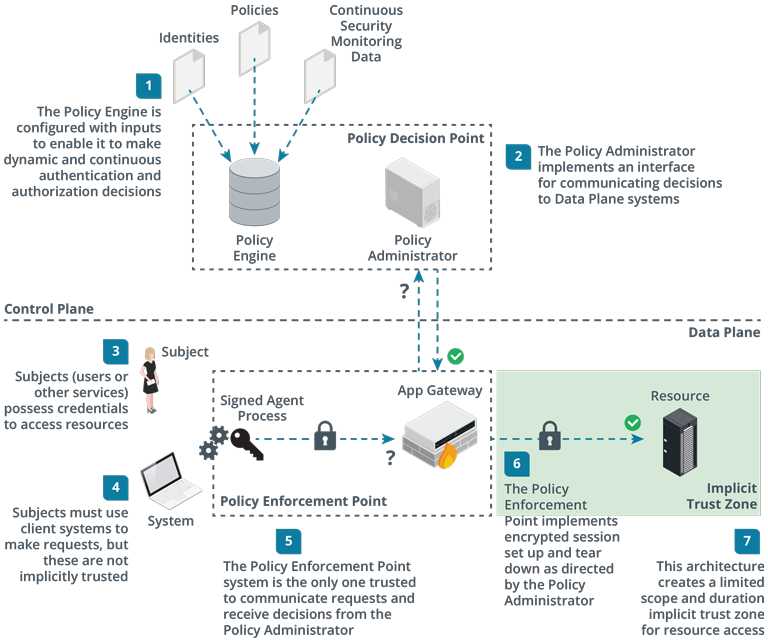
Control Plane
Control plane manages policies that dictate how users and devices are authorized to access network resources.
- defines policies and makes access decisions
- implemented through a centralized policy decision point
- responsible for:
- defining policies that limit access to resources on a least privilege basis
- monitoring network activity for suspicious behavior
- updating policies to reflect changing network conditions and security threats
- comprised of two subsystems:
- policy engine
- configured with:
- subject and host identities and credentials
- access control policies
- up-to-date threat intelligence
- behavioral analytics
- other results of host and network security scanning and monitoring
- this state data allows it to define an algorithm and metrics for making dynamic authentication and authorization decisions on a per-request basis
- configured with:
- policy administrator
- responsible for managing the process of issuing access tokens and establishing or tearing down sessions
- based on the decisions made by the policy engine
- implements an interface between the control plane and the data plane
- responsible for managing the process of issuing access tokens and establishing or tearing down sessions
- policy engine
- responsible for:
Data Plane
In the data plane, a subject (user or service) uses a system (e.g., a client host PC, laptop, or smartphone) to make requests for a given resource.
- systems establish sessions for secure information transfers
- A resource is typically an enterprise app running on a server or cloud
- Each request is mediated by a policy enforcement point
- might be implemented as a software agent running on the client host that communicates with an app gateway
- interfaces with the policy administrator to:
- set up a secure data pathway if access is approved
- or tear down a session if access is denied or revoked
Info
- The processes implementing the policy enforcement point are the only ones permitted to interface with the policy administrator
- critical to establish a root of trust for these processes so that policy decisions cannot be tampered with
Implicit trust zone is the data pathway established between the policy enforcement point and the resource.
- e.g.,
- outcome of a successful access request might be
- an IPSec tunnel established between
- a digitally signed agent process running on the client
- a trusted web application gateway
- and the resource server
- an IPSec tunnel established between
- because the data is protected by IPSec,
- no tampering by anyone with access to the underlying network infrastructure is possible
- outcome of a successful access request might be
Goal
- goal of zero trust design is to make this implicit trust zone as small as possible, and as transient as possible
- Trusted sessions might only be established for individual transactions
- this micro-segmented approach is in contrast with perimeter-based models
- where trust is assumed once a user is authenticated and joined the network
- place in the network is not a sufficient reason to trust a subject request
- even if a user is nominally authenticated,
- behavioral analytics might cause a request to be blocked or a session to be terminated
- this micro-segmented approach is in contrast with perimeter-based models
Zero Trust Examples
| Example | Description |
|---|---|
| Google BeyondCorp | - widely recognized example of a zero trust security architecture - uses a system of multiple security layers, including identity verification, device verification, and access control policies, to secure Google’s internal network - has enabled Google to provide its employees with remote access to company resources while maintaining high security |
| Cisco Zero Trust Architecture | - Cisco has developed a comprehensive zero trust security architecture incorporating network segmentation, access control policies, and threat detection and response capabilities - architecture is designed to protect against a wide range of cyber threats, including insider threats and external attacks. |
| Palo Alto Networks Prisma Access | - Prisma Access is a cloud-delivered security service that uses a zero trust architecture to secure network traffic - provides secure access to cloud and Internet resources while also preventing data exfiltration and other cyber threats |