Wi-Fi 5 (802.11ac)
Wi-Fi 5 is designed to work only in the 5 GHz band.
- aka 802.11ac
- A dual band access point can use its 2.4 GHz radio to support clients on legacy standards (802.11g/n) in mixed mode
- A tri band access point has one 2.4 GHz radio and two 5 GHz radios
- aim is to get throughput of Gigabit Ethernet or better
- supports
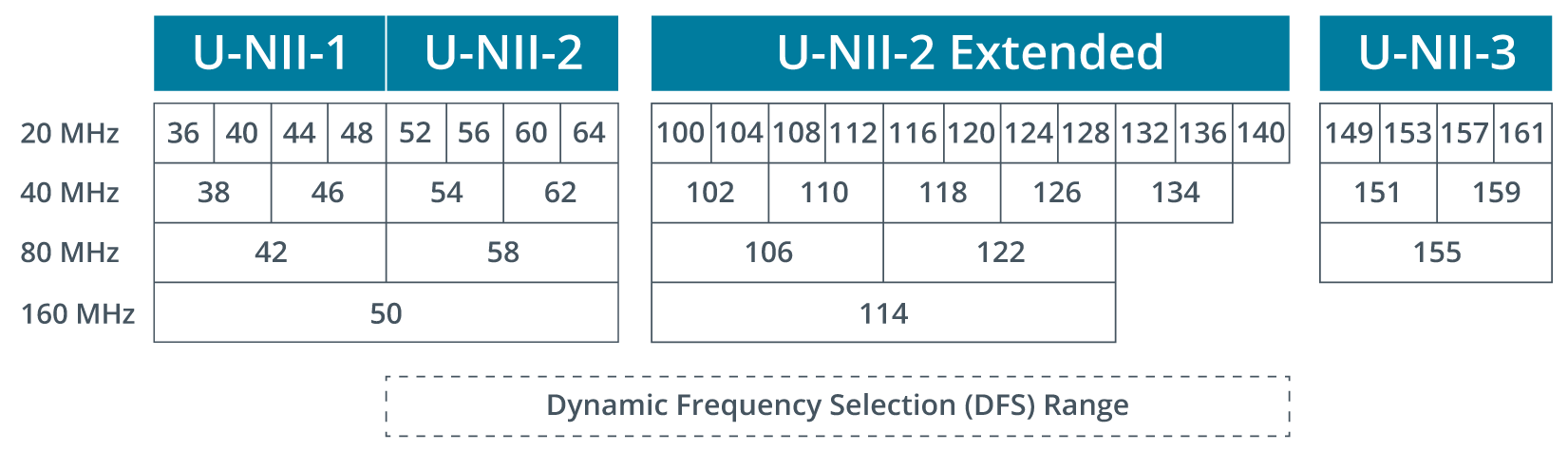
- wider 80 and 160 MHz bonded channels
- up to eight spatial streams
- denser modulation (at close ranges)
- in practice, most Wi-Fi 5 access points only support 4x4 streams
- effectively 4 clients simultaneously
- supports
- uses radio spectrum designated as very high throughput (VHT)
Important
Wi-Fi 5 access points are marketed using AC values, such as AC5300. The 5300 value is made up of the following:
- 1,000 Mbps over a 40 MHz channel with 2x2 streams on the 2.4 GHz radio
- 2,166 Mbps over an 80 MHz bonded channel with 4x4 streams on the first 5 GHz radio
- 2,166 Mbps on the second 5 GHz radio
Info
You’ll notice that,
- given 802.11n 150 Mbps per stream (40 MHz channels)
- and 802.11ac 433 Mbps per stream (80 MHz channels),
- none of those values can be made to add up
- The labels are only useful as relative performance indicators
Multiuser MIMO
- In basic 802.11 operation modes, bandwidth is shared between all stations (an end-point that has access to wifi, aka host)
- An AP can communicate with only one station at a time
- multiple station requests go into a queue
- means that Wi-Fi networks experience the same sort of contention issues as legacy Ethernet hubs
- Wi-Fi 5 products partially address this problem using multiuser MIMO (MU-MIMO)
- downlink MU-MIMO (DL MU-MIMO) allows the access point to use its multiple antennas to send data to up to four clients simultaneously