Voice and Video Services
Private Branch Exchange
- legacy voice services use the public switched telephone network (PSTN)
- residential telephone installation would be serviced by:
- simple box providing a one- or two-line analog interface to the local exchange
- analog interface is called plain old telephone service (POTS)
- each line provides a single channel for an incoming or outgoing call
- a typical business requires tens or hundreds of lines for voice comms, let alone capacity for data comms
- historically, this requirement would be facilitated by a digital trunk line
- referred to as a time division multiplexing (TDM) circuit
- can multiplex separate voice and data channels for transmission over a single cable
- historically, this requirement would be facilitated by a digital trunk line
- simple box providing a one- or two-line analog interface to the local exchange
- residential telephone installation would be serviced by:
A private branch exchange (PBX) is an automated switchboard providing a single connection point for an organization’s voice lines.
- a TDM-based PBX connects to the telecommunications carrier over a digital trunk line, which supports multiple channels (inward and outward calls)
- supplied as vendor-specific hardware
- allows for the configuration of the internal phone system to direct and route calls to local extensions
- provides other telephony features:
- call waiting, music on hold, and voicemail
VoIP-Enabled PBX
- TDM-based PBXes are being replaced by hybrid and fully IP/VoIP PBXes
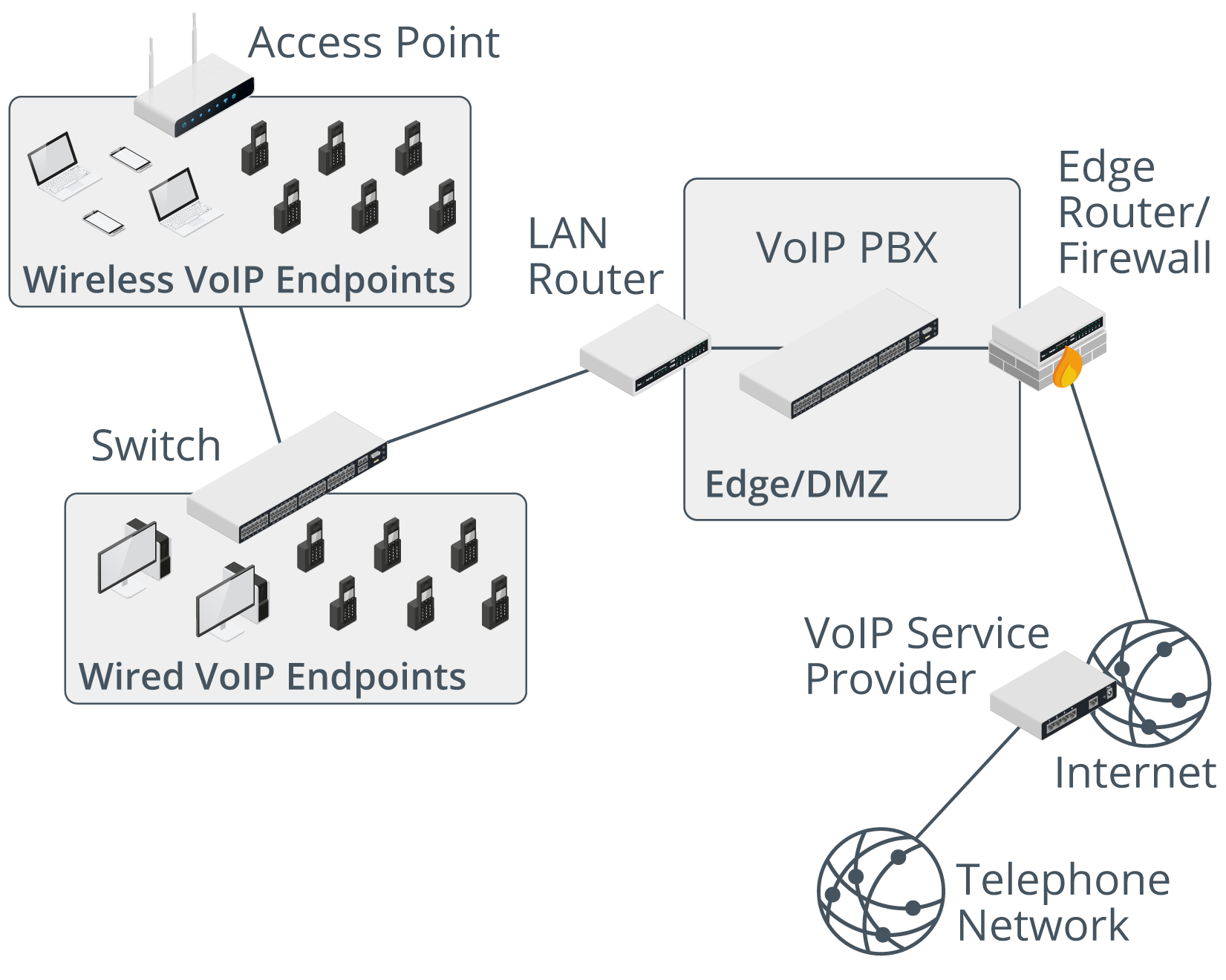
- for internal calls and conferences, a VoIP PBX establishes connections between local VoIP endpoints with data transmitted over the local Ethernet network
- can route incoming and outgoing calls from and to external networks
- might involve:
- calls between internal and external VoIP endpoints
- or with voice telephone network callers and receivers
- might involve:
- supports music on hold and voicemail
- can be implemented as software running on a Windows or Linux server
- e.g., 3CX, Asterick
- are hardware solutions
- VoIP PBX runs on a router
- e.g., Cisco Unified Communications Manager
- placed at the network edge and protected by a firewall
- internal clients connect to PBX over Ethernet data cabling and switching infrastructure
- use IP at Network layer for addressing
- uses the organizations Internet link to connect to a VoIP service provider
- facilitates inward and outward dialing to voice-based telephone networks
- internal clients connect to PBX over Ethernet data cabling and switching infrastructure