Voice VLANs
- Voice over IP (VoIP) transmits voice traffic as data packets rather than over circuit-based transmission lines
- bandwidth and latency requirements of voice traffic mean that it is often necessary to prioritize it over other types of data packets
- can be accomplished using a dedicated VLAN for voice traffic
- bandwidth and latency requirements of voice traffic mean that it is often necessary to prioritize it over other types of data packets
- network infrastructures have limited wall ports
- so, most VoIP endpoints incorporate an embedded switch with just two external ports
- handset is connected via its uplink port to the wall port and via the structured cabling to an access switch
- computer is connected to the handset via the other port
- handset forwards data traffic from the PC to the access switch as untagged frames
- handset sends voice traffic over the same physical link but uses 802.1Q tagged frames
- so, most VoIP endpoints incorporate an embedded switch with just two external ports
- normally a switch needs to be configured as a trunk port to process tagged frames
- adds lots of configuration complexity
- most switches now support the concept of a voice or auxiliary VLAN
- to distinguish the PC and VoIP traffic without having to configure a trunk
Example
- The interface configuration assigns traffic from the PC to VLAN 100 and the voice traffic from VLAN 101:
interface GigabitEthernet0/0switchport mode accessswitchport access vlan 100switchport voice vlan 101
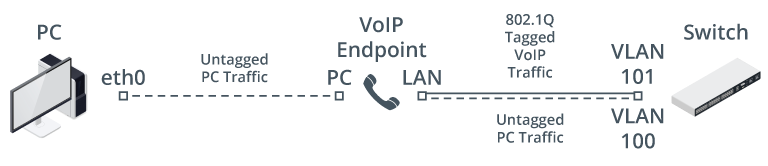
- switch will only accept tagged frames that match the configured voice VLAN ID
- to avoid manual configuration:
- the voice VLAN ID and other configuration parameters can be communicated to the handset using a protocol such as Cisco Discovery Protocol (CDP)
- to avoid manual configuration: