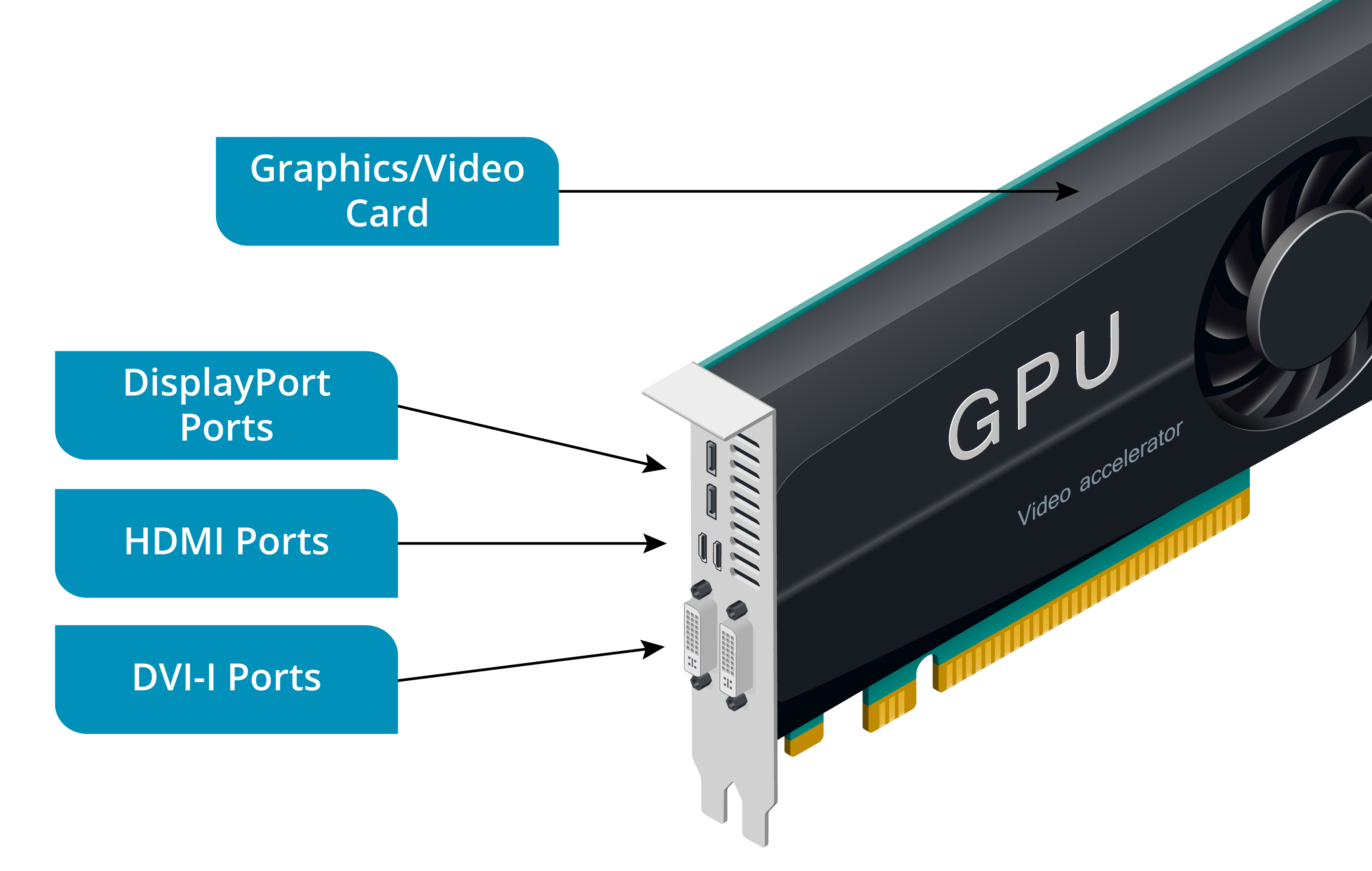
Video Cards
The video card (or graphics adapter) generates the signal to drive a monitor or projector.
- Low-end graphics adapters are likely to be included with the motherboard chipset or as part of the CPU itself
- referred to as an onboard adapter or onboard graphics
- a more powerful video adapter can be installed as an add-on card via a PCIe slot
- Most graphics adapters are based on chipsets by ATI/AMD, NVIDIA, and Intel
Video cards are distinguished by the following features:
- Graphics Processing Unit (GPU)—A microprocessor designed and optimized for processing instructions that render 2-D and 3-D images and effects on-screen
- The basic test for a GPU is the frame rate it can produce for a particular game or application
- Other performance characteristics include support for levels of texture and lighting effects
- Graphics memory—3-D cards need a substantial amount of memory for processing and texture effects
- A dedicated card may be fitted with up to 32 GB GDDR RAM at the high end
- 8 GB would be more typical of current mid-range performance cards
- Low-end cards use shared memory (that is, the adapter uses the system RAM)
- Some cards may use a mix of dedicated and shared
- Video ports—The type and number of connectors, such as HDMI, DisplayPort, and Thunderbolt
Info
Graphics Double Data Rate (GDDR) memory technology is similar to the DDR modules used for system RAM.
- Most modern cards use a PCIe x16 interface
- Dual cards, using two (or more) slots, are also available