Unshielded Twisted Pair (UTP)
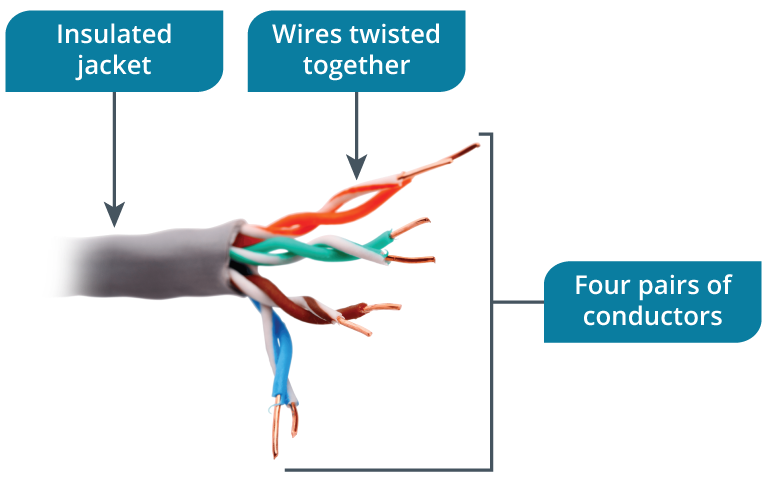
The most popular type of network cable is of a copper wire construction called unshielded twisted pair (UTP).
- used in telephone networks and data networks extensively
- made up of four copper conductor wire pairs
- one pair of insulted wires twisted together forms a balanced pair
- pair carries the same signal but with different polarity
- one is positive
- one is negative
- allows receiver to distinguish signal from noise (interference) better
- pair carries the same signal but with different polarity
- pairs are twisted at different rates
- reduces external interference and crosstalk
- crosstalk is whereby one pair causes interference in another due to their proximity
- has an insulated outer jacket
- the electrical signaling method is only reliable over limited range
- signal suffers from attenuation
- loses strength over long ranges
- Most UTP cable segments have a maximum distance of 100 m (328 feet)
- signal suffers from attenuation
- most twisted pair cable used in office networks is unshielded twisted pair (UTP)
- buildings are often flood wired
- involves cables being laid to every location in the building that may need a telephone or computer
- buildings are often flood wired
- copper wire thickness is measured using American Wire Gauge (AWG)
- increasing AWG numbers represent thinner wire
Types of Conductor Wires
- two types of conductor wires:
- solid cabling uses a single thick wire per conductor
- used for cables that run behind walls or through ducts
- uses thicker 22 to 24 AWG
- lower attenuation
- stranded cabling uses thin filament wires wrapped around one another
- used to make flexible patch cords
- usually 26 AWG
- higher attenuation, so poor for more than 5 m in length
- solid cabling uses a single thick wire per conductor