Three-Tiered Network Hierarchy Topology
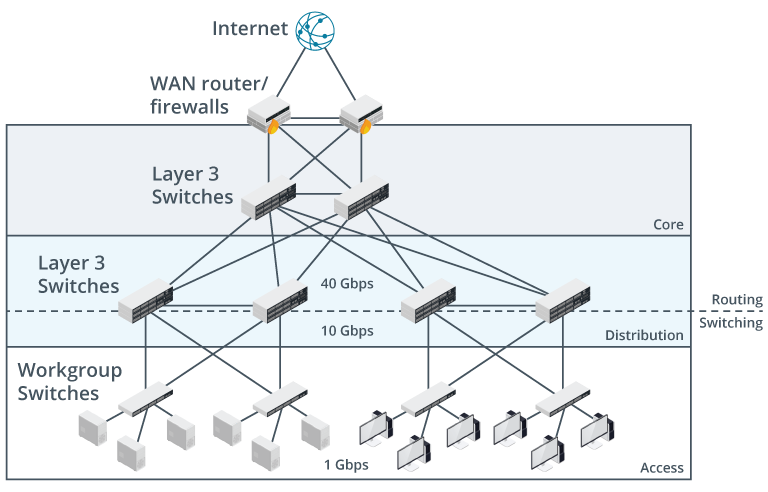
- hierarchical model breaks down a large and complex network design into smaller sections based on functions performed
- each function can be assessed by network designers to identify the most efficient hardware and software to use to implement it
- many corporate office networks follow Cisco’s design principles:
- three-tiered hierarchy:
- access
- distribution
- core
- three-tiered hierarchy:
Access/Edge Layer
- the access/edge layer allows end user devices to connect to the network
- implemented for each site using structured cabling and wall ports for wired access and access points for wireless access
- both are ultimately connected to workgroup switches
- switches deployed to serve the access layer are called LAN switches or data switches
- end systems connect to switches in the access/edge layer in a star topology
- there are no direct links between the access switches
- 1 Gbps access port and 10 Gbps uplinks ports are typical on a workgroup switch
Distribution/Aggregation Layer
- distribution/aggregation layer provides fault tolerant interconnections between different access blocks and either core or other distribution blocks
- each access switch has full or partial mesh links to each router or layer 3 switch in its distribution layer block
- distribution layer is often used to implement traffic policies
- e.g., routing boundaries, filtering, or quality of service (QoS)
- a layer 3 switch is a capable of IP routing between virtual LAN (VLAN) subnets using hardware-optimized path selection and forwarding
- used to implement the distribution/aggregation layer
- have different capabilities to the layer 2 workgroup switches used in access tier
- Aggregation switches have 10 Gbps interfaces and 40 Gbps (or 40/100 Gbps) uplink/backbone ports
- works on the principle of “route once, switch many”
- means that once a route is discovered,
- it is cached with the destination MAC address
- subsequent communications are switched without invoking the routing lookup
- means that once a route is discovered,
- a router uses a generic processor and firmware to process incoming packets
- but a layer 3 switch uses an application-specific integrated circuit (ASIC)
- impacts the relative performance
- much faster, but not always very flexible
- cannot perform WAN routing
- work with interior routing protocols only
- often only supports Ethernet
Core Layer
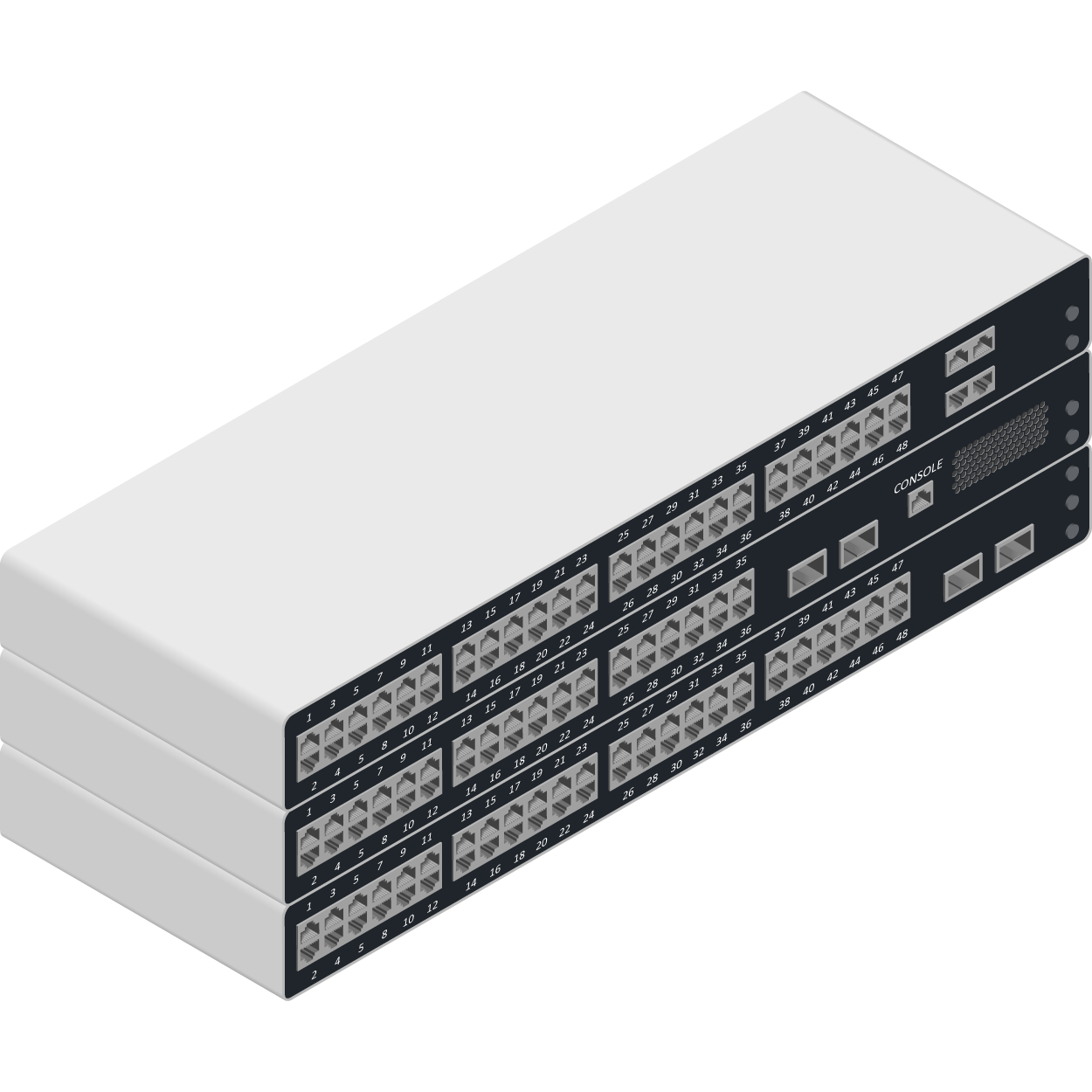
The core layer provides a highly available network backbone.
- client and server computers should not be attached directly to the core
- purpose should be kept simple:
- provide redundant traffic paths for data to continue to flow around the access and distribution layers of the network
- routers or layer 3 switches in the core layer establish a full mesh topology with switches in the distribution layer blocks
Collapsed Core
- Medium-sized networks might not need separate core and distribution layers
- in a two-tiered or collapsed core model, a monolithic core layer is implemented as a full mesh
- impractical if there are a large number of core switches
- design is less scalable
- impractical if there are a large number of core switches