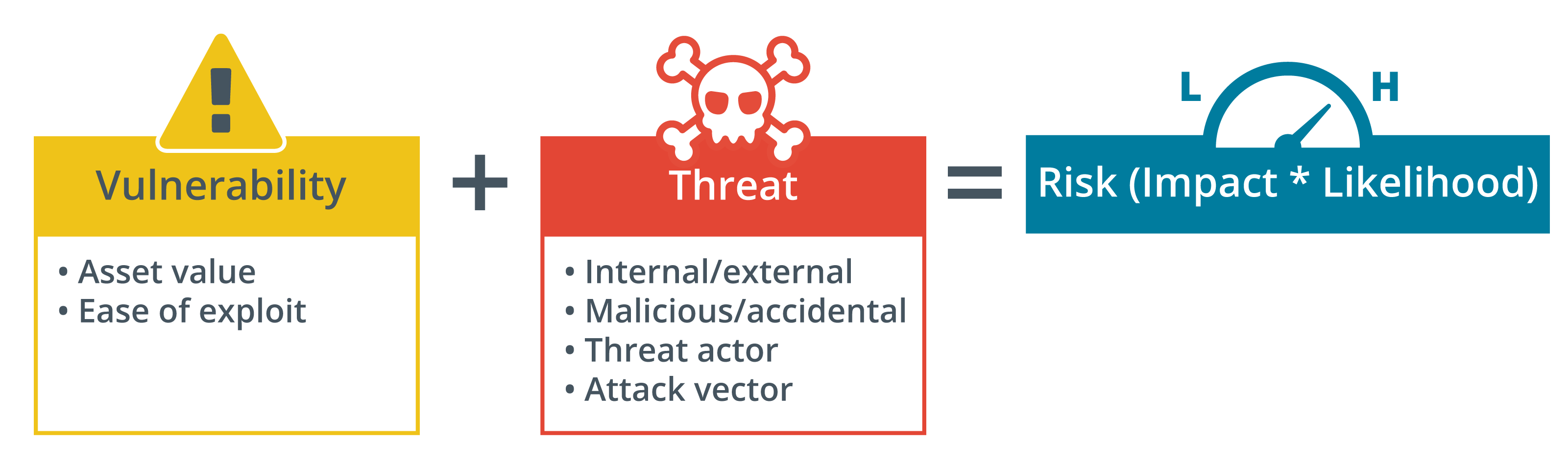
Threats, Vulnerabilities, Risk, and Impact
When you look at how an attack might affect you, you can speak of it in terms of threats, vulnerabilities, and the associated risk.
Threats
A threat is something that has the potential to cause harm to an information system.
- tend to be specific to certain environments
- E.g., virus for Windows would be unlikely to have an effect on Linux
- can be a person or circumstance
- a threat source carries out a threat or causes it to take place
- aka threat actor or threat agent
- can be deliberate or accidental
- accidental threats are the results of either unintentional actions or inactions
- deliberate threats are intentional actions taken by attackers
- the path or tool used by a threat actor is a threat vector
A threat actor is a person or group who exploits a vulnerability.
Threat Categories
- Human
- threats carried out by people
- internal vs external attackers
- good and bad actors
- Natural
- uncontrollable events such as earthquakes, tornadoes, fires, and floods
- Technological and operational
- threats that operate inside information systems
- E.g., malicious code, hardware/software failures, improperly running processes
- Physical and environmental
- facility-based threats
- E.g., breach of physical security, loss of heating/cooling, etc.
Vulnerabilities
Vulnerabilities are weaknesses, or flaws, in an information system that threats can exploit to cause harm.
- Types:
- People
- people can be a vulnerability if inadequately trained or otherwise
- Process
- flaws in an organization’s procedures
- Facility
- weaknesses in physical security
- Technology
- improperly designed information systems
- People
Exploits
Exploit is an successful attack against a vulnerability.
- take place in a window of vulnerability
- period from when a vulnerability is discovered to being patched
Info
Zero-day is when a vulnerability is exploited before or as soon as it is discovered.
Risk
Risk is the potential of a threat exploiting a vulnerability.
- To have risk in an environment requires:
- there is a threat
- there is a vulnerability the threat can exploit
- Best strategy is to spend time mitigating the most likely attacks, not every possible attack
Likelihood is probability that a risk event will occur.
Types
- Financial
- affect financial resources or financial operations
- System/Service
- impact how an organization provides information technology (IT) systems and services
- Operational
- affect the normal operation of information systems and services
- Reputational
- negatively affect an organization’s reputation or brand
- Compliance
- relate to a possible violation of a law, regulation, or organizational policy
- Strategic
- may have a lasting impact on an organization’s long-term viability
Risk Analysis
- risk analysis is the process of reviewing known vulnerabilities and threats
- risk responses:
- Risk avoidance
- process of applying safeguards to avoid a negative impact
- Risk mitigation
- reduce, but not eliminate, a negative impact
- amount of risk left over is residual risk
- Risk transfer
- passes its risk to another entity, at which point the risk impact is borne by the other entity
- Risk acceptance
- decide to deliberately take no action against an identified risk
- may choose to accept the risk if the cost of the risk itself is less than the cost to avoid, mitigate, or transfer the risk
- Risk avoidance
- risk responses:
Impact
Some organizations, like NSA, add a factor called impact.
Impact is the effect of a threat being realized.
- takes into account the value of the asset being threatened and uses it to calculate risk