TCP-IP
The Transmission Control Protocol/Internet Protocol (TCP/IP) suite is used to perform logical addressing and data forwarding functions on most networks.
A protocol is a set of rules that allows networked hosts to communicate data in a structured format.
- Often, several protocols used are designed to work together as a protocol suite
- Most networks have converged on the use of the Transmission Control Protocol/Internet Protocol (TCP/IP) suite
- function of each protocol can be better understood by dividing network functions into layers
- Protocols operating at lower layers are said to encapsulate data from higher protocols
- Each protocol adds its own header fields to data it is transporting from an upper layer protocol
Layers
- the TCP/IP suite uses a model with four distinct layers
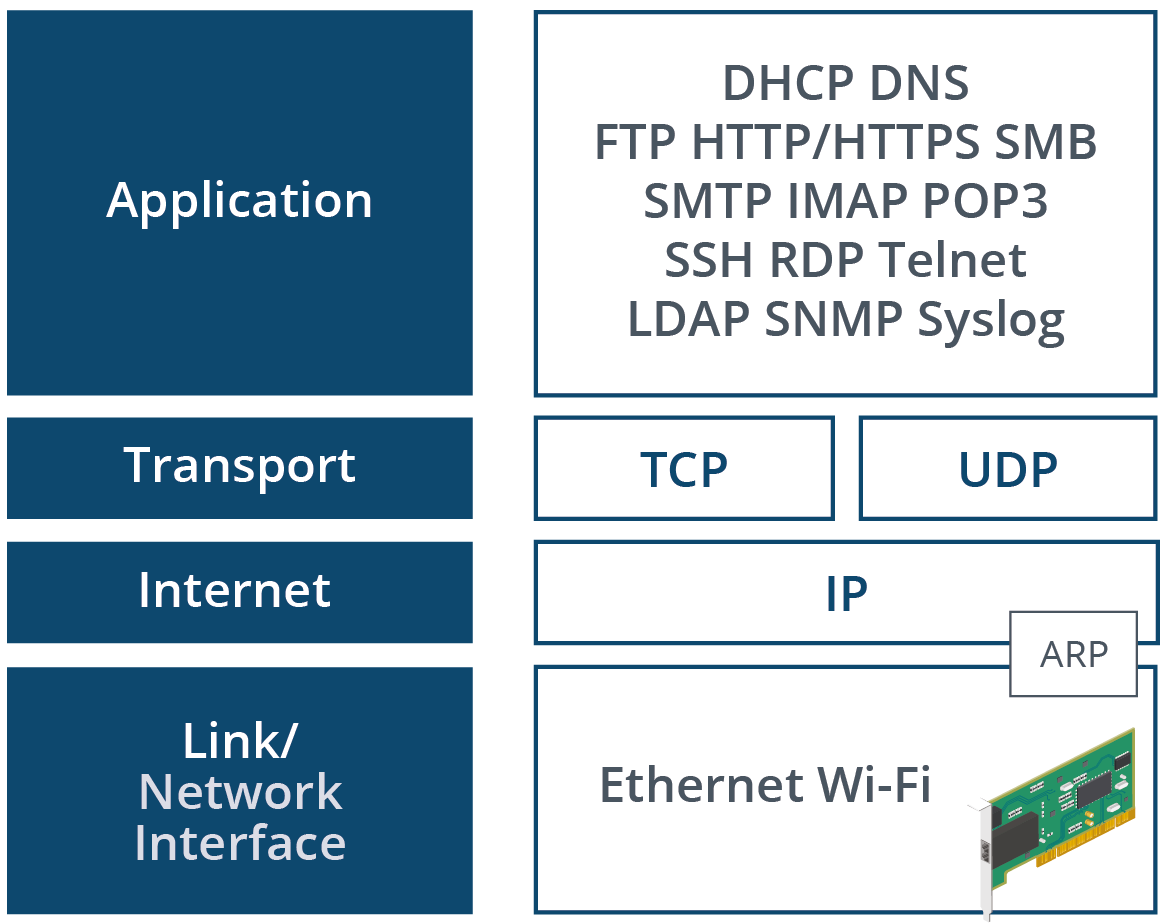
Link or Network Interface Layer
- Link layer is responsible for putting frames onto the physical network
- does not contain TCP/IP protocols as such
- at this layer, different local networking products and media can be used
- Ethernet or Wi-Fi.
- WAN interfaces, such as DSL and cable modems, also work at the Link layer
- Communications on this layer take place only on a local network segment and not between different networks
- On an Ethernet or Wi-Fi segment, data at the link layer is packaged in a unit called a frame
- node interfaces are identified by a MAC address
Internet Layer
The Internet Protocol (IP) provides packet addressing and routing within a network of networks.
- device that communicates on IP network is generically referred to as an end system host
- For data to be sent from one IP network to another, it must be forwarded by an intermediate system (a router)
- provides best effort delivery that is unreliable and connectionless
- packet might be lost, delivered out of sequence, duplicated, or delayed
- deals with addressing
Transport Layer
- Transport layer determines how each host manages multiple connections for different application layer protocols at the same time
- implemented by one of two protocols:
- Transmission Control Protocol (TCP)
- guarantees connection-oriented forwarding of packets
- can identify and recover from lost or out-of-order packets
- mitigates the inherent unreliability of IP
- used by most TCP/IP application protocols, as failing to receive a packet or processing it incorrectly can cause serious data errors
- User Datagram Protocol (UDP)
- provides unreliable, connectionless forwarding
- faster than TCP
- comes with less of a transmission overhead
- does not need to send extra information to establish reliable connections
- used in time-sensitive applications where a few missing or out of order packets can be tolerated
- E.g., speech or video
- manifests as a glitch in video or audio, instead of crashing the application
- Transmission Control Protocol (TCP)
Application Layer
- contains protocols that perform some high-level function
- numerous application protocols in the TCP/IP suite
- used to configure and manage network hosts and to operate services
- each application protocol uses a TCP or UDP port to allow a client to connect to a server
Info
- TCP/IP was originally developed by the US Department of Defense
- but is now an open standard to which anyone may contribute
- Developments are implemented through the Internet Engineering Task Force (IETF), which is split into working groups
- Standards are published as Request For Comments (RFCs)
- The official repository for RFCs is at rfc-editor.org