State Government
- Under the Constitution, powers that are not specifically granted to the federal government are reserved to the states
- most states are organized under a constitution
- describes relationship between a state and its citizens
- thus, lists more individual rights than federal Constitution
- usually longer
- easier to change
3 Branches
- legislature
- executive
- lead by governor
- govern and make laws for the state
- power limited by federal Supremacy Clause
- sets forth the rule that federal Constitution, treaties, and federal law outrank any conflicting state laws
- judicial
- similar to the [[Judicial Branch#Judicial Branch#Structure of the Federal Judiciary|federal system]]
State Courts
- trial courts are the original jurisdiction courts for a state
- county courts are entry-level courts for most disputes
- can hear most cases but limited to disputes between citizens of the state
- 2 appellate courts
- state intermediate appellate court
- hears appeals from trial courts
- state supreme court
- hears appeals from appellate court
- not all states have the exact same structure
- could have different names in different states
- U.S. Supreme Court has no authority over the organization or procedures used by state courts
- may not interpret issues that rely solely on state law or state constitutions
- only highest court in a state can make interpretations about a state’s law
- state and federal courts do not exist in separate spheres, though
- state courts can review cases that concern issues of constitutional or federal law
- must yield to the superiority and previous decisions of Supreme Court
- Supreme Court can review a state court case if:
- concerns a question of federal law
- concerns a federal constitutional issue
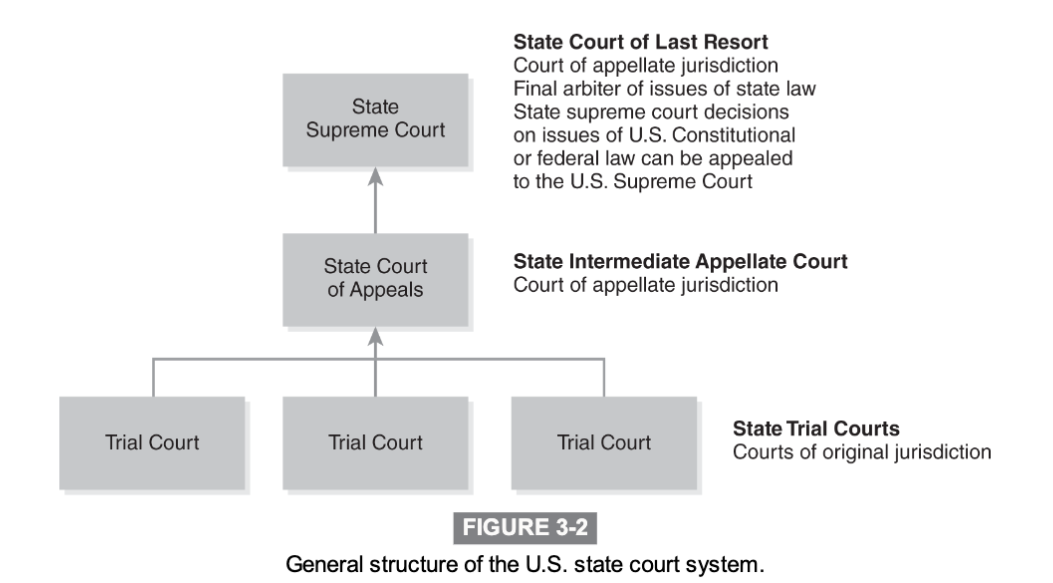
Comparing State and Federal Judicial Systems
| State Judicial System | Federal Judicial System |
|---|
| Courts of Original Jurisdiction | Trial courts | U.S. District Courts |
| Courts of Appellate Jurisdiction | Jurisdiction Intermediate appellate courts | Circuit Courts of Appeal |
| Courts of Last Resort | State supreme court | U.S. Supreme Court |
| Scope of Authority | General authority to hear all disputes; authority is limited to disputes involving state citizens | Cases must involve a federal question or involve disputes between citizens of different states and be over $75,00 |
| Authority of Court of Last Resort | Final, unless the case involves a federal question; if so, case can be appealed to U.S. Supreme Court | Final |