Spine and Leaf Topology
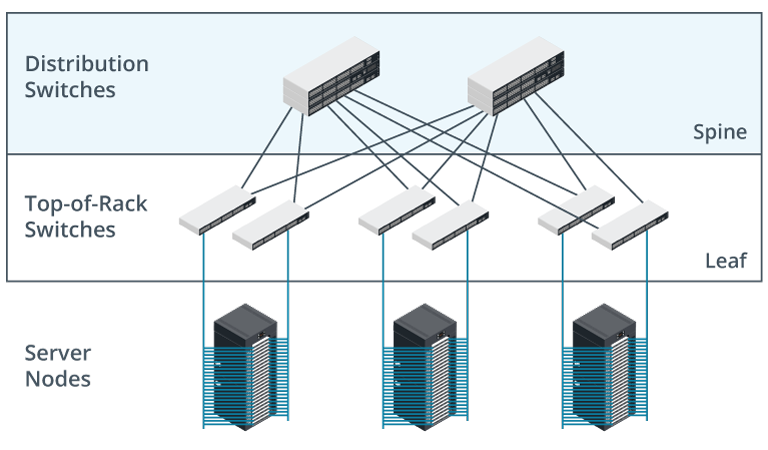
Spine and leaf topology is a network topology commonly used in datacenters comprising a top tier of aggregation switches forming a backbone for a leaf tier of top-of-rack switches.
- better support for
- east-west traffic
- SDN and overlay network within datacenters
- two layers:
- spine layer
- comprises a backbone of top-tier distribution switches
- not linked to one another
- leaf layer
- contains access switches
- Each access switch is connected to every spine switch in a full mesh topology
- access switches never have direct connections to one another
- spine layer
Benefits
- each server is only ever a single hop from the backbone
- makes network latency more predictable
- multiple redundant paths between a leaf switch and the backbone
- allows for load balancing and failover
- no direct connections between spine switches in the backbone or between leaf switches
- network is loop free and does not need to run spanning tree
- Instead, each leaf switch runs a protocol called Equal Cost Multipathing (ECMP)
- distribute traffic between the links to the spine switches
- Servers are connected to multiple leaf switches for multipath redundancy, using a first hop gateway protocol to determine the active path
- improved scalability
- adding spine and/or leaf nodes does not change the topology
- means adding capacity for service needs that change unpredictably, such as storage, is easy
Top of Rack Switches
- leaf layer access switches are implemented as top-of-rack switches
Top-of-rack (ToR) switches are switch models designed to provide high-speed connectivity to a rack of server appliances and support higher bandwidths than ordinary workgroup switches.
- may have 10 Gbps access port and 40/100 Gbps uplink ports
- usually place at the top of the rack
- ensures cleaner cable management and better accessibility