Software-Defined WAN (SD-WAN)
Software-defined WAN (SD-WAN) is a service that uses software-defined mechanisms and routing policies to implement virtual tunnels and overlay networks over multiple types of transport network.
- enables organizations to connect their branch offices, datacenters, and cloud infrastructure over a wide area network (WAN)
- efficient, secure, connectivity to corporate clouds
- replaces hub-and-spoke designs
- hub and branch office design with on-premises datacenters has a number of performance and reliability drawbacks
- mitigate some of the issues by:
- Shifting services to dedicated datacenters in the cloud
- service availability and integrity is separated from site accessibility considerations
- Shifting services to dedicated datacenters in the cloud
- access to datacenter or cloud would be routed and authorized via the hub office
- is a type of overlay network that:
- provisions a corporate WAN across multiple locations
- facilitate secure access to the cloud directly from a branch office or other remote location
- uses automation and orchestration to provision links dynamically based on application requirements and network congestion
- uses IPSec to ensure that traffic is tunneled through the underlying transport networks securely
- benefits:
- provide enhanced security features
- can apply encryption
- can segment traffic based on priority ratings
- ensures critical data is fully protected
- can intelligently route traffic based on application
- tightly integrates with firewalls
- centralizes management of network security policies
- provide enhanced security features
- should apply:
- microsegmentation
- zero-trust policies
- to ensure all requests and responses are authenticated and authorized
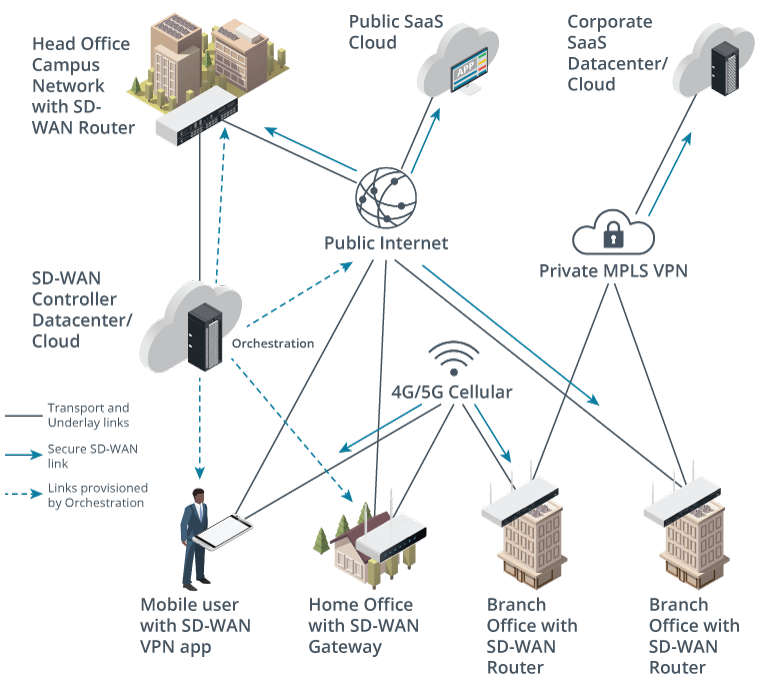
- managed by a controller and management software
- located in a corporate datacenter or public cloud
- each site has an SD-WAN capable:
- router
- gateway
- or VPN app
- SDN controller orchestrates connections to networks and clouds enrolled in the SD-WAN
- uses any available IP underlay network to provision the fastest or most reliable available transport to networks and clouds enrolled in the SD-WAN
- e.g., broadband Internet, 4G/5G cellular, or private Multiprotocol Label Switching (MPLS) VPNs
- ensures each access request is authenticated and authorized
- uses any available IP underlay network to provision the fastest or most reliable available transport to networks and clouds enrolled in the SD-WAN