Small Computer System Interface (SCSI)
Background
- Modern bus interfaces such as USB and Thunderbolt use serial communications
- serial links can achieve Mbps and Gbps speeds through the use of improved signaling and encoding methods
- a serial interface essentially transfers 1 bit at a time
- a parallel interface transfers 8 bits (1 byte) or more
- requires more wires in the cable and more pins in the connectors
- bulkier
SCSI
Small computer system interface (SCSI) is one example of a legacy parallel bus.
- One SCSI host bus adapter (HBA) can control multiple devices attached by internal ribbon cables or external SCSI cables
- SCSI standard also defines a command language that allows the host adapter to identify which devices are connected to the bus and how they are accessed
- could be used for both internal devices and external peripherals
- but now unlikely to find it used for any purpose other than the connection of internal hard disk drives
- support data rates up to 320 MBps
- numerous versions of SCSI with many different physical connectors
- only likely to come across:
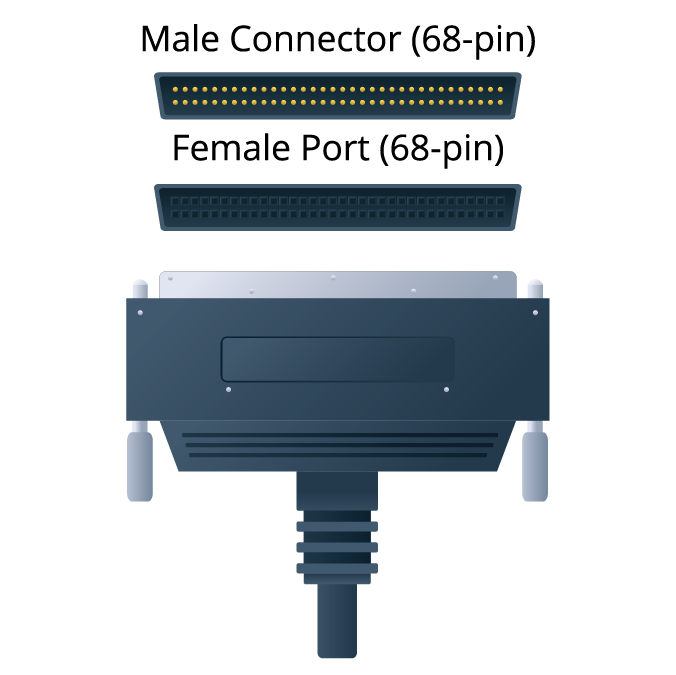
- high density (HD) 68-pin connectors
- HD-68 is used with Molex power connectors
- or single connector attachment (SCA) 80-pin connectors
- SCA incorporates a power connector
- high density (HD) 68-pin connectors
- only likely to come across:
- Each device on a wide SCSI bus must be configured with a unique ID, from 0 to 15
- host adapter is usually set to 7 or 15
- bootable hard disk is usually allocated ID 0
- first and last devices on a SCSI bus must be terminated
- Termination may either be enabled internally on the device by setting a switch or by physically connecting a terminator pack to a device or the host adapter
- while parallel SCSI as a physical interface has almost completely disappeared, the software interface and command set are used in many other storage technologies, including serial attached SCSI (SAS)
- SAS is a dominant interface for enterprise-class storage devices in the PC workstation and server market