Simple Network Management Protocol (SNMP)
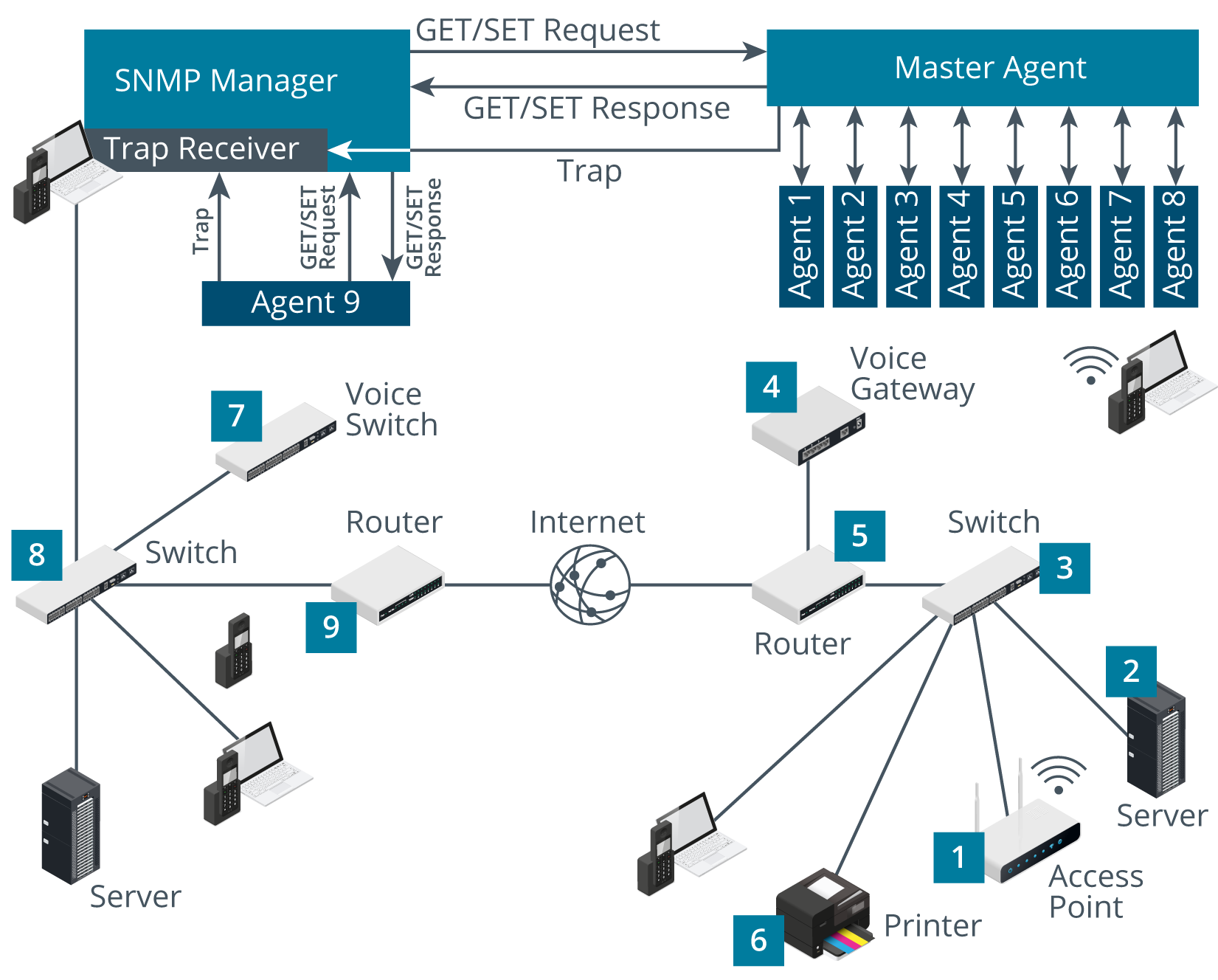
The Simple Network Management Protocol (SNMP) is a widely used framework for remote management and monitoring of servers and network appliances.
- consists of agents and monitors
SNMP Agents and Monitors
SNMP Agents
- agent is a process running on a switch, router, server, or other SNMP-compatible network device
- a managed device is one that is running an SNMP agent
- agent maintains a data store called management information base (MIB)
- holds variables relating to the activity of the device
- e.g., number of frames per second handled by the switch
- each parameter stored in a MIB is referred to by a numeric Object Identifier (OID)
- stored within a tree structure
- part of tree is generic to SNMP, part is defined by device vendor
- holds variables relating to the activity of the device
- can initiate a trap operation
- configured with:
- the community string or community name of the computers allowed to manage the agent
- community string acts as a password
- only 2:
- one for read-only access
- one for read-write access (privileged mode)
- the IP address or host name of the server running the management system
- the community string or community name of the computers allowed to manage the agent
- can only pass information to management systems with same community string
SNMP Monitor
An SNMP monitor is management software that provides a location from which you can oversee network activity.
- polls agents at regular intervals for information from their MIBs
- displays the information for review
- displays any trap operations as alerts
- can retrieve information from a device in two ways:
- Get
- software queries the agent for a single OID
- used by the monitor to perform regular polling
- Trap
- agent informs the monitor of a notable event
- e.g., port failure
- threshold for triggering traps can be set for each value
- agent informs the monitor of a notable event
- Get
- Set command changes variables
- multiple Get and Get Next commands are used to walk an MIB subtree
- used to discover the complete layout of an MIB
- device queries use UDP port 161
- traps use UDP port 162
SNMP Security
- SNMP v2c is a protocol version with no support for robust authentication or encryption
- many networks use this
- guidelines for using:
- SNMP v2c community strings are sent in plaintext and should not be transmitted of the network if there is risk of interception
- use difficult-to-guess community strings
- never leave it blank or set it to the default
- use access control lists to restrict management operations to known hosts
- 1 or 2 host IPs
- SNMP v3 supports encryption and strong user-based authentication
- agents are configured with a list of usernames and access permissions
- instead of community strings
- when auth is required,
- SNMP message is signed with a hash of the user’s passphrase
- agent can verify the signature and authenticate the user using its own record of the passphrase
- authPriv mode enables encryption using the credential as a key
- authNoPriv mode does not encrypt packets
- agents are configured with a list of usernames and access permissions
- disable SNMP if not used