Server-Side Request Forgery (SSRF)
Server-side request forgery (SSRF) is a type of web application security vulnerability that occurs when an attacker can send unauthorized requests from a vulnerable web application to other internal or external systems to gain unauthorized access.
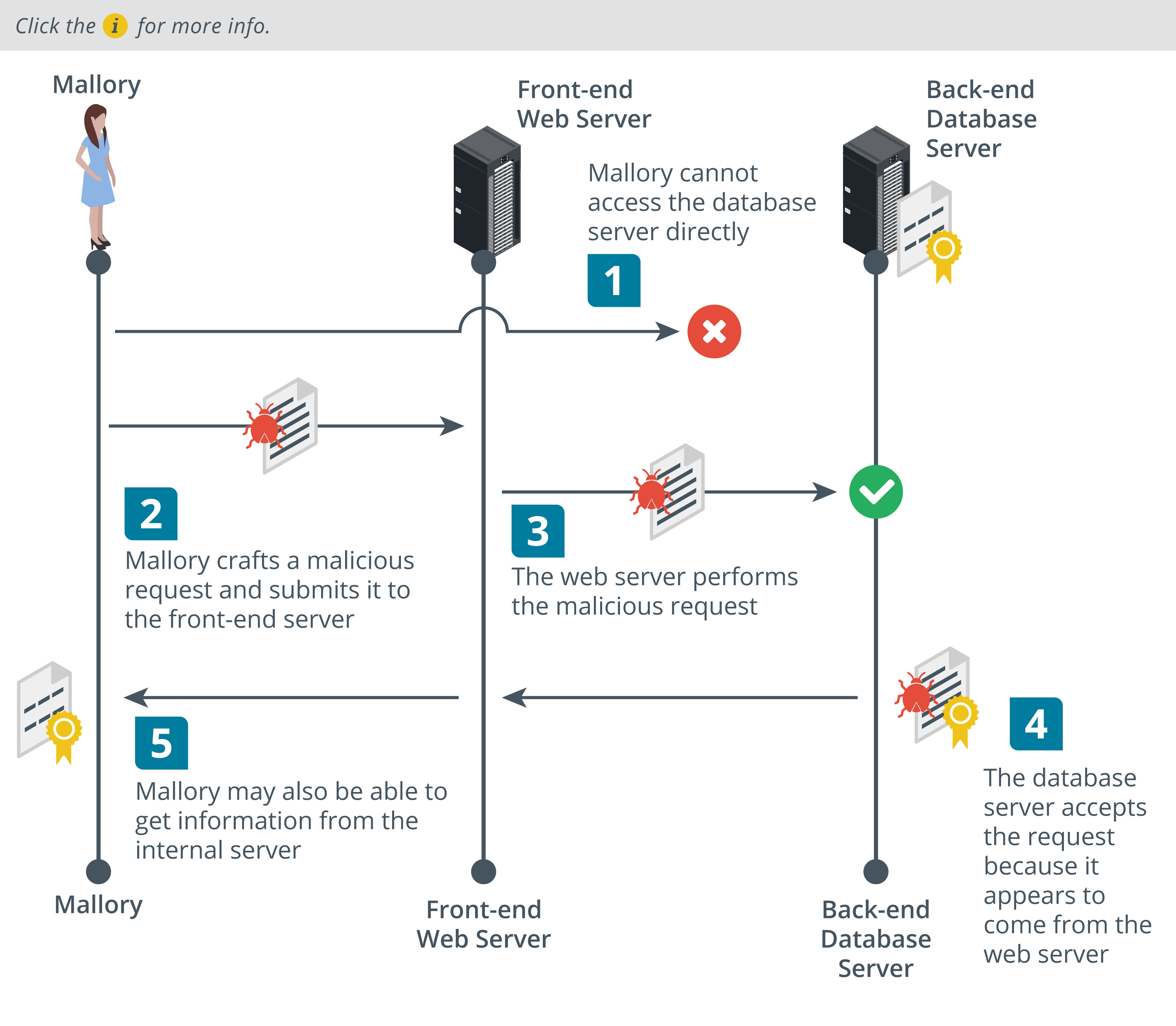
- threat actor takes advantage of the trust established between the server and the resources it can access, including itself
- causes a server application to process an arbitrary request that targets another service
- target service could be
- another application running on the same host
- or a service running on a remote host
- exploits both the lack of authentication between the internal servers and services
- relies on weak input validation
- allows the attacker to submit arbitrary requests
- often targeted against cloud infrastructure
- where web server is only the public-facing component of a deeper processing chain
- typically involves an attacker exploiting the web application’s ability to send HTTP requests to other systems,
- which are then abused to instruct “hidden” internal or external systems to provide the attacker with access to protected features or to steal information
Example
A well-documented example of SSRF occured in the 2019 CaptialOne breach.
https://krebsonsecurity.com/2019/08/what-we-can-learn-from-the-capital-one-hack/
How it Works
- web application comprises:
- multiple layers of servers
- with a client interface
- middleware logic layers
- and a database layer
- Requests initiated from the client interface (a web form) are likely to require multiple requests and responses between the middleware and back-end servers
- will be implemented as HTTP header requests and responses between each server
- SSRF is a means of accessing these internal servers by causing the public server to execute requests on them
- manipulated request is made with the server’s privilege level
- works by manipulating the input of a vulnerable web application to cause it to send an HTTP request to a server of the attacker’s choice
- attacker can use this ability to perform a range of malicious activities
Tip
PortSwigger (the maintainers of Burp Suite) have published an excellent technical overview of SSRF.
https://portswigger.net/web-security/ssrf
Common Techniques Used to Exploit SSRF Vulns
- An attacker uses SSRF to access internal resources on a network, such as databases or file systems, that should be inaccessible directly from the Internet
- An attacker can use SSRF to access other web applications to steal data or launch attacks against other systems
- An attacker can use SSRF to scan the internal network for open ports or other vulnerable services
- then used to launch further attacks
Mitigation
- input validation
- Ensure that all user input is properly validated and sanitized to prevent attackers from manipulating requests
- whitelist hosts
- Web applications should only be allowed to access trusted hosts and block all other requests by default
- Firewall and network segmentation
- Network segmentation can prevent unauthorized access to internal systems
- combine with firewalls to block traffic from unauthorized sources
- Secure coding practices
- using well established and trusted libraries
- avoiding user-controlled data in requests
- implement safe configuration settings