Security Zones
A security zone is an area of the network (or of a connected network) where the security configuration is the same for all hosts within it.
- In physical security, an area separated by barriers that control entry and exit points
- network architecture and security control infrastructure must ensure that these zones are segregated from one another by physical and/or logical segmentation
- Traffic between zones should be strictly controlled using a security device
- Traffic policies should apply the principle of least privilege
Info
A zone must have a known entry and exit point.
- e.g., if the only authorized access point for a zone is a router, placing a wireless access point within the zone would be a security violation
Creating Zones
- network architecture features that create segments mapped to subnets allow the creation of a zone-based security topology
- Hosts outside the perimeter are in a public Internet zone and are untrusted
- Hosts within the perimeter will have different levels of trust and access control requirements
- To map out the internal security topology,
- analyze the systems and data assets that support workflows
- and identify ones that have similar access control requirements:
- Database and file systems that host company data and personal data should prioritize confidentiality and integrity
- Data should not usually be held within a single zone
- Separating information into different zones will reduce the breach’s impact
- Client devices need to prioritize integrity and availability
- should not store data and therefore have a lower confidentiality requirement
- Public-facing application servers should prioritize integrity and availability
- should not store sensitive data
- Publicly accessible servers must not be considered fully trusted
- Application servers that support the network infrastructure must exhibit high levels of confidentiality, integrity, and availability
- Database and file systems that host company data and personal data should prioritize confidentiality and integrity
- This analysis will generate a list of the security zones needed
- a basic setup includes:
- intranet
- the internal network
- extranet
- an intranet segment extended to business partners
- e.g., API access to an internal ERP system
- honeynet
- decoy networks designed to attract attackers
- screened subnets or DMZ
- area of the network open to public-facing access
- typically houses web servers
- Ad Hoc network
- temporary networks that may bypass security control
- intranet
Example
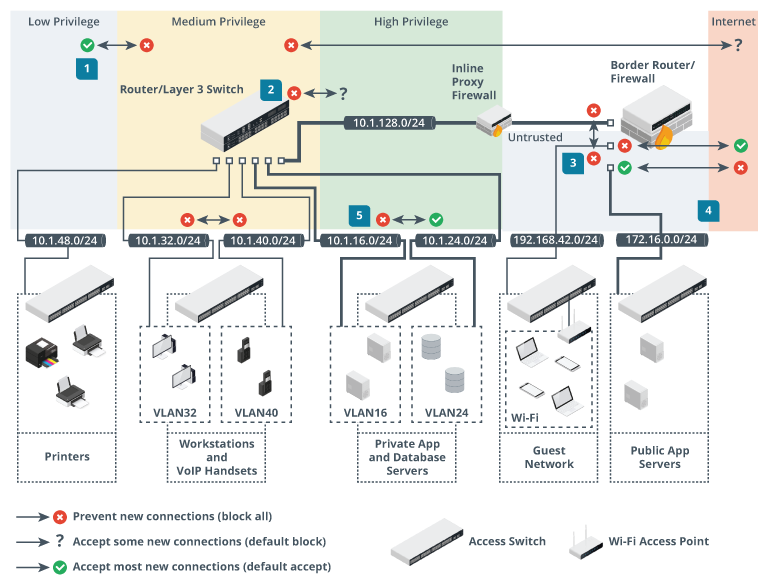
- how traffic between hosts in zones with different privilege sensitivities can be subject to access controls:
- low privilege zone containing hosts that are difficult to secure and patch, such as printers, can accept connections but cannot initiate requests to any other hosts
- Client devices on the enterprise LAN can make authorized requests in different zones, such as to internal servers or Internet websites, but cannot accept new connection requests
- Hosts in a guest zone can access the Internet, but are not allowed to access the enterprise LAN
- Public-facing servers can accept requests from the Internet but cannot initiate requests to the enterprise LAN or to the Internet
- Where hosts are separated by VLANs within the same zone additional access rules can be configured
- e.g., app servers should be able to make requests to databases, but not vice versa