Routing Information Protocol (RIP)
The Routing Information Protocol (RIP) is a distance vector routing protocol that uses a hop count to determine the least-cost path to a destination network.
- only considers a single piece of information about the network topology:
- the next hop router to reach a given network or subnet (vector)
- considers only one metric to select the optimal path to a given destination network:
- lowest hop count (distance)
- no longer widely deployed
- useful to understand the function of more advanced protocols
- sends regular updates (every 30s) of its entire routing database to neighboring routers
- can also send triggered updates whenever changes occur
- when a router receives an update from a neighbor,
- it adds unknown routes to its own routing table
- increases the hop count by one
- identifies the originator of the updates as the next hop to the specified networks
Example 1
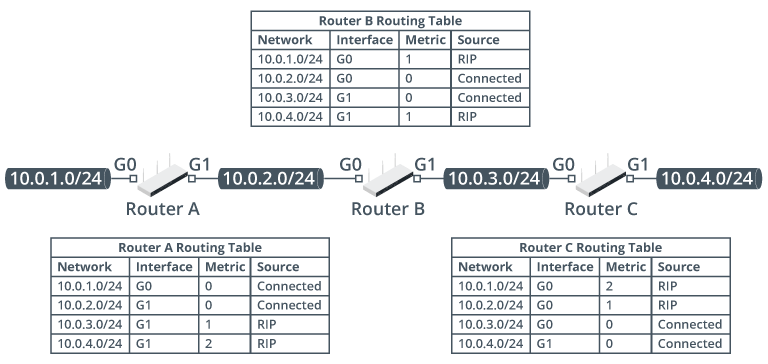
RIP has been used to propagate route information between three routers connected in a chain.
- Router A learns about networks
10.0.3.0/24and10.0.4.0/24from Router B
- adds 1 to the hop count metric of these routes
- Router B learns about
10.0.1.0/24from Router A and about10.0.4.0/24from Router C- Router A and Router C do not exchange any information directly
- the distance vector process by which Router A learns about Router C’s networks is often referred to as “routing by rumor”
Example 2
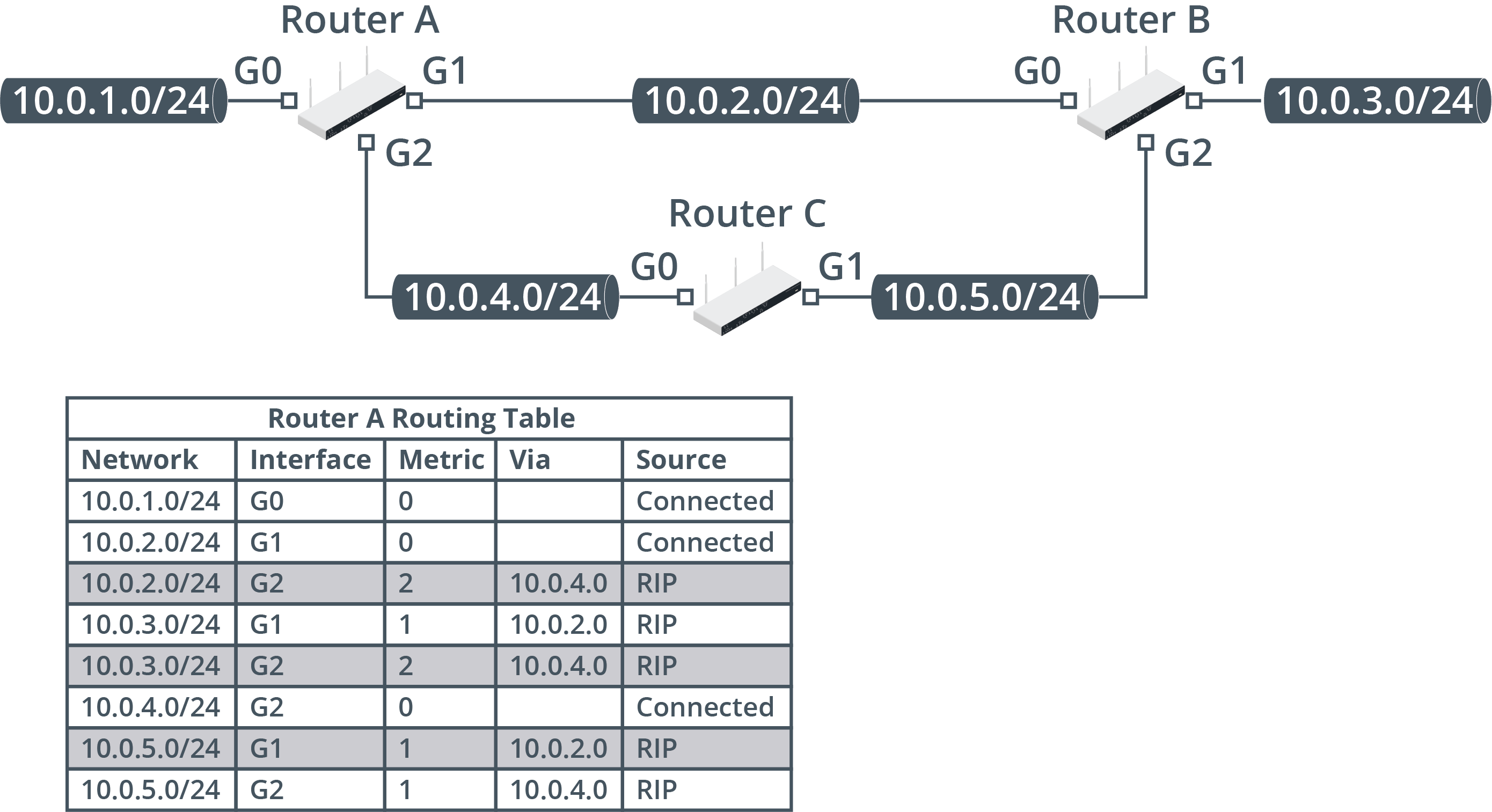
This example illustrates a mesh topology where there are multiple paths between networks.
- Router A has two possible paths to network
10.0.3.0/24
- learned from Router B and Router C
- it can forward a packet out of its G1 interface over network
10.0.2.0/24
- will take 1 hop to reach the destination
- could also forward the packet out of G2 and reach the destination via Router C and then Router B
- this takes 2 hops, so is not used as the preferred route
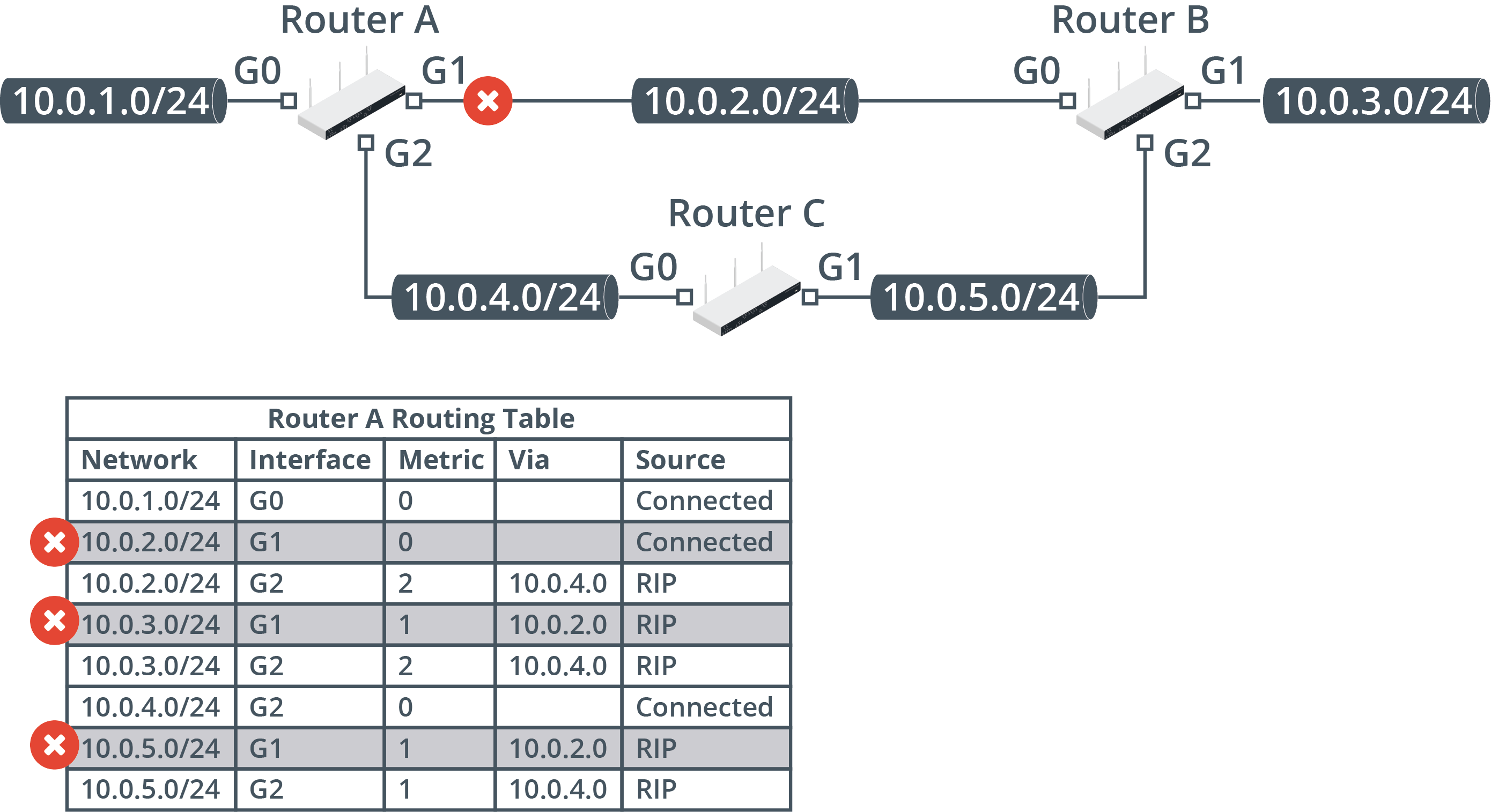
If Router A’s G1 link goes down, those entries will be removed from the routing table and the alternative routes via
10.0.4.0/24will be selected:
- to help prevent overlooping
- the maximum hop count allowed is 15
- consequently, this limits the maximum size of a RIP network
- since networks that have a hop count of 16 or higher are unreachable