Procedural Law
Procedural law deals with the processes that courts use to decide cases.
- procedural areas of law are designate to ensure due process
- all parties in a case are entitled to a fair and consistent process within the courts
- 3 types of procedural law:
- Criminal
- Civil
- Administrative
Civil
Civil procedure deals with the procedures and processes that courts use to conduct civil trials.
- concern claims between individuals
- substantive areas of law such as contract law and property law are civil law areas
- parties must follow civil procedure rules in court
- in federal courts
- case begins when a complaint is filed with the court
- a court document that sets forth the names of the parties and the facts and legal claims
- rules outlining civil trial process are found in the Federal Rules of Civil Procedure
- made by the Supreme Court
- approved by Congress
- case begins when a complaint is filed with the court
- State courts also have rules
- often based on Federal Rules of Civil Procedure
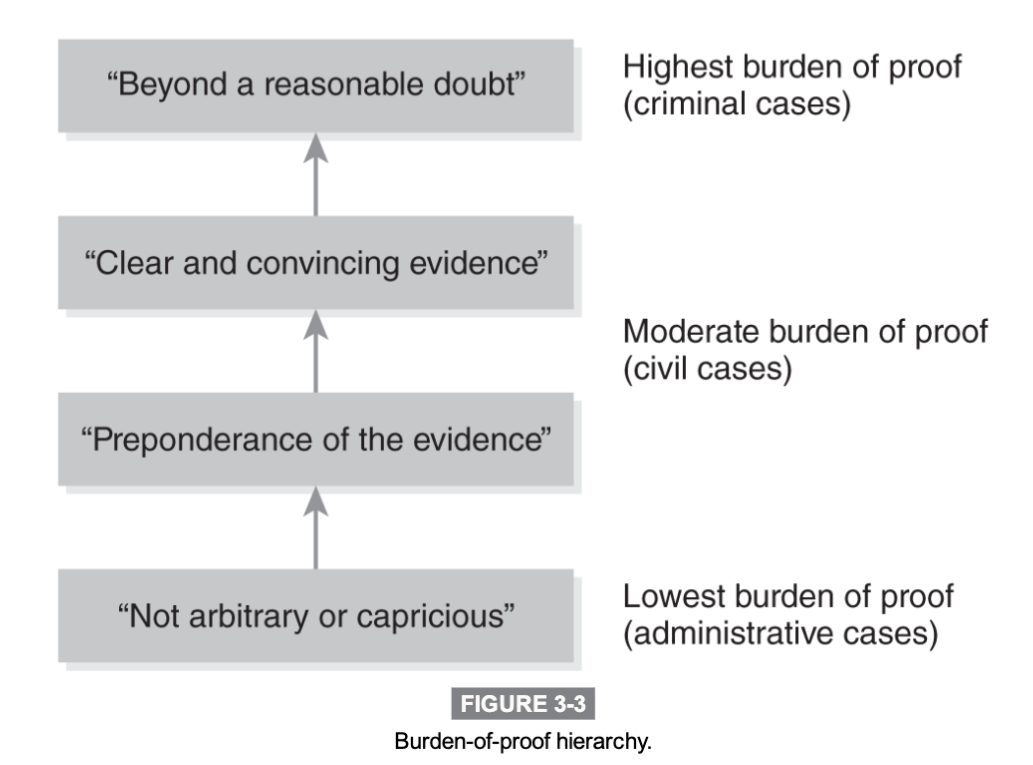
- civil trial cases must be proven by a preponderance of the evidence
- means that it is more probable than not that an action (or wrong) took place
- >50%
- lowest level of proof in a civil case
- means that it is more probable than not that an action (or wrong) took place
- some civil cases use the clear and convincing evidence standard
- a party must convince a court that it is more likely than not that an action (or wrong) took place
- E.g., actions to terminate parental rights would use this standard
Criminal
Criminal procedure deals with the rules that courts follow in criminal law cases.
- includes the processes for investigating and punishing crimes
- federal and state governments have criminal codes
- specify the actions that constitute a crime
- wrongs against society
- prosecuted by the government against an alleged wrongdoer
- specify the actions that constitute a crime
- the federal or state official with the power to pursue criminal cases is called a prosecutor
- In the federal system
- rules outlining the criminal trial process are called the Federal Rules of Criminal Procedure
- State courts also have rules
- often modeled after federal rules
- most criminal cases are tried in front of a jury
- decides questions of fact
- judges role is to watch over the proceedings and decide questions of law
- standard of proof for most criminal cases is beyond a reasonable doubt
- burden is met when a prosecutor proves to a jury that there can be no reasonable doubt in the mind of a reasonable person that a defendant is guilty
- highest level of persuasion
- is not 100% sure, but sure that reasonable doubt has been eliminated
- Why is there a higher burden of proof in criminal cases?
- because a criminal penalty usually includes jail time, financial penalties, or even death sentence
- these penalties infringe on fundamental rights to liberty, property, and life
- thus, only impose strong penalties with strong proof
Administrative
Administrative procedure sets forth the process under which administrative agencies make and enforce rules.
- federal government and most states delegate some regulatory and enforcement functions to administrative agencies
- delegate some of these functions in very detailed ways and for very specific reasons
- When governments delegate power in this way, it is possible to have an agency that:
- creates rules (a legislative function)
- enforces rules (an executive function)
- reviews rules (a judicial power)
- actions of these agencies are the focus of administrative procedure
- must be dealt in fair and consistent manner
- at the federal level
- Administrative Procedure Act (1946) helps define the federal administrative process
- states the procedures for agency rulemaking, enforcement, and review
- allows U.S. federal courts to review agency decisions
- Administrative Procedure Act (1946) helps define the federal administrative process
- different burden of proof for administrative cases
- administrative decision is valid so long as it is not arbitrary and capricious, or abuse of the law
- no reasonable connection between facts of the case and the administrative outcome
- administrative decision is valid so long as it is not arbitrary and capricious, or abuse of the law