Power Supply Connectors
Each PSU has a number of power connectors attached.
- power connectors supply DC voltage to the motherboard and devices at 3.3 VDC, 5 VDC, and 12 VDC
- Not all components use power at precisely these voltages
- Voltage regulators are used to correct the voltage supplied from the PSU to the voltage required by the component
- motherboard’s power port is referred to as the P1 connector
- PSU will also have a number of Molex and/or SATA device power connectors and 4/6/8-pin connectors for use with CPU and PCIe adapter card power ports
Power Connectors
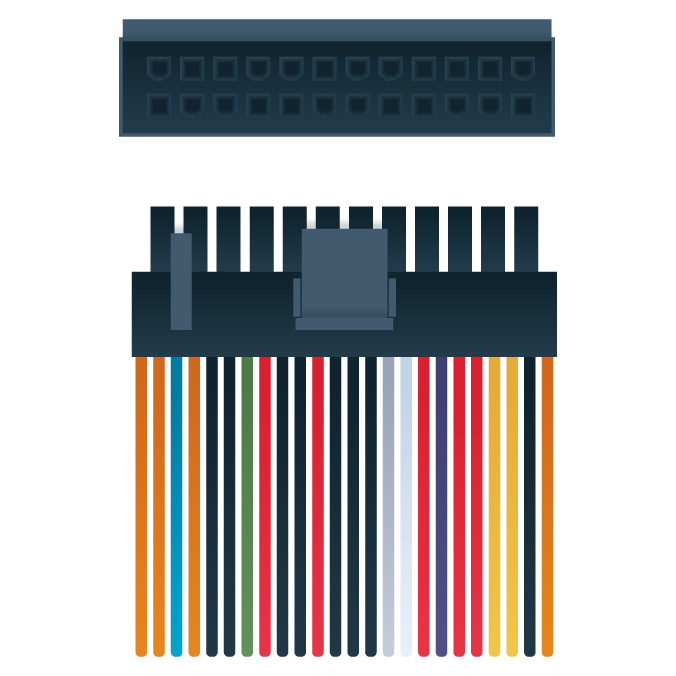
20-pin to 24-pin Motherboard Adapter
P1 Adapter is the primary connector for power from the power supply unit (PSU) to the motherboard.
- ATX PSU standard has gone through several revisions, specifying different connector form factors
- original ATX specification, the P1 connector is 20-pin (2x10)
- Most systems are now based on the ATX12V version 2 specification
- black wires are ground
- yellow are +12 V
- red are +5 V
- orange are +3.3 V
- 24-pin (2x12) P1 form factor
- Some PSUs have a 20+4-pin P1 adapter cable for compatibility with older motherboards with a 20-pin port
Entry-Level Power Supply (EPS)
The Entry-Level Power Supply (EPS) specification comes in 8-pin +12V connections with 4 pairs of yellow and black wires.
- +12V
- developed for server-class hardware
Molex
Molex is an older connector that supplies power to peripheral devises housed inside the system’s case, such as optical or disk drives.
- white color
- 4 pins
- red, yellow, and black wires
- +5V or +12V
Molex KK
The Molex KK connector is commonly used to connect the fan to the motherboard.
- can supply +5V or +12V
- has three circular pins
- black, yellow, and red wires
Modular Power Supplies
A modular PSU has power connector cables that are detachable from the unit.
- minimizes clutter within the chassis, improving airflow and cooling
- E.g., non-modular PSU might have four or five Molex or SATA device power connectors, but the PC might only require two of them
- With a modular PSU, the unnecessary cables can be removed
Redundant Power Supplies
A computer system may be fitted with two PSUs, with one acting as a failover redundant power supply.
- could also be connected to a different grid power circuit
- configuration requires a compatible motherboard
- more commonly found on server systems than on desktop PCs
- On a server, typically each PSU plugs into a backplane and is hot-swappable
- allows a faulty unit to be removed and replaced without having to open the case and without the server ever losing power