Open Shortest Path First (OSPF)
- a distance vector algorithm relies on directly connected neighbors for information about remote networks
- a link state algorithm allows a router to store the complete network topology and assess the least-cost paths from this topology database
Open Shortest Path First (OSPF) is a dynamic routing protocol that uses a link-state algorithm and a hierarchical topology.
- is suited to large organizations with multiple redundant paths between networks
- OSPF is hierarchical, wheres EIGRP is a flat routing system
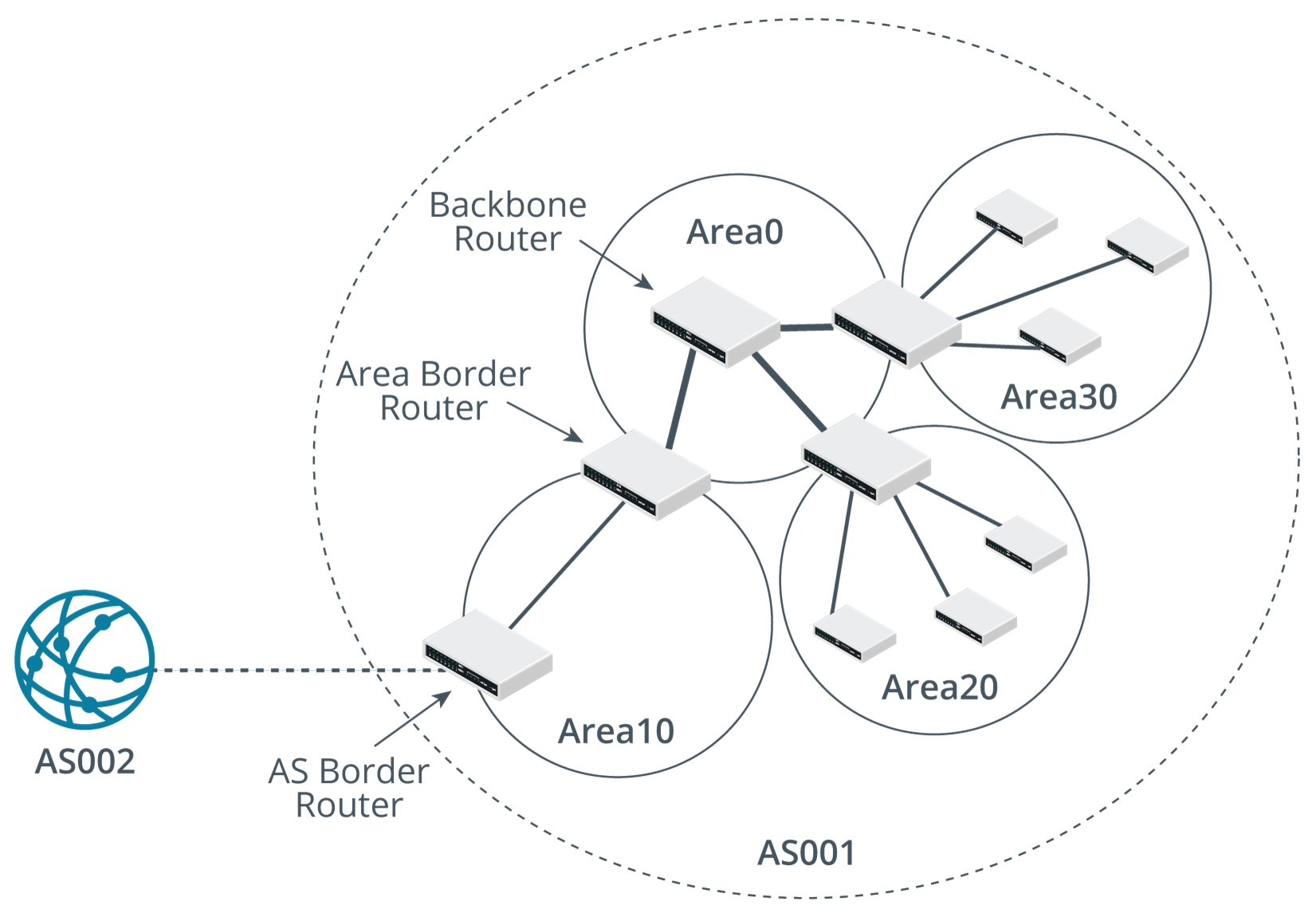
- networks and their connected hosts and routers within an autonomous system are grouped in OSPF areas
- routers within a given area share the same topological database of the networks they serve
- routers that can connect to multiple areas are known as border routers
- a backbone (always called Area 0) is created by the collection of border routers
- only visible to the border routers
- invisible to the routers within a specific area
- in a given area, routers exchange OSPF hello messages:
- as a form of keep-alive packet
- and in order to acquire neighbors with which to exchange routing information
- neighbors share Link State Advertisement (LSA) updates
- to build a consistent link state database (LSDB) that represents the network topology of the area
- router applies an algorithm called shortest path first (SPF) to analyze the LDSB and add least-cost, loop free routes to its routing table
- use of a topology table of the whole network to select routes is the key difference between link state and distance vector algorithms
Benefits
- small, frequent updates used by OSPF lead to:
- more rapid convergence
- more efficiently supports larger networks
- use of areas to subdivide the network minimizes the amount of routing traffic that must be passed around the network as a whole
- further improving convergence performance
Downside
- link state algorithms can be more expensive to implement
- require more CPU and memory resource
- messages are sent as multicast using OSPF’s own datagram format
- tagged as protocol 89 in the IP datagram’s Protocol field
- various packet types and mechanisms to ensure:
- sequencing and reliable delivery
- to check for errors
- supports plaintext or cryptographic authentication