OSI Layer 2 – Data Link
Layer 2 is the Data Link layer.
- responsible for transferring data between nodes on the same logical segment
- a segment is one where all nodes can send traffic to one another using hardware addresses, regardless of whether they share access to the same media
- layer 2 segment could include a physical segment
- referred to as a logical topology
- local networks typically use a central node
- provides a forwarding function, receiving communication from one node and sending it to another
- to do this, each node interface must have a Data Link layer address
- called local addresses or hardware addresses
- Data link layer performs an encapsulation process
- organizes streams of bits arriving from the physical layer into structured units called frames
- each frame contains a network layer packet as its payload
- Data link layer adds control information to the payload in the form of header fields
- includes:
- source and destination hardware addresses
- a basic error check to test if the frame was received intact
- includes:
- organizes streams of bits arriving from the physical layer into structured units called frames
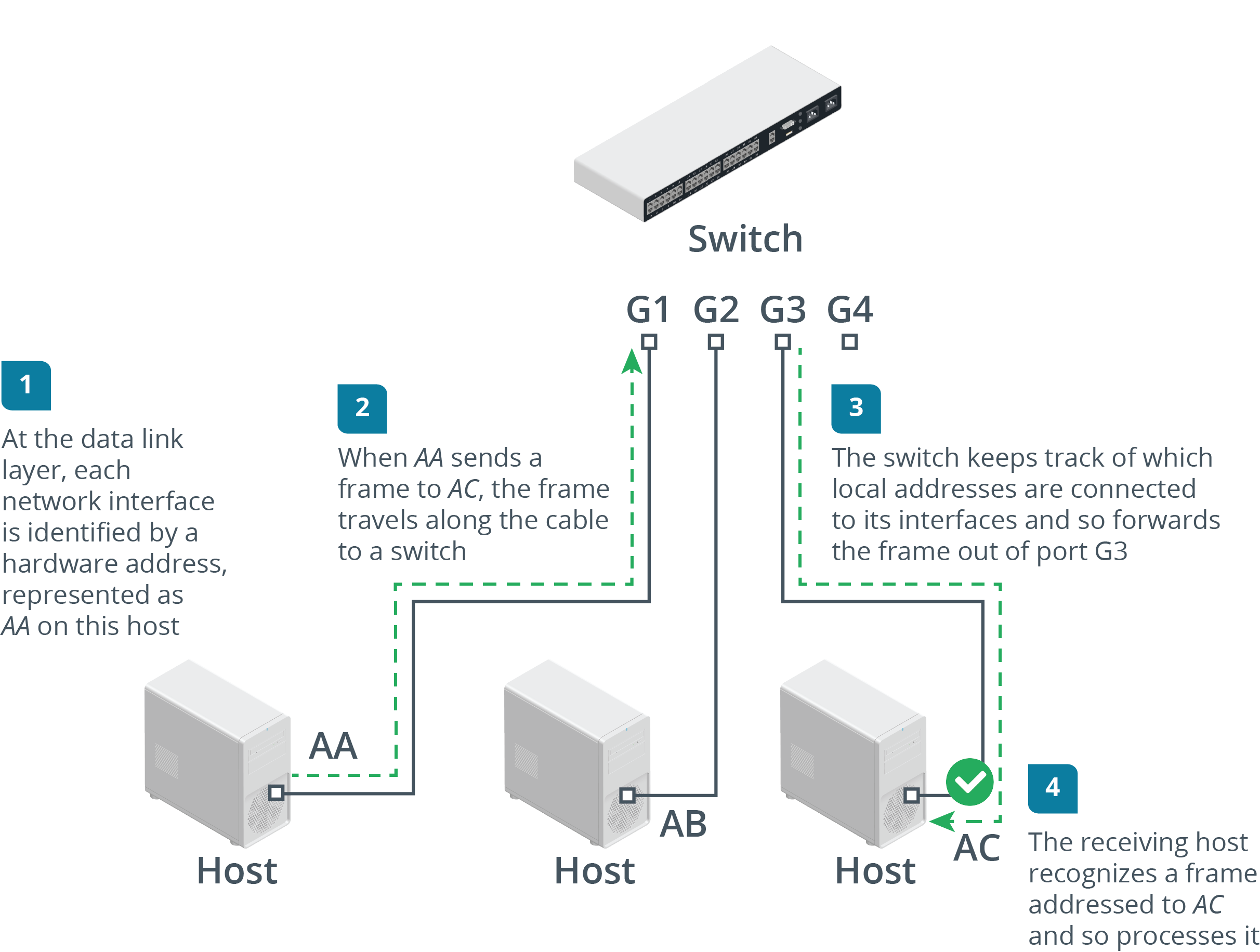
Devices Operating at the Data Link Layer
- Network Adapter or Network Interface Card (NIC) — A NIC joins an end system host to a network
- Bridge — is a type of intermediate system that joins physical network segments while minimizing the performance reduction of having more nodes on the same network
- Switch — An advanced type of bridge with many ports
- creates links between large numbers of nodes more efficiently
- Wireless Access Point (WAP) — allows nodes with wireless network cards to communicate and creates a bridge between wireless networks and wired ones