Network Interface Card (NIC)
Ethernet communications are established by either electrical signaling over copper twisted pair cable or pulses of light transmitted over fiber optic cable.
- The transceiver component is responsible for physically connecting a host to the transmission medium (cable).
- implemented in a network interface card/controller (NIC)
- aka network adapter
- implemented in a network interface card/controller (NIC)
- Most computers have a built-in 1000BASE-T Ethernet network adapter as part of the motherboard chipset
- most Ethernet adapters now support Gigabit Ethernet
- 10 GbE and 40 GbE adapters are much more expensive than Gigabit models
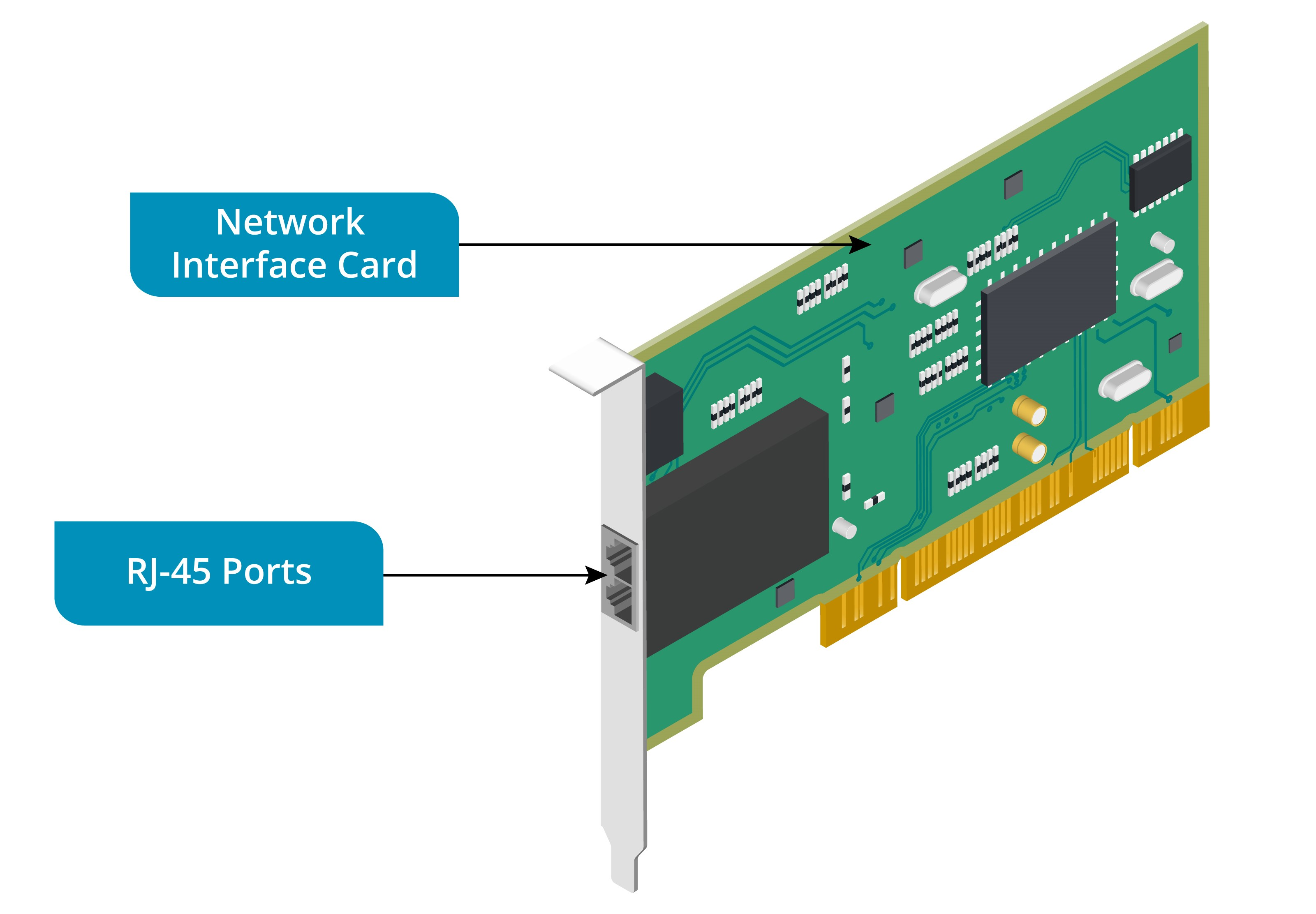
Uses for NIC
- may be occasions when you need to install an add-on NIC:
- need to upgrade an adapter to use a different type of network or cabling/connector
- E.g., copper cable versus fiber optic
- NIC with multiple ports on one card
- allows connections to different networks
- aggregate separate links into a higher bandwidth channel
- Wi-Fi adapter to connect to a wireless network
- developed to different 802.11 standards
- cards that can connect to cellular data networks
- need to upgrade an adapter to use a different type of network or cabling/connector
How it Works
- For the NIC to be able to process the electrical or light signals as digital data
- the signals must be divided into regular units with a consistent format
- must also be a means for each node on the local network to address communications to other nodes
- Ethernet provides a data link protocol to perform these framing and addressing functions
- Each Ethernet network interface port has a unique hardware/physical address, called the Media Access Control (MAC) Address