Multicast and Anycast Addressing
- majority of IPv4 traffic is unicast or broadcast
- others are used in special circumstances
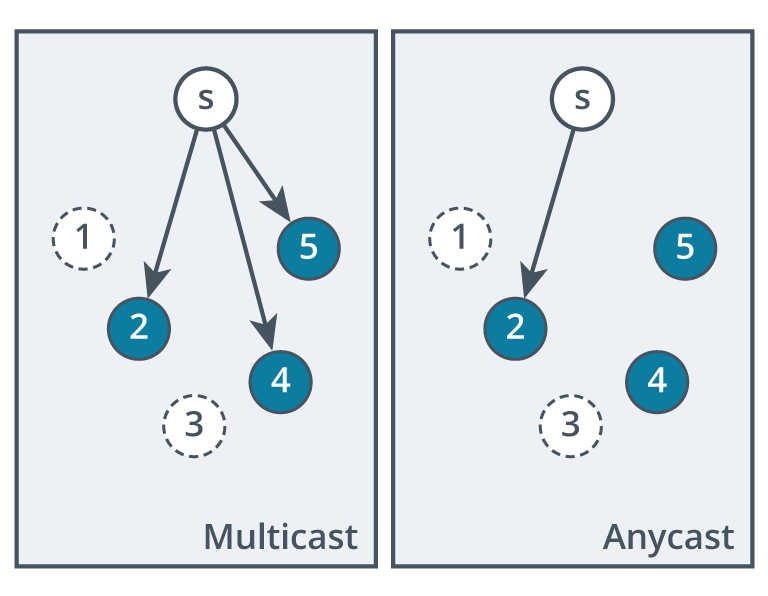
Multicast
IP multicasting allows one host on the Internet (or private IP network) to send content to other hosts that have identified themselves as interested in receiving the originating host’s content.
- multicast packets are sent to a destination IP address from a special range configured for that multicast group
- reserved IPv4 multicast range:
224.0.0.0-239.255.255.255 - intent to receive multicasts from a particular host is signaled by joining a multicast group
- Internet Group Management Protocol (IGMP) is typically used to configure group memberships and IP addresses
- at layer 2, multicasts are delivered using a special MAC address
- comprised of the prefix
01-005E, remainder expressing the multicast group IP in hex notation - to deliver frame only to members of the multicast group:
- switch must be capable of IGMP snooping
- if not, will treat the multicast MAC address like a broadcast and flood the multicast transmissions out of all ports
- switch must be capable of IGMP snooping
- comprised of the prefix
Anycast Addressing
Anycast means that a group of hosts is configured with the same IP address.
- when a router forwards a packet to an anycast group,
- uses a prioritization algorithm and metrics to select the host that is closest
- will receive the packet and be able to process it the most quickly
- allows the service behind the IP address to be provisioned more quickly and reliably
- allows for load balancing and failover between the server and hosts sharing the IP address
- uses a prioritization algorithm and metrics to select the host that is closest
Info
- there is no anycast address range
- hosts participating in an anycast group are configured with the same unicast address
- anycast forwarding is handled by routers
- typically using a dynamic routing protocol
- E.g., Border Gateway Protocol (BGP)