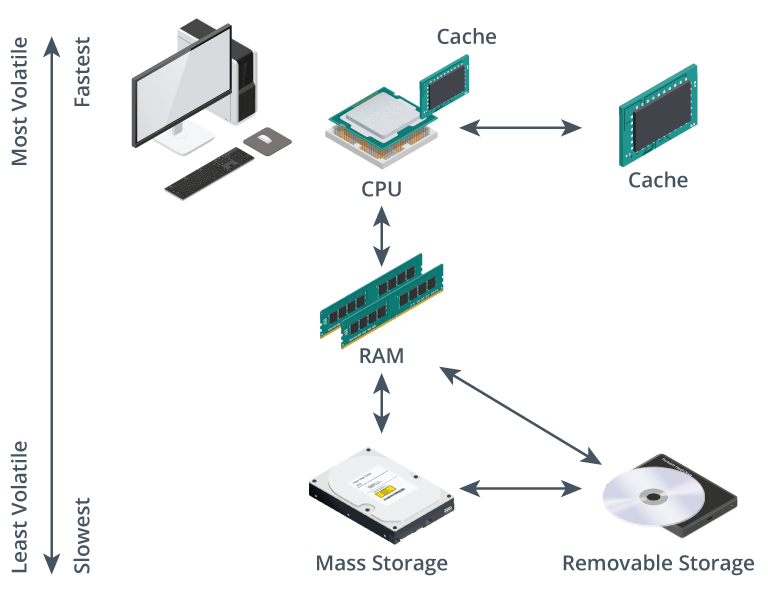
All computer software and data are processed by using the ones and zeroes of binary code
Software works by running instructions in the central processing unit (CPU)
This can be referred to as the compute or processing function of a PC
Instructions and data also require storage
CPU can only store a limited number of instructions internally at any one time
Additional storage for running programs and open data files is provided through system memory (RAM)
random-access memory (RAM) storage technology is nonpersistent
Nonpersistent means that the RAM devices can only hold data when the PC is powered on
Mass storage devices are used to preserve data when the computer is turned off
processing and storage components are connected by bus interfaces implemented on the motherboard
instructions and data are stored using transistors and capacitors
transmitted between components over the bus using electrical signals
The motherboard’s system clock synchronizes the operation of all parts of the PC and provides the basic timing signal for the CPU
Clock speeds are measured in megahertz (MHz) or gigahertz (GHz)
Clock multipliers take the timing signal produced by the generator and apply a multiplication factor to produce different timing signals for different types of buses
means that one type of bus can work at a different speed (or frequency) to another type of bus
The type of motherboard influences system speed and the range of system devices and adapter cards that can be installed or upgraded
Each motherboard is designed to support a particular range of CPUs
PC CPUs are principally manufactured by Intel and Advanced Micro Devices (AMD)