Motherboard Adapter Connectors
Expansion slots accept plug-in adapter cards to extend the range of functions the computer can perform.
- two types of expansion slot interfaces
- Peripheral Component Interconnect Express (PCIe) interface
- Peripheral Component Interconnect (PCI) Interface
Peripheral Component Interconnect Express Interface
The Peripheral Component Interconnect Express (PCIe) bus is the mainstream interface for modern adapter cards.
- uses point-to-point serial communications
- meaning that each component can have a dedicated link to any other component
- Each point-to-point connection is referred to as a link
- Each link can make use of one or more lanes
- The raw transfer rate of each lane depends on the PCIe version supported
- Transfer rates are measured in gigatransfers per second (GT/s)
- Throughput in GB/s is the rate achieved after loss through encoding is accounted for
| Version | GT/s | GB/s for x1 | GB/s for x16 |
|---|---|---|---|
| 2 | 5 | 0.5 | 8 |
| 3 | 8 | 0.985 | 15.754 |
| 4 | 16 | 1.969 | 31.508 |
| 5 | 32 | 3.938 | 63.015 |
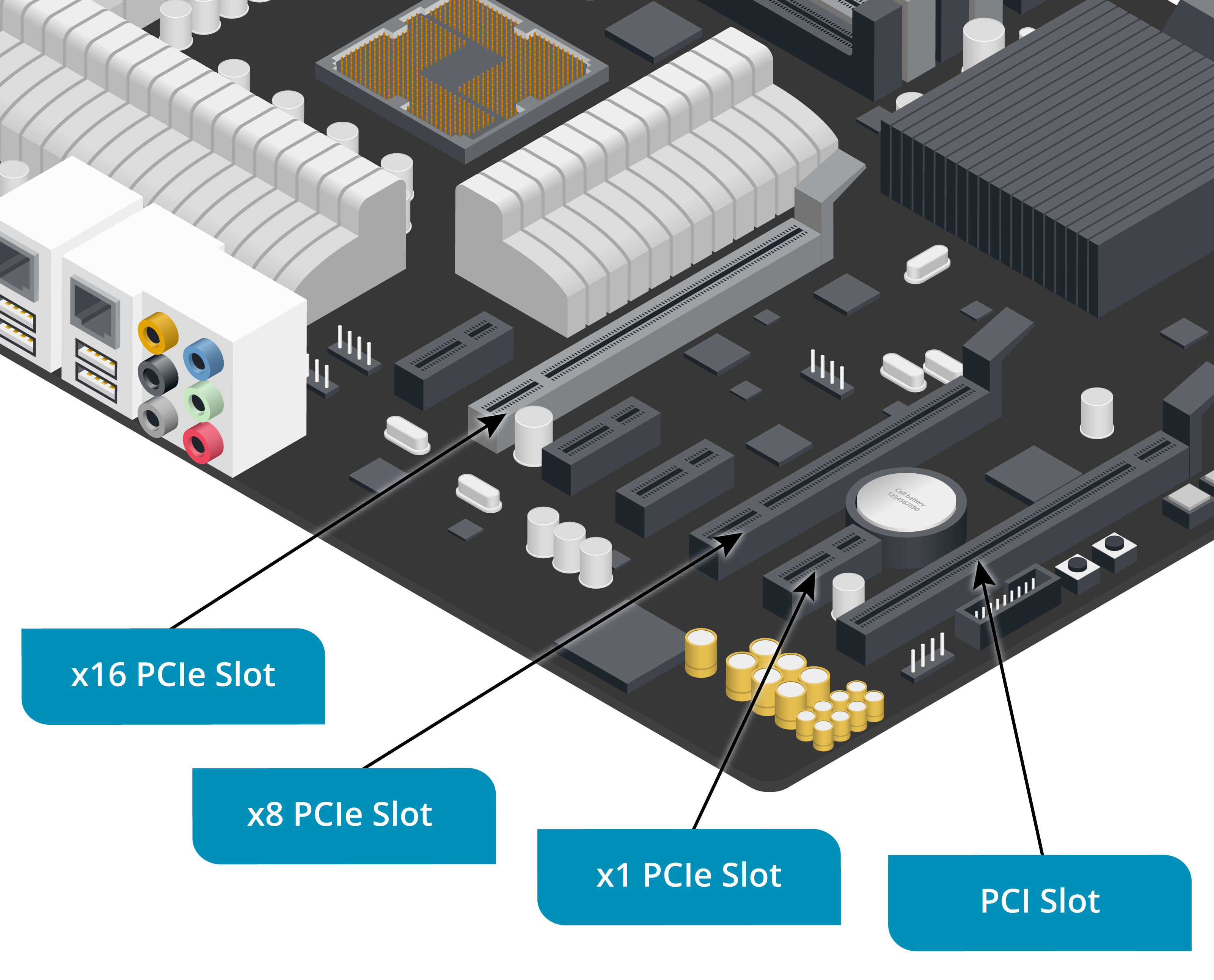
- Adapter slots with more lanes are physically longer
- Each PCIe adapter card supports a specific number of lanes
- typically x1, x4, x8, or x16
- ideally, a card should be plugged into a port that supports the same number of lanes
- if insufficient slots are available, a card will fit in any port with an equal or greater number of lanes
- referred to as up-plugging
- E.g., a x8 card will fit in a x8 or x16 socket
- card should work at x8 but in some circumstances may only work at x1
- possible to fit a longer card into a shorter slot
- referred to as down-plugging
- as the card is not obstructed by other features in the case
- if insufficient slots are available, a card will fit in any port with an equal or greater number of lanes
- All PCIe versions are backwards-compatible
- E.g., can connect a PCIe version 2 adapter to a version 4 motherboard, or install a version 3 adapter into a version 2 motherboard
- bus link works at the speed of the lowest version component
- PCIe can supply up to 75W to a graphics card via a dedicated graphics adapter slot and up to 25W over other slots
- An extra 75W power can be supplied via a PCIe power connector
Info
- A slot may support a lower number of lanes than its physical size suggests
- The number of lanes supported by each slot is indicated by a label on the motherboard
- E.g., a slot that is physically x16 but supports only x8 operation will be labelled x16/x8 or x16 @ x8.
Peripheral Component Interconnect Interface
- Computers can support more than one expansion bus, often to support older technologies
- Peripheral Component Interconnect (PCI) is a legacy bus type
- superseded by PCI Express
- PCIe is software-compatible with PCI
- meaning that PCI ports can be included on a PCIe motherboard to support legacy adapter cards, but PCI cards cannot be fitted into PCIe slots
- PCI uses parallel communications
- Most types of PCI are 32-bit and work at 33.3 MHz
- transfer rate of up to 133 MBps
- (that is, 32 bits divided by 8 to get 4 bytes, then multiplied by the clock rate of 33.3)
- transfer rate of up to 133 MBps
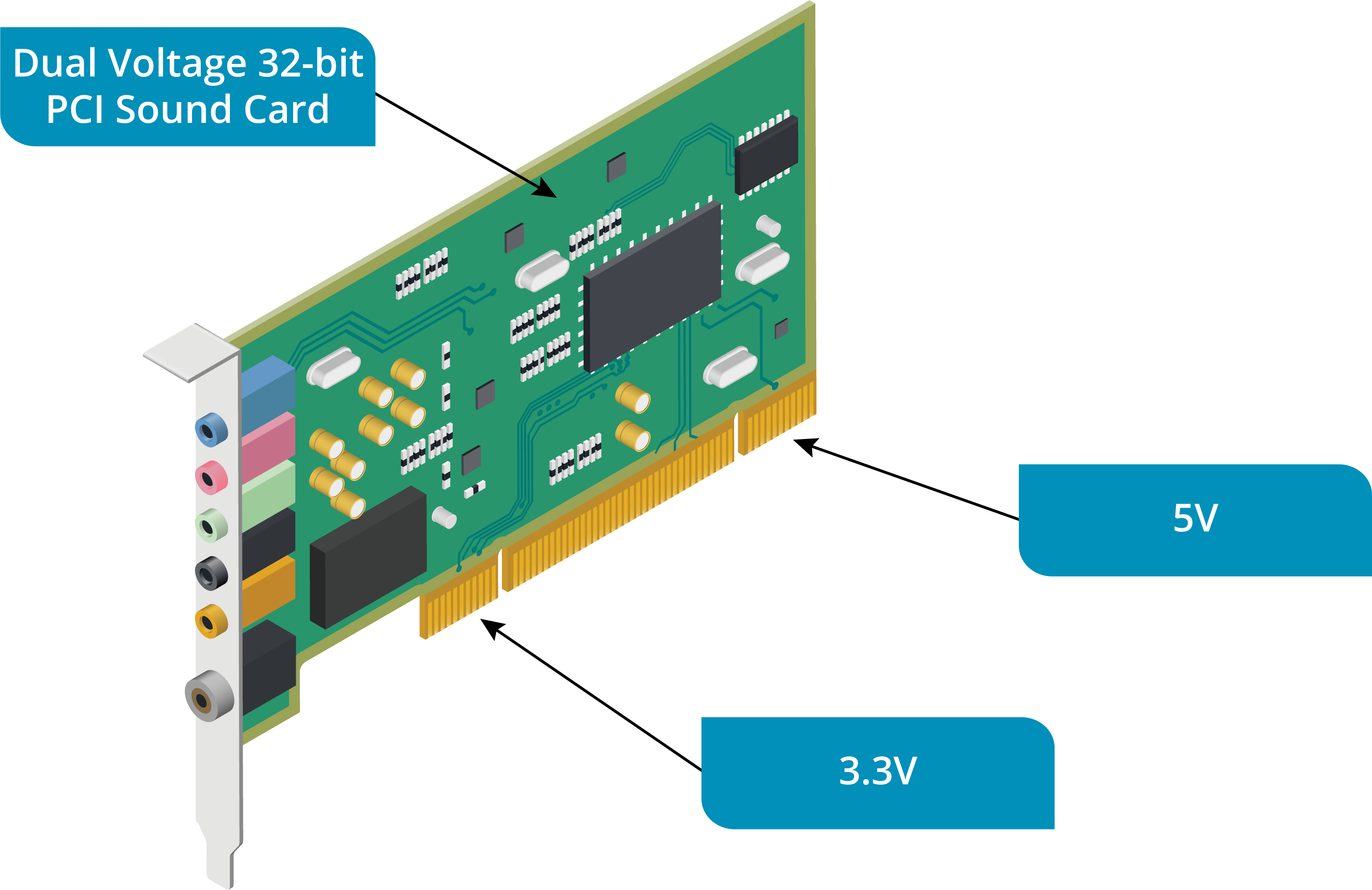
- earliest PCI cards were designed for 5V signaling, but 3.3V and dual-voltage cards became more prevalent
- To prevent an incompatible PCI card from being inserted into a motherboard slot, the keying for the three types of cards is different