Load Balancers
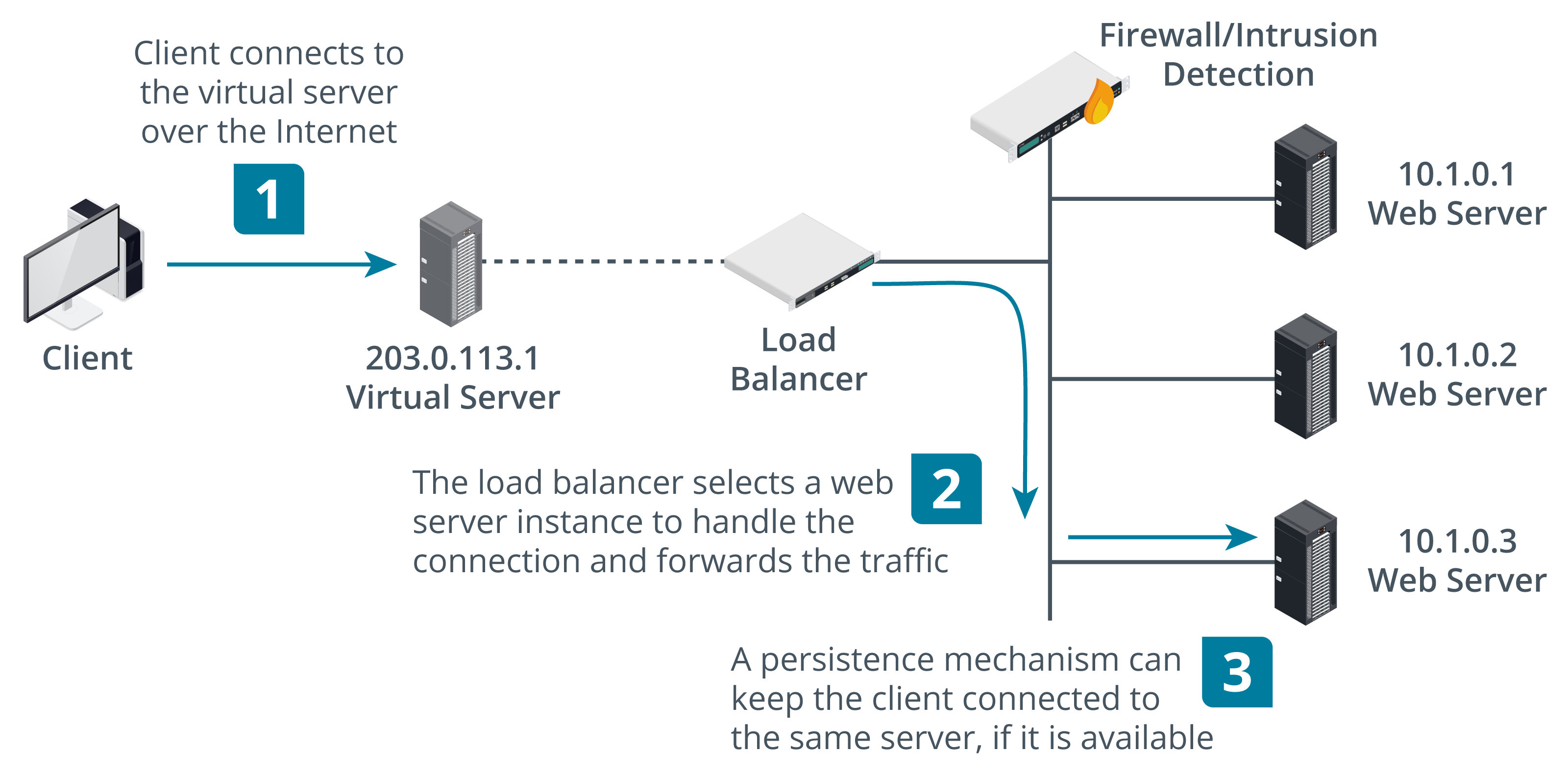
A load balancer can be deployed to distribute client requests across server nodes in a farm or pool.
- NIC teaming allows load balancing at the component level
- can use a load balancer in any situation where you have multiple servers providing the same function
- E.g., web servers, email servers, web conferencing servers, and streaming media servers
- placed in front of the server network
- distributes requests from the client network or Internet to the application servers
- service address is advertised to clients as a virtual server
- used to provision:
- high availability services that can scale from light to heavy loads
- fault tolerant services
- provide mitigation against denial of service attacks
Two Types of Load Balancers
- Layer 4 switch
- basic load balancers make forwarding decisions on IP address and TCP/UDP header values
- works at the Transport layer of OSI model
- Layer 7 switch (content switch)
- makes forwarding decisions based on application-level data
- a request for a particular URL or data types like video or audio streaming
- requires more complex logic
- makes forwarding decisions based on application-level data
Info
- appliances can perform switch-like forwarding at layer 3, 4, and 7
- collectively referred to as multilayer switches
Scheduling
The scheduling algorithm is the code and metrics that determine which node is selected for processing each incoming request.
- simplest type is called round robin
- means picking the next node
- Other methods include
- picking the node with the fewest connections
- or the best response time
- Each method can be weighted using
- administrator-set preferences
- dynamic load information
- or both
- uses some type of heartbeat or health check probe
- to verify whether each node is available and under load or not
- Layer 4 load balancers can only make basic connectivity tests
- layer 7 appliances can test the application’s state and verify host availability
Source IP Affinity and Session Persistence
Source IP or session affinity is a scheduling approach used by load balancers to route traffic to devices that have already established connections with the client in question.
- layer 4 approach to handling user sessions
- when a client establishes a session, it becomes stuck to the node that first accepted the request
- application-layer load balancer uses persistence to keep a client connected to a session
- configuration option that enables a client to maintain a connection with a load-balanced server over the duration of the session
- aka sticky sessions
- works by setting a cookie either on the node or injected by the load balancer
- can be more reliable than source IP affinity
- but requires the browser to accept the cookie