Judicial Branch
- Article III of the Constitution establishes the judicial branch of the federal government
- vests the judicial power of the United States in one supreme court
- highest court in the country
- only court specifically required by the U.S. Constitution
- Congress determines the number of Supreme Court justices
- currently 9
- president nominates justices when there is a vacancy
- nominees typically highly respected state or federal judges or attorneys
- Senate confirms nomination
- Supreme Court justices are appoint for life
- serve until retirement, death, or removal
- can be removed if the are impeached and convicted by congress
- Why life terms?
- original drafters did not want the review of law to be dependent on popular political ideas
- don’t want federal judges fired if decisions were unpopular or not favorable to a political party
Structure of the Federal Judiciary
Jurisdiction
- important to understand how different courts in the federal system relate to one another
- can be applied to state judicial systems
- Courts have the ability to hear only cases (disputes) that are within their jurisdiction
- jurisdiction describes the types of cases that a court has the authority to hear
- 3 main types of jurisdiction:
- Original jurisdiction
- power of a court to hear the initial dispute between parties
- courts conduct trials
- usually trial courts have original jurisdiction
- Concurrent jurisdiction
- jurisdiction that is shared by several different courts
- Appellate jurisdiction
- power of a court to review a decision made by a lower court
- Original jurisdiction
- 3 main types of jurisdiction:
- jurisdiction describes the types of cases that a court has the authority to hear
- federal courts have limited jurisdiction
- can hear only certain types of cases that fall within a limited subject matter
- determined by the Constitution and laws made by Congress
- Can hear only these cases:
- disputes regarding federal laws or constitutional issues
- disputes between residents of different states where the amount of money in controversy is great than $75,000
- cannot hear cases outside its functional or subject matter jurisdiction
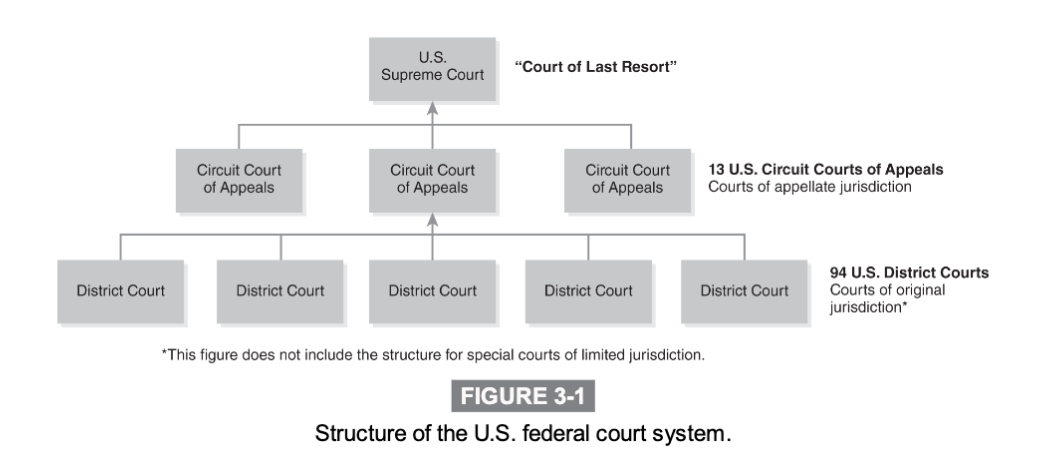
Hierarchy
- Article III also gives Congress the power to make as many lower-level federal courts as needed
- Congress has established:
- district courts
- lowest level courts
- 94 judicial districts in U.S.
- each has at least one judicial district
- some states may be divided into many judicial districts
- each distract may have more than one judge
- # of judges is determined by the number of cases, caseload, in the district
- one judge hears a case at the trial court level
- are the workhorse of the federal judicial system
- serve as courts of original jurisdiction
- may hear disputes between parties or conduct criminal trials for violations of federal law
- each district court has its own bankruptcy court
- Constitution gives federal government the sole power over bankruptcy law
- appellate courts
- intermediate appellate courts are the next level
- called U.S. Courts of Appeals
- 13 Courts of Appeals
- 94 district courts are grouped into 12 geographical circuits
- one Federal Circuit that hears cases from specialized courts
- hears appeals from the district courts in their circuit
- E.g., Seventh Circuit Court of Appeals hears cases from Illinois, Indiana, and Wisconsin, located in Chicago
- Congress determines number of judges in each circuit
- usually hear cases in 3 judge panels
- is a court of appellate jurisdiction
- do not review the facts of a case, nor accepts any additional evidence
- reviews the record of the trial court only for mistakes of law
- court of last resort is the highest level of court in any judicial system
- in federal system, it’s called Supreme Court
- court of appellate jurisdiction
- typically decides cases on appeal from U.S. Court of Appeals
- reviews the decision of the lower court
- no obligation to review a decision
- a party has to ask the Supreme Court to review the case with a petition called a writ of certiorari
- approved by 4/9 justices
- may decide to hear a case if:
- a federal law is unconstitutional
- two or more federal appellate courts have ruled differently on same issue
- has exclusive original jurisdiction to decide cases about disputes between state governments
- exercises concurrent jurisdiction with federal district courts in some cases and original jurisdiction very rarely
- most cases are appeals cases
- has the power to decide cases that involve questions about the federal Constitution and other federal laws
- can review both state and federal laws to ensure they don’t conflict with Constitution
- called judicial review
- final authority on cases heard in the federal court system
- decisions cannot be appealed
- in federal system, it’s called Supreme Court
- called U.S. Courts of Appeals
- intermediate appellate courts are the next level
- specialized courts
- E.g., FISA Court
- district courts
- Congress has established:
Info
An appeal is a formal request for a higher authority to review the decision of a lower court.
- Any party who is unhappy with the judgment received in a district court can appeal to the Court of Appeals for that district
- unhappy party must be able to show that the trial court made a legal error that affected the holding, or decision, in the case