Infrastructure Network Type
- At the Data Link layer, Wi-Fi uses similar framing and MAC addressing concepts to Ethernet
- Each radio has a base MAC address
- assigned by vendor
- e.g., a dual band adapter will have 2 MAC addresses, one for 2.4 and one for 5 GHz
- Each radio has a base MAC address
- each station can join a WLAN through a service set identifier (SSID)
- an be up to 32 bytes in length
- should only use ASCII letters and digits, hyphen, and underscore
- for compatibility
- when attempting to connect, a station:
- probes to establish 802.11 standards support and security configuration
- complete authentication required
- requests to associate with the network
Infrastructure
- most sites use infrastructure network type
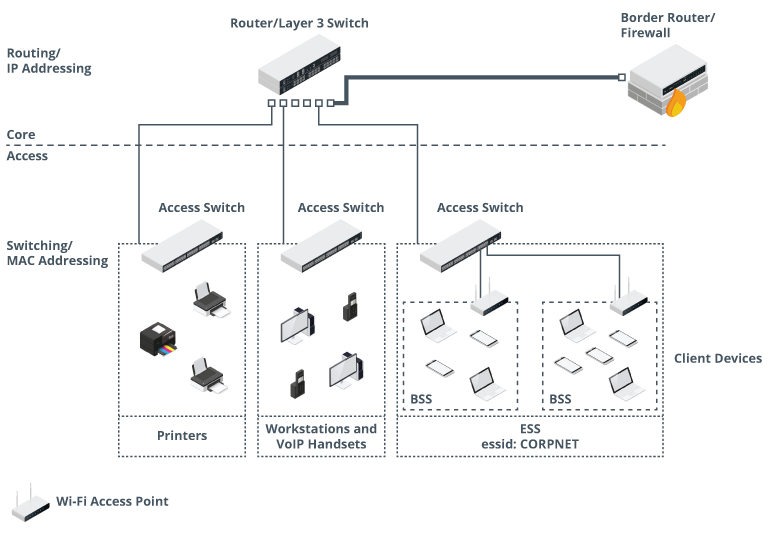
- infrastructure topology means that each station is configured to connect to WLAN via an access point (AP)
- makes a logical star topology
- each client requires a wireless adapter compatible with AP
- AP mediates communications between client devices using a specific frequency and channel
- arrangement referred to as Basic Service Set (BSS) in 802.11 standards
- basic service set identifier (BSSID) is a virtual MAC address derived from one of the AP’s radios
- identifies the access point hosting a BSS
- any given AP could operate multiple BSSs on its 2.4, 5, 6 GHz radios
- could be configured with separate SSIDs or the same
- each network can have different security properties
- e.g., guest network with no authentication
- client will join the BSS with best signal
- basic service set identifier (BSSID) is a virtual MAC address derived from one of the AP’s radios
Wireless Distribution System
- AP can provide a bridge to a cabled network segment
- the cabled network is referred to as a distribution system (DS)
- on enterprise LAN, each AP is cabled to a switch
- can be used to network multiple APs
- AP will not support wireless clients in this mode
- multiple APs connected to same DS can host an Extended Service Set (ESS)
- is a group of basic service sets that are all configured with the same SSID and security information
- each BSS uses a different channel within each frequency band
- when deployed this way, network name is called extended SSID (ESSID)
- has same format as an SSID
- when deployed this way, network name is called extended SSID (ESSID)
Info
- This infrastructure isn’t limited to running a single ESS
- Each ESS could be mapped to a VLAN to segment the traffic as it is carried around the switched network