Identity and Access Management (IAM)
Identity and access management (IAM) is a security process that provides identification, authentication, and authorization mechanisms for users, computers, and other entities to work with organizational assets such as networks, operating systems, and applications.
- aka identity management (IdM), and access management
- helps organizations protect digital assets by ensuring only authorized users can access them
- is about managing user identities, authentication, and access control
4 Main Processes
- Identification
- process by which a user account (and its credentials) is issued to the correct person
- aka enrollment
- creating an account or ID that uniquely represents the user, devices or process on the network
- Authentication
- A method of validating a particular entity’s or individual’s unique credentials
- Proving that a subject is who or what it claims to be when it attempts to access the resource
- authentication factor determines what sort of credential the subject can use
- e.g.,
- people may be authenticated with a password
- computer system could be authenticated using a token (e.g., digital certificate)
- e.g.,
- Authorization
- process of determining what rights and privileges a particular entity has
- determining what rights the subjects should have on each resource and enforcing those rights
- an auth model determines how these rights are granted
- e.g., discretionary model, mandatory model
- Accounting
- tracking authorized usage of a resource or use of rights by a subject by alerting when unauthorized use is detected or attempted
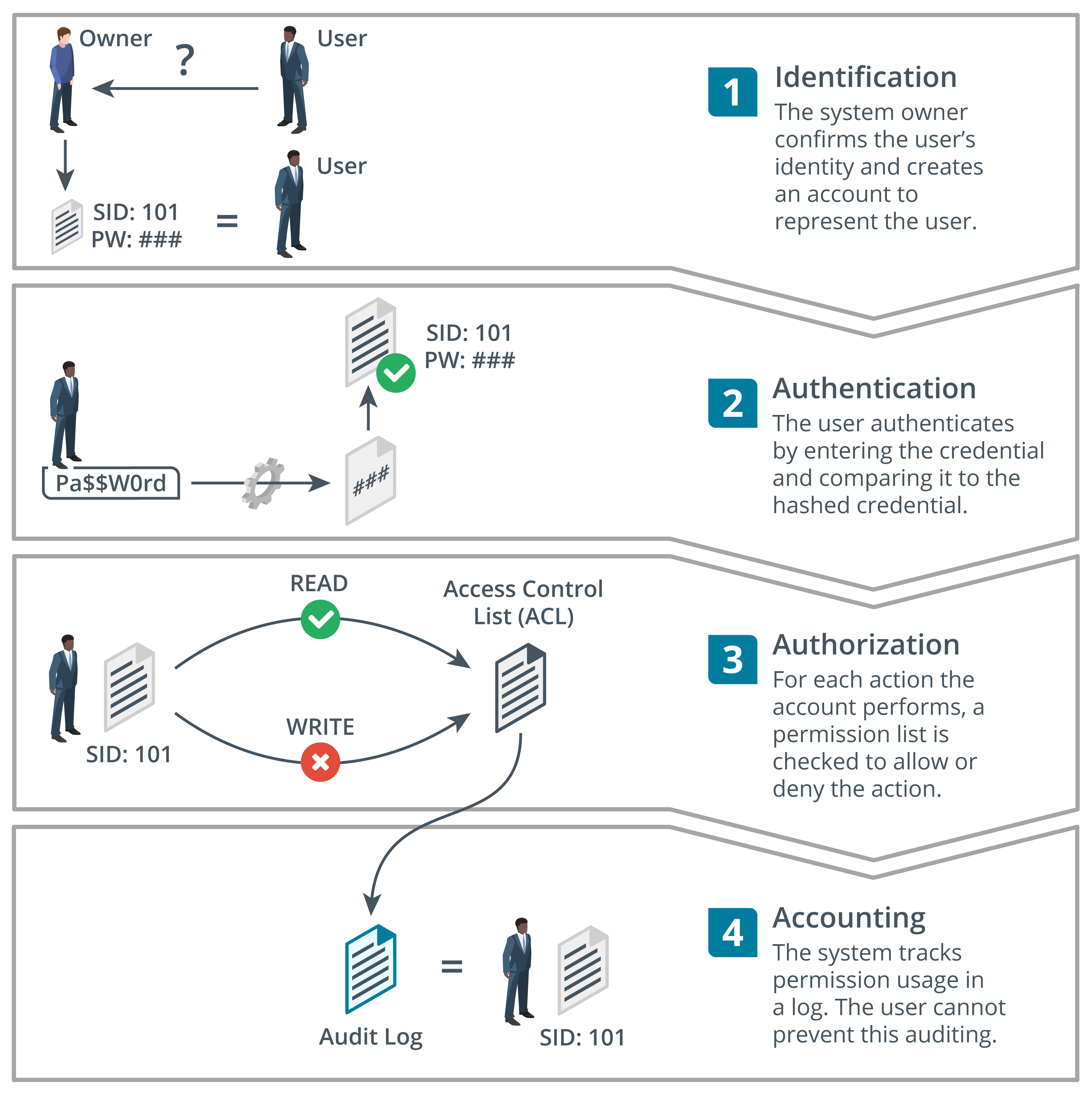
Example
Setting up IAM for an e-commerce site.
- to enroll users, need to select the appropriate controls to perform each function:
- identification
- ensure that customers are legitimate
- e.g., ensure billing and delivery addresses match
- ensure legit payment methods
- authentication
- ensure that customers have unique accounts
- only they can manage their orders and billing info
- authorization
- rules to ensure customers can place orders only when they have valid payment mechanisms in place
- might operate loyalty schemes or promotions
- authorize only certain customer to view unique offers or content
- accounting
- system must record the actions a customer takes
- nonrepudiation
- processes should apply to both people and systems
Identity Management
Identity management is the process whereby individuals are given access to system resources by associating user rights with a given identity.
- provisioning
- subject is issues a unique identity assertion
- user is issued a password for use in authenticating the identity assertion
Access Management
Access management is the process that controls access to resources once they have been granted.
- identifies who a user is and what they’re allowed to access
- Components:
- Authentication
- establishes identity with identity proofing and authentication factor
- Authorization
- evaluates access rights after authentication
- e.g., comparing identity assertion against an ACL
- Policy Management
- serves as the enforcement arm of authentication and authorization
- established based on business needs and management decisions
- Federation
- an association of organizations that facilitate the exchange of information about users and access to resources
- allows resource sharing across multiple organization using identities and authentication established at home organization
- without requiring separate credentials
- Identity Repositories
- directories services for the administration of user accounts and associated attributes
- Authentication