IEEE 802.1X
IEEE 802.1X Port-based network access control (PNAC) is a standard for encapsulating EAP communications over a LAN (EAPoL) or WLAN (EAPoW) to implement port-based authentication.
- aka port-based NAC and enterprise authentication
- allows a switch to require authentication when a host connects to one of its ports
- uses AAA architecture
- supplicant is the device requesting access
- authenticator is the switching device (or network access appliance)
- does not validate authentication requests directly
- acts as conduit for authentication data
- authentication server
- server that holds or can contact a directory of network objects and that can:
- validate authentication requests
- issue authorizations
- and perform accounting of security events
- server that holds or can contact a directory of network objects and that can:
- implemented by two protocols:
- Extensible Authentication Protocol (EAP)
- allows the use of different mechanisms to authenticate against a network directory
- e.g., certificate with MFA
- uses EAP when a device connects to an Ethernet switch port, WAP, or VPN gateway
- allows the use of different mechanisms to authenticate against a network directory
- a AAA protocol, such as Remote Authentication Dial-In User Service (RADIUS)
- allows the authenticator and authentication server to communicate authentication and authorization decisions
- authenticator is a RADIUS client
- authentication server is a RADIUS server
- Extensible Authentication Protocol (EAP)
- configured by selecting WPA2-Enterprise or WPA3-Enterprise as the security method on the access point
How it Works
How it Works - General Workflow
Enterprise authentication uses the following general workflow:
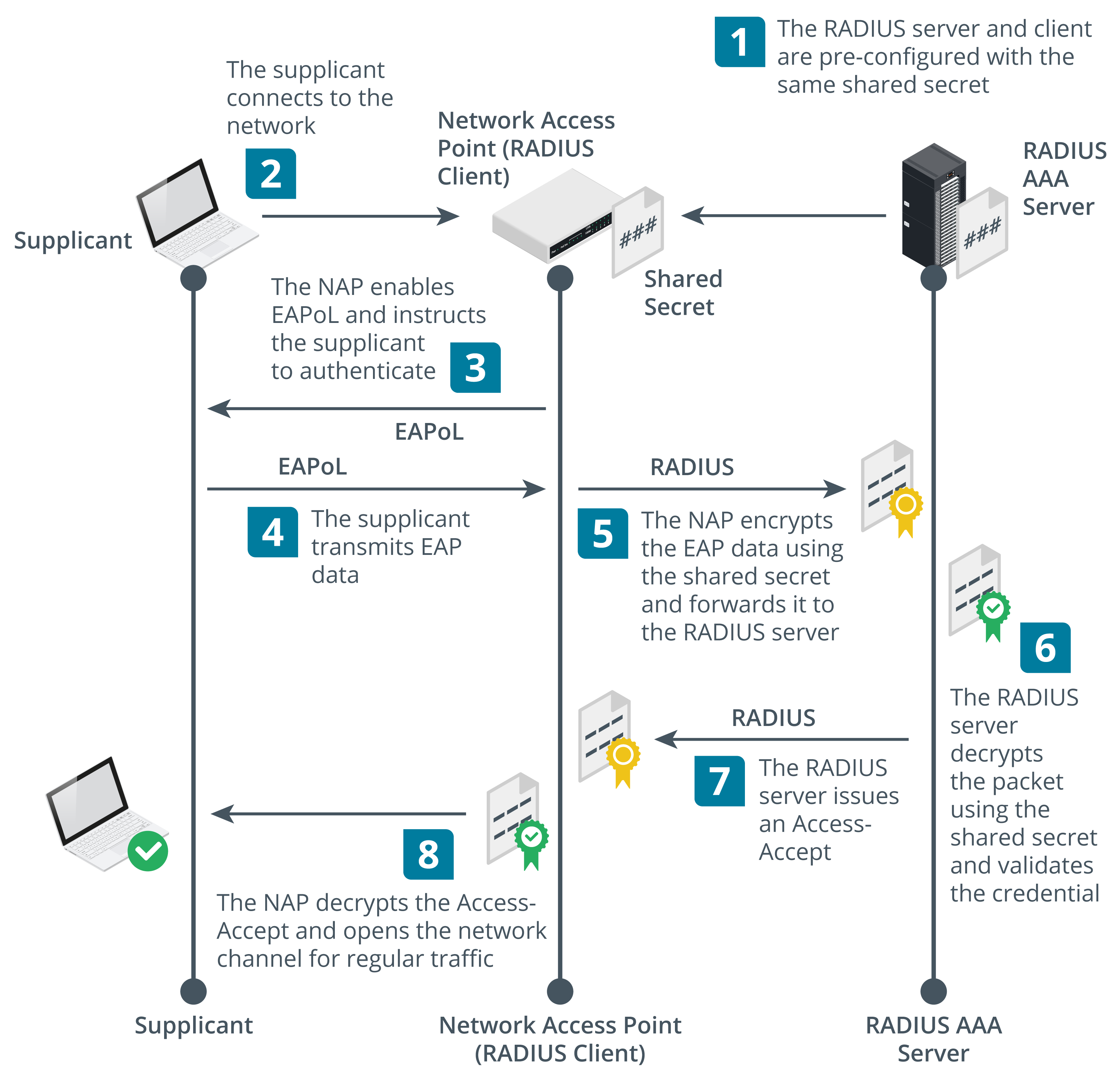
- When a wireless station (a supplicant) requests an association, the AP enables the channel for EAPoW traffic only.
- It passes the credentials submitted by the supplicant to an Authentication, Authorization, and Accounting (AAA) server on the wired network for validation.
- The AAA server (not the access point) determines whether to accept the credential.
- When the user has been authenticated, the AAA server transmits a master key (MK) to the wireless PC or laptop.
- The wireless station and authentication server then derive the same pairwise master key (PMK) from the MK.
- The AAA server transmits the PMK to the access point.
- The wireless station and access point use the PMK to derive session keys, using either the WPA2 4-way handshake or WPA3 SAE methods.
Detailed
- When a host connects to an 802.1X-enabled switch port
- switch opens the port for the EAP over LAN (EAPoL) protocol only
- only allows full data access once the host is authenticated
- switch receives an EAP packet with the supplicant’s credentials
- are encrypted and cannot be read by the switch
- switch uses the RADIUS protocol to send the EAP packet to the authentication server
- authentication server can access the directory of user accounts and can validate the credential
- If authentication is successful,
- it informs the switch that full network access can be granted
- switch opens the port for the EAP over LAN (EAPoL) protocol only
RADIUS
- if the AAA protocol is RADIUS
- switch is configured as a RADIUS client by
- specifying the IP address or host name of the RADIUS server
- setting a shared secret
- RADIUS server
- is positioned in a secure zone within the private network
- stores or obtains account details
- can validate authentication credentials
- switch does not have to store auth credentials
- switch forwards auth data between the server and supplicant device
- uses the shared secret to validate RADIUS clients
- switch is configured as a RADIUS client by