IEEE 802.11 Wireless Standards
IEEE 802.11 standards are standards for wireless networking based on spread spectrum radio transmission in the 2.4 GHz and 5 GHz bands.
- aka Wi-Fi
- define the Physical layer media by which data is encoded into a radio carrier signal using a modulation scheme
- properties of radio waves include:
- amplitude
- the height of peaks and troughs
- frequency
- the number of peaks per unit of time
- phase
- the angle of a wave at a point in time
- amplitude
- Modulation changes one or more of those properties to encode a signal
- properties of radio waves include:
- use different carrier methods to provide sufficient resistance to interference from noise and other radio sources
- Wi-Fi Alliance certifies products conforming to Wi-Fi standards
CSMA/CA
- a wireless radio transmitting and receiving within a particular range of frequencies with the same modulation scheme is a half-duplex shared access medium (a physical bus)
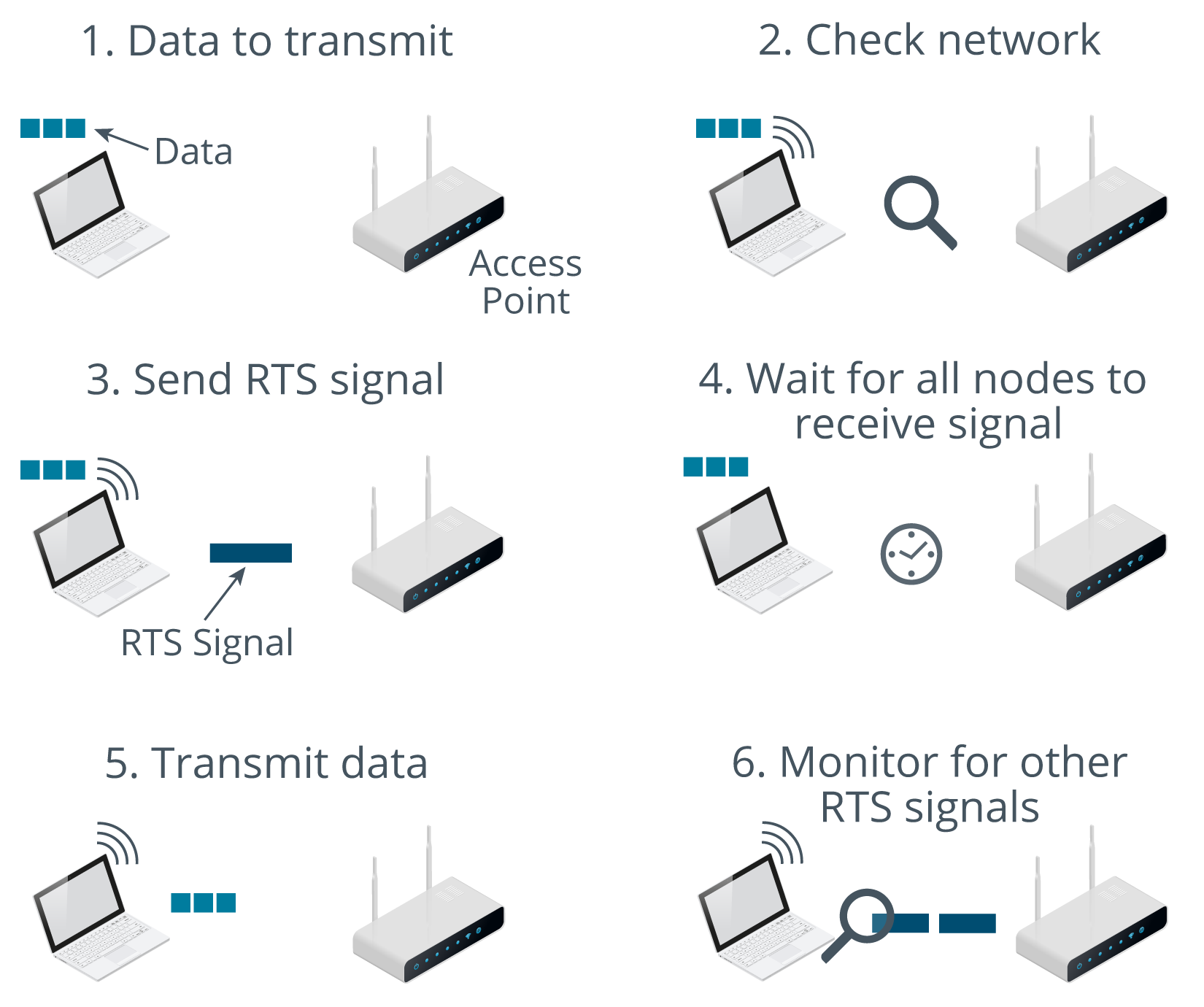
- 802.11 uses carrier sense multiple access with collision avoidance (CSMA/CA)
- to cope with contention
- under CSMA/CA,
- when a station receives a frame, it performs error checking
- If the frame is intact, the station responds with an acknowledgment (ACK)
- If the ACK is not received, the transmitting station resends the frame until timing out
- 802.11 also defines a virtual carrier sense flow control mechanism
- to further reduce the incidence of collisions
- A station broadcasts a request to send (RTS) with
- the source and destination
- the time required to transmit
- receiving station responds with a clear to send (CTS)
- all other stations in range do not attempt to transmit within that period
Implementation
- Wi-Fi typically uses logical star topology to establish a wireless local area network (WLAN)
- access point (AP) mediates connections between client device radios (stations)
Frequency Bands
Two main frequency bands used by the IEEE 802.11 standards:
-
2.4 GHz standard
- better at propagating through solid surfaces, giving it the longest signal range
- does not support a high number of individual channels and is often congested, with both other Wi-Fi networks and other types of wireless technology, such as Bluetooth
- microwave ovens work at frequencies in the 2.4 GHz band
- increased risk of interference
- the maximum achievable data rates are typically lower than with 5 GHz
-
5 GHz standard
- less effective at penetrating solid surfaces
- does not support the maximum ranges achieved with 2.4 GHz standards
- supports more individual channels
- suffers less from congestion and interference
- supports higher data rates at shorter ranges
- less effective at penetrating solid surfaces
-
nominal indoor range for Wi-Fi is 45 m (150 feet) over 2.4 GHz
- 30 m (100 feet) over 5 GHz
-
clients are only likely to connect at full speed from a third to a half of those distances
- Depending on the wireless standard used, building features that may block the signal, and interference from other radio sources