Hybrid Network Topology
- network topology establishes how nodes are physically and logically connected
- basic topologies:
- point to point
- star
- mesh
- basic topologies:
- basic topologies do not always support network requirements
A hybrid topology is anything that uses a mixture of point-to-point, star, and mesh physical and/or logical topologies.
- often used to:
- implement redundancy and fault tolerance
- connect sites in WANs and in enterprise campus networks
Types
- Hierarchical star
- corporate networks are often designed in a hierarchy
- known as tree topology
- can be combined with a star topology to implement each node in the overall tree
- links between nodes in the tree are referred to as backbones or trunks
- because they aggregate and distribute traffic from multiple different areas of the network
- corporate networks are often designed in a hierarchy
- Hierarchical star-mesh
- nodes at the top of the hierarchy can be configured in a partial or full mesh for redundancy
- switches or routers lower in the hierarchy establish star topologies that connect end systems to the network
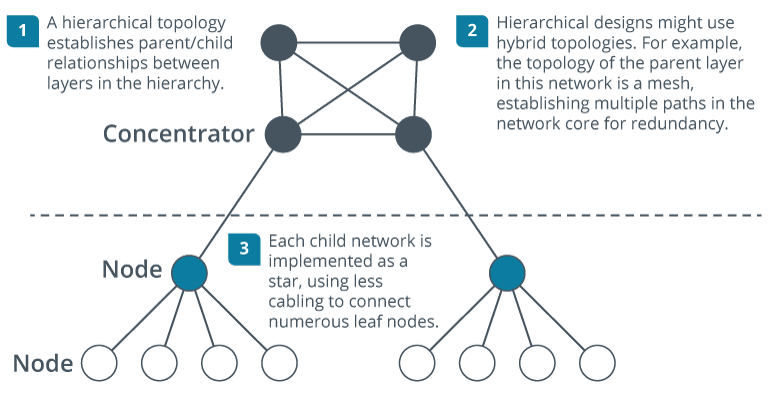
- star of stars
- a WAN might be configured as a hub and spoke between a central office and branch offices
- each site implementing a star topology to connect to end systems
- referred to as as snowflake topology