Hubs
A hub is a legacy network hardware device that acts like a multiport repeater so that every port receives transmissions sent from any other port.
- aka repeater
- used to implement the 10BASE-T and 100BASE-T Ethernet cabling designs
- design is referred to as a star topology because each end system is cabled to a concentrator (the hub)
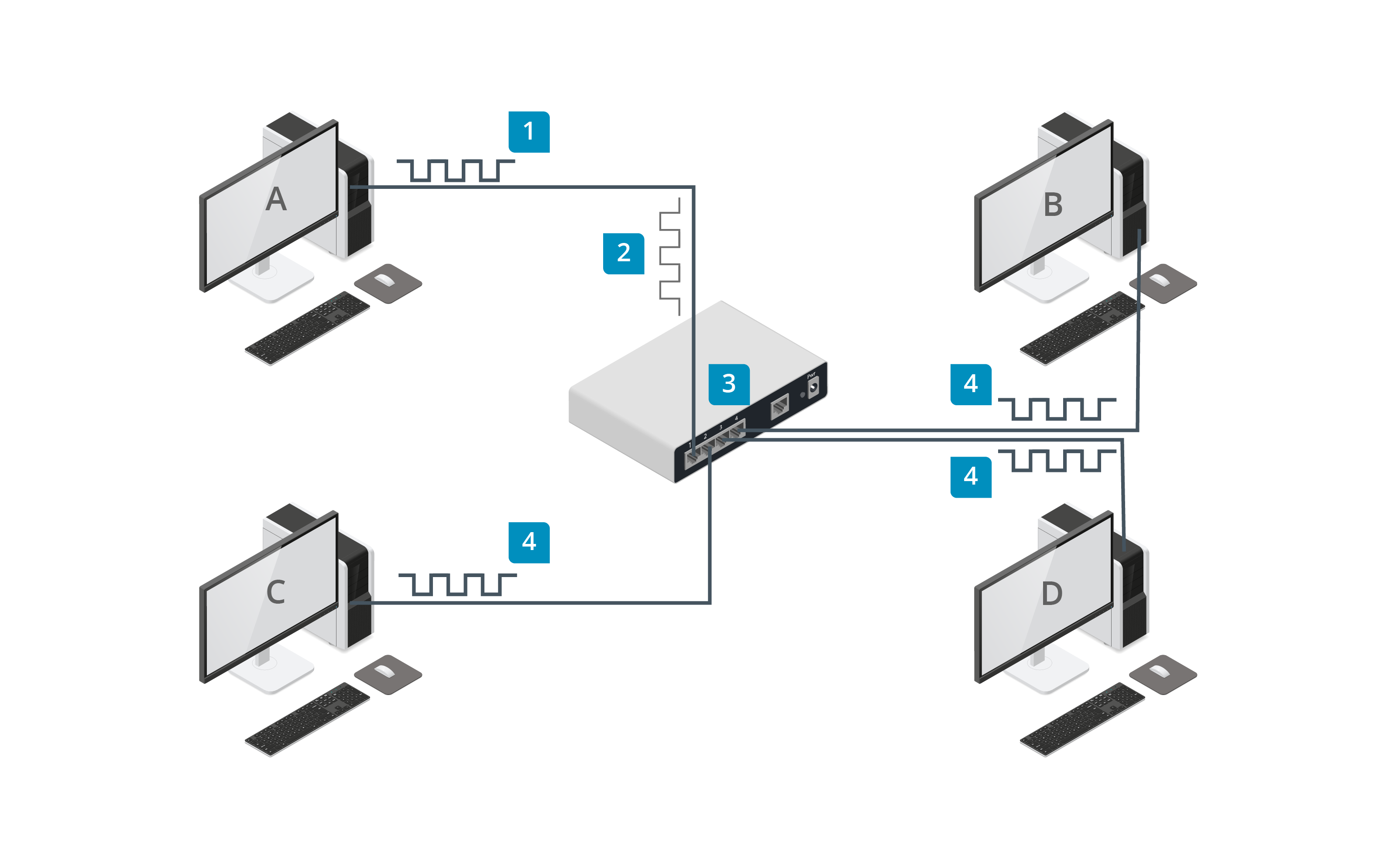
How it Works
- works at the physical layer
- hub typically has between 4-48 ports
- each computer is cabled to one port
- The circuitry in the hub repeats an incoming transmission from a computer attached to one port across all the other ports
- electrically, network segments looks like a single length of cable
- Each computer attached to a hub receives all the traffic sent by other connected devices
- referred to as a collision domain
- every hub port is part of the same shared media access area and same collision domain
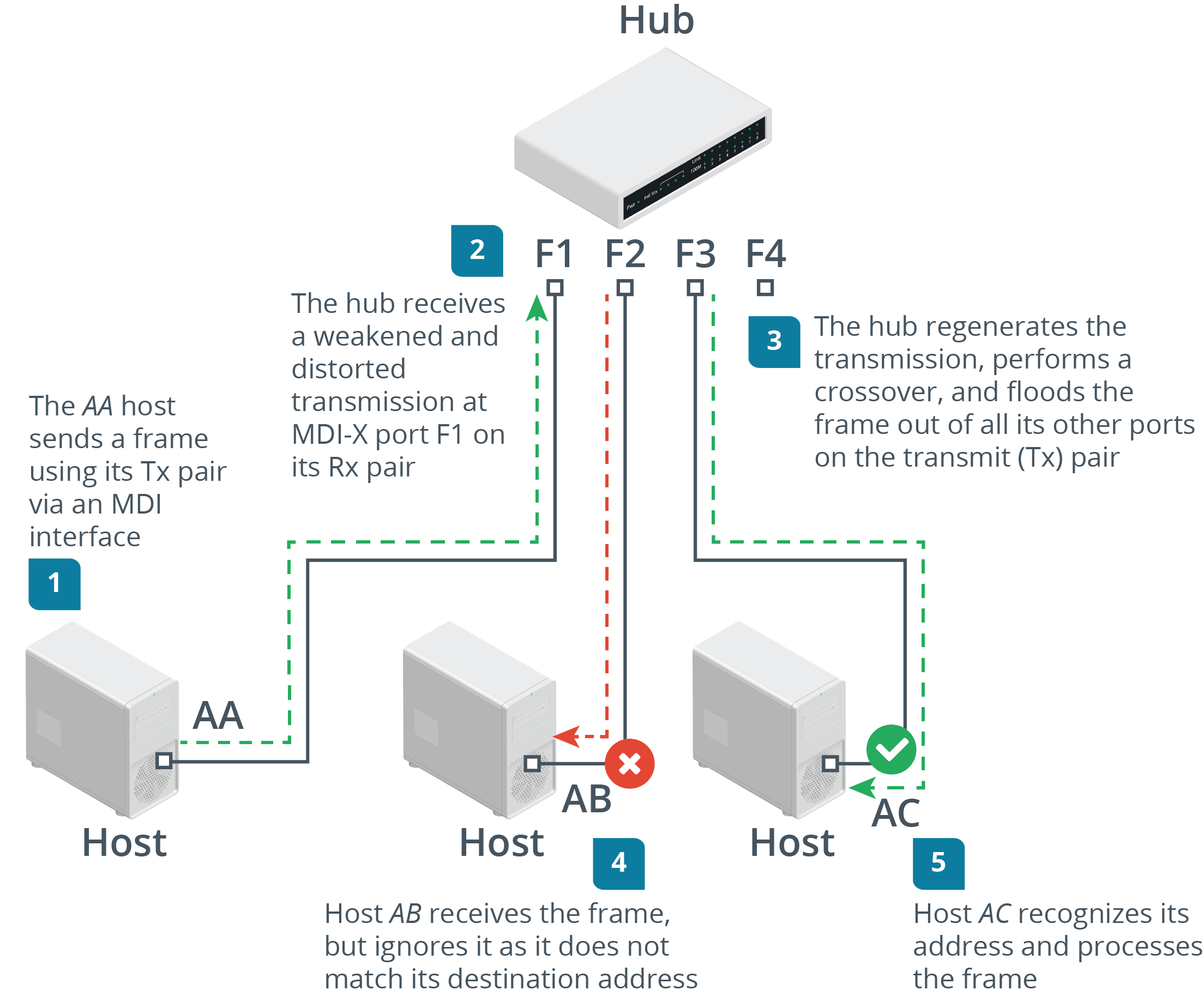
- Each computer will ignore any frames that do not match its MAC address
- However, when lots of computers are in the same collision domain, performance is reduced
- as only one computer can send a frame at any one time
- If two computers try to send at the same time, there is a collision, and they must wait for a random period before trying again
- The more computers there are, the more collisions
Weaknesses
- all node interfaces are half-duplex
- means that the computer can send or receive, but not at the same time
- use CSMA/CD protocol
- media bandwidth is shared between all nodes
- 10 Mbps or 100 Mbps
- no hubs are compatible with Gigabit Ethernet
- These limitations mean that almost all networks are now based on Ethernet switching
- only likely to encounter a hub being used in very specific circumstances, such as where legacy equipment must be kept in service
Security Weakness of Hubs
- a broadcast transmission is sent to all hosts in the same logical network area
- accomplished by using the broadcast MAC address (
ff:ff:ff:ff:ff:ff)- a unicast transmission is addressed to a single host only
- uses host’s MAC address
- with hubs, all interfaces receive all unicast and broadcast transmissions
- hosts are typically configured to ignore unicast transmissions not addressed to them
- setting an interface to promiscuous mode allows a host to capture (sniff) all unicast transmissions
MDI and MDIX
- when Ethernet is wired to a hub, need to distinguish the interface on an end system from the intermediate system (hub)
- end system interface is called medium dependent interface (MDI)
- hub interface is called MDI crossover (MDIX)
- means that transmit (Tx) wires on the host connect to the receive (Rx) wires on the hub
- are no configuration options for a hub
- just connect and power