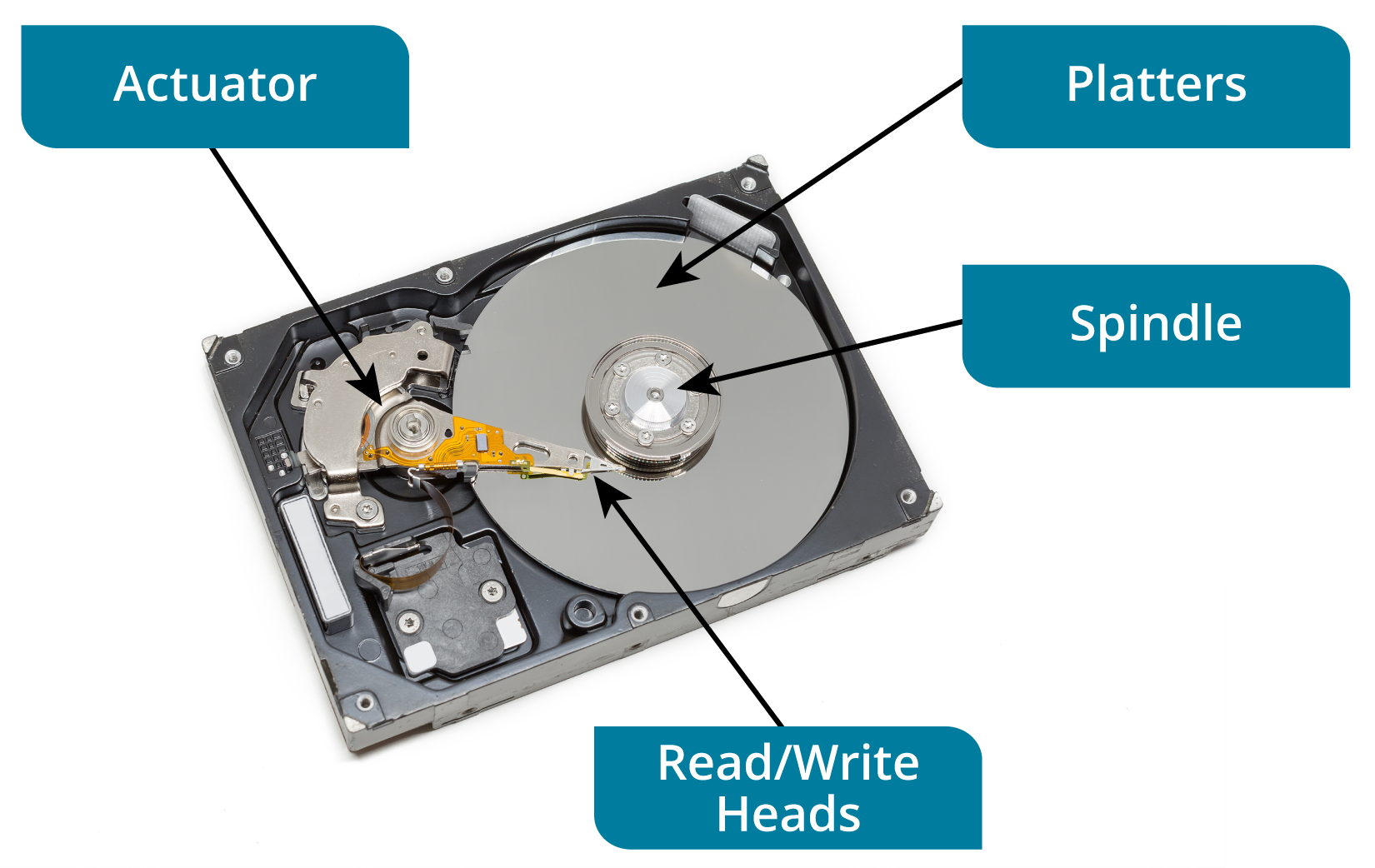
Hard Disk Drives (HDD)
A hard disk drive (HDD) stores data on metal or glass platters that are coated with a magnetic substance.
- top and bottom of each platter is accessed by its own read/write head, moved by an actuator mechanism
- The platters are mounted on a spindle and spun at high speed
- Each side of each platter is divided into circular tracks
- a track contains several sectors
- each with a capacity of 512 bytes
- This low-level formatting is also referred to as the drive geometry
- means that the performance of an HDD is determined by the speed at which the disks spin
- measured in revolutions per minute (RPM)
- High performance drives are rated at 15,000 or 10,000 rpm
- average performance is 7,200 or 5,400 rpm
- RPM is one factor determining access time
- a multi-metric timeframe that includes both access and seek time
- access time is the delay as the read/write head locates a particular track position
- seek time is the time it takes to move from one point to the point in which the data resides
- measured in milliseconds
- encompasses the total time for a computer to read/write required data
- high-performance drive will have an access time below 3 ms
- typical drive might have an access time of around 6 ms
- a multi-metric timeframe that includes both access and seek time
- internal transfer rate (or data or disk transfer rate) of a drive is a measure of how fast read/write operations are performed on the disk platters
- 15 K drive should support an internal transfer rate of up to about 180 MBps
- 7.2 K drives will be around 110 MBps.
- Most HDDs use a SATA interface
- some legacy devices use EIDE/PATA or SCSI interfaces
- two main form factors for HDDs
- mainstream type used in desktop PCs are 3.5-inch units
- 2.5 -inch form factor is used for laptops and as portable external drives
- vary in height, with 15 mm, 9.5 mm, 7 mm, and 5 mm form factors