Functions of a SOHO Router
Small office/home office (SOHO) is a category of LAN with a small number of computing hosts that typically rely on a single integrated appliance for local and Internet connectivity.
- powered by SOHO router
- primary function is to forward traffic between LAN and WAN
- can use the OSI model to analyze each of the functions of a SOHO router
Physical Layer Functions
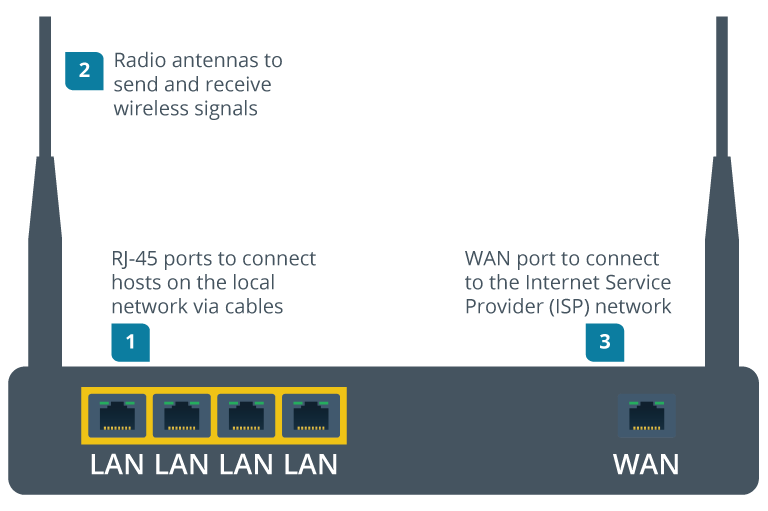
- At physical layer, the SOHO router provides the following interfaces:
- RJ45 ports (usually 4)
- for local cabled network
- typically labeled as LAN ports
- Radio antennae
- transmit and receive wireless signals
- type of modem
- connect to the ISP’s network
- typically labeled as WAN port
- RJ45 ports (usually 4)
Data Link Layer Functions
- Layer 2 functions:
- Ethernet switch
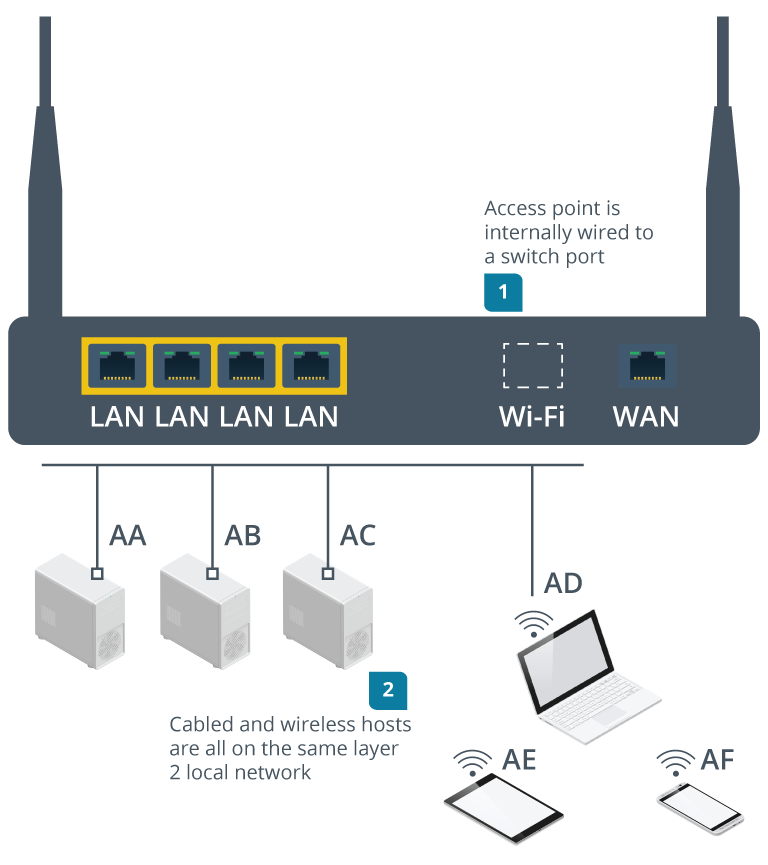
- RJ45 jacks connected internally by an Ethernet switch
- Wireless access point
- radio antennae implements a version of Wi-Fi standard
- access point functions as a wireless hub
- access point is wired to the Ethernet switch via internal port
- forms a bridge between cabled and wireless segments, creating a single logical Data Link network
- Ethernet switch
- each host interface is identified by a media access control (MAC) address
Network Layer Functions
- SOHO router makes forwarding decisions between private local network and public internet
- zones are distinguished by IP addresses
- local network uses private address range
- router runs a DHCP server to allocate a unique address to each host
- router’s WAN interface is allocated a public IP address by the ISP
Transport and Application Layer and Security Functions
- network security is a matter of allowing or preventing devices, users, and services from using the network
- WAN interface is the network perimeter
- SOHO router can implement a firewall with filtering rules
- At transport layer, each application is identified by a port number
- firewall can specify rules for each port