Fixed Income
Fixed Income Introduction
Bond Market
- Fixed income is another word for the bond market
- Bonds play the crucial role of setting the price of borrowing and lending to governments, businesses, and consumers
- Bond prices, bond yields, inflation, and credit worthiness are foundational to the setting of interest rates
5 Topics Covered
1. How the bond market came to be
2. Bond valuation drivers
3. The role of central bankers in setting interest rates
4. The yield curve and why it matters
5. Movements in the yield curve
What you will learn
- Use of bonds to finance governments
- Biggest market in the world
- Use of yields to compare bonds
- Explore how government bond yields are yardsticks by which all other investments are measured
- Keeping governments accountable
- How interest rate decisions are made
- Inputs to bond valuation
- How the yield curve affects everything
- Interpret the meaning of the 4 major shifts in the yield curve
Roots of The Bond Market
- Bonds are, effectively, tradable I Owe You notes
- Fixed income market is the biggest market in the world
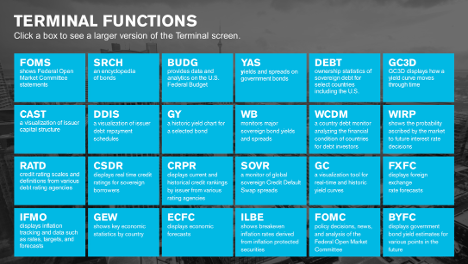
- Fixed Income (SRCH) function is the encyclopedia of bonds
- US Bond Market holds a 1/5 of the worlds bonds, which is one of the reasons for the USD’s centricity in currencies
Budgets
- Type Budget (BUDG) for an overview of US gov. tax receipts and outlays
- Outlays = US gov. spending
- Receipts = US gov. income from taxes
- When Outlay line is above Receipts, this means the government is spending beyond its means and needs to borrow money
- this represents a budget deficit
Type ‘Treasury Securities’ in the command line to call up government debt (TSECTOTL Index)
- Total amount of government debt according to the Federal Reserve
Type ‘Sovereign Debt Owners’ (DEBT) into command line to see the owners of the US gov. debt securities
- Foreign countries consider US bond market as safest of financial investments
- They park their FX reserves in the bond market
VIX Volatility Index
- Shows US gov. 10 year bond yields and fear gauge
- Known as the worlds fear gauge
- When VIX is high, investors are scared
- When low, investors are complacent
- Bond prices move inversely to bond yields
Corporate Bonds
- Why do companies borrow in the bond market?
- In almost all countries, a discrepancy in tax treatments means that debt repayments lower companies’ tax bill by reducing pretax profits through interest payments
- Companies can borrow money for longer terms from the bond market than from banks, which are not typically keen on making long term loans to corporations
Structure of a Bond
- Effectively an I.O.U note which promises to make regular fixed amount payments called coupons and a large payment at the end of the loan called the principle
Yields
- APR = Yield
- Generally, the lower the price of a bond, the higher the APR
- A smaller upfront sum results in greater fixed amount repayments down the road
- High Yields = happy lenders, sad borrowers
- Borrowers have to promise to pay back relatively more to secure a loan
- Lenders are happy as they get relatively more repayments for their planned loans
- Low Yields = sad lenders, happy borrowers
Summary
- Fixed Income is another word for the bond market, where loan agreements are bought and sold
- Fixed income stems from the fixed nature of bond repayments
- The growth of governments (increased spending) has been the main factor giving rise to the $110T world bond market
- Investors view US government bonds as the safest and most liquid financial asset in the world
- There are millions of bonds outstanding and investors use yields to compare one bond to another
Bond Valuation
- Yields facilitate bond valuation
How Are Bond Yields Calculated?
- Yield and Spread (YAS) can tell you interest (APR) on a bond
- Bond yield is just the interest rate on an equivalent bank account for the duration of the bond
Bond Valuation Drivers
- Credit Risk
- Credit risk factors:
- Debt/GDP
- Deficit/GDP
- Repayment schedule
- Credit risk indicators
- Credit ratings
- Credit Default swaps
- Credit risk factors:
- Macroeconomics
- Short-term interest rates
- Inflation
Credit Risk
- As investors doubt the creditworthiness of a borrower, they expect to be paid less in the future, and so the price of a bond decreases
- The calculation of yield assumes all planned cashflows will be made, the yield or return from a lower cash outlay will be higher
- The worse the bond, the lower the price and higher the yield (APR, interest rate)
Credit Risk Factors
- DEBT/GDP Proportion
- When a government borrows or spends, it drives GDP growth
- When the debt comes due, debt repayments inhibit GDP growth
- The greater the debt as a proportion of GDP, the greater the debt repayments, and therefore the greater the drag on the economy
- World Country Debt Monitor (WCDM) shows world countries’ debt
- There is no preordained debt to GDP percentage that will make a gov. bond yields spike
- But, the rule of thumb is, the higher the government’s debt burden in proportion to its GDP, the riskier its bonds
- But there is no general rule, as Japan is one of the most indebted countries, but has one of the lowest gov. bond yields
- They can print more currency
- Deficit/GDP Proportion
- Takes the annual government budget deficit and divides it by the GDP and expresses it as a percentage
- Deficit will result in a negative ratio, surplus: a positive ratio
- The higher the deficit as a percentage of GDP, the higher the rate at which government is racking up new debt
- Over time, this means that the interest payments go up as a proportion of the government budget
- Investors will typically demand a higher yield to compensate for the elevated risk
- Ultimately the bond market can refuse to finance a budget deficit, but again there is no hard and fast rule on the percentage of deficit to GDP ratio
- Repayment Schedule
- This asks whether the investor believes the borrower will have the cash for the repayments when they come due
- Government short term debt is more risky. This is when they have larger repayments and lower yields
- Most Gov. use long term debt repayment plans
- US can use short-term because they can print the world’s reserve currency and have the ability to tax one of the wealthiest economies
Credit Risk Indicators
Credit Ratings
- There are several credit rating agencies that rate bonds, each has their own rating system
- 7.5% of BBB rated bonds have defaulted in 10 years and 94% of CCC or lower rated have defaulted within 10 years
- Therefore it is important that governments have their bonds rated by a trustworthy credit rating company
- Rating agencies also rate corporate bonds
- Bonds with a BBB- rating or above are called investment grade
- BB+ and below are noninvestment grade, speculative, high-yield, or junk
- Type “Credit Rating” (CRPR) to find ratings of company bonds
Credit Default Swaps
- Alternative to monitoring credit ratings
- CDS is a form of insurance against corporations and governments going bust
- CDSs often provide a more timely warning of impending default than credit ratings
- Its because they are real time readings based on traded instruments
- The higher the CDS spread, the higher the risk
- Sovereign CDS (SOVR) shows government CDS
- High CDS spread = low credit worthiness
Macroeconomics
Short-Term Interest Rates
- Utopian government bonds are risk free government bonds
- These bonds have a yield equal to the US gov bond because the US gov bond is the ‘safest’ financial asset (also considered risk-free)
- Utopian gov. bonds will match the US gov bond by lowering or raising the price to change the yield
- The price does not match instantly, it does so because holders of the Utopian gov bond will sell it and buy the US gov bond if the yield is higher, this then causes the Utopian bonds price to lower and its yield to increase
Inflation
- Inflation makes you less willing to pay for a bond because it decreases your future purchasing power for the same amount, even through interest
- Bonds are called nominal, or not real, because you do not adjust bond yields for inflation
- Inflation benefits borrows because the payment stays the same, but their income usually rises to match inflation
- Most Governments are borrowers, so they don’t usually mind a bit of inflation
Summary
- A bond yield is jus the interest rate on an equivalent bank account for the duration of the bond
- The three biggest factors driving bond yields are the creditworthiness of the borrower, inflation, and short-term interest rates
- The bond market instills discipline in governments as declining creditworthiness makes future borrowing more expensive
- Short-term borrowing is cheaper but riskier for borrowers than long term borrowers as it relies ongoing appetite of lenders
- As repayments to bondholders are fixed, inflation will corrode the purchasing power of fixed bond payments, sending yields up
- US government bond yields serve as benchmarks for all investments, yields on other bonds tend to move with them
Central Bankers and Interest Rates
Central Bank Mandates
- Central banks try to find a good balance with inflation
Inflation
- Once inflation takes hold, it is hard to tame
- This is because it is psychological
- Once price increases become engrained, they are hard to unseat
- High inflation erodes the price of bonds and sends yields up
Central Banking Decision-making
- The look at 3 main inflation indicators
- GDP deflator from the quarterly GDP report
- Monthly CPI statistic
- Core personal consumer expenditure
- Treasury Inflationary Protected Securities or TIPS
- TIPS compensate the lender in the event of inflation
- Attempts to decrease the effect of inflation on bonds
- Stabilizes the price and repayments
- Inflation Break Even Rates (ILBE) gleans inflation expectations using the TIPS method
- Small changes in inflation expectations compound and are highly corrosive to bond prices
- The output gap
- The difference in the economy’s potential output and its actual output
- Tightness typically coincides with inflation
- Slackness frequently coincides with deflation
- Output gap % = (actual output - potential output) / potential output
- When actual GDP line is under Potential GDP then there is slack and sign of deflation
- When potential is above actual then the output is tight and there is potential for inflation
Central Bank Tools
Once a Central Bank makes its decision, what tools does it have at its disposal?
- Alter money supply in many ways
- Adjusting short-term interest rates
- Making statements about public policy
- Short-term Interest Rates
- When interest rates go up, it becomes more attractive to deposit cash → dissuades consumption and investment
- Rate hikes slow growth and contain inflation
- FOMC function shows when government meets to set interest rates
- Statements
- Anything stated about the future action of changing interest rates will change bond yields
Summary
- Most central banks have a mandate to prevent runaway inflation and deflation
- As inflation is corrosive to bonds, fixed-income investors watch hawkishly for any signs of inflation
- Central banks closely monitor inflation expectations and the output gap when making rate decisions
- Central banks contain inflation and deflation by directly changing interest rates or by altering interest rate expectations
- Over the past few decades, short-term interest rates have been the tool of choice to steer economies
The Yield Curve and Why it Matters
The Yield Curve is a physical representation of the cost of borrowing.
- The x-axis showcases bonds of different times to maturity (1 year, 5, 10 year bonds)
- The y-axis shows the rate an investor would receive each year at the bonds time-to-maturity
- Yield curve is positively sloped with shorter term bonds with smaller yields than longer term bonds
- The difference between the yield of longer and shorter term bonds is called the Term Premium
Corporate Impact of Yield Curve
- Most corporate projects are multi-year, and so borrow money to match the length of the project
- Lenders to companies face risk of rising short-term interest rates and rising inflation, which decrease the price of the bond, but also face the additional probability of a company going bust
- So corporations have to pay more for borrowing money than a gov
- Spread measures how much more a business pays to borrow money than a government does
- Yield curve regulates economic growth through the cost of borrowing
- When companies borrow more for projects, this leads to GDP growth
Consumer Impact of Yield Curve
- Government bond yields influence the affordability of homes (30 year mortgage rates) and the overall level of activity in the housing market
- New homes also lead to purchase of other things to furnish and fix the house
Global Impact
- Countries’ 10 year gov bond yields are strongly correlated with each other and US
- This means that the economies tend to move in sync, stimulated or depressed
Summary
- The yield curve represents the cost of borrowing for various loan lengths
- The yield curves are naturally upward sloping due to elevated risk of long-term lending
- Corporate bonds are priced using a spread off the government yield curve so the yield curve indirectly regulates government funding
- Consumer borrowing for big-ticket items is priced off the yield curve
- Yield curves of developed economies are correlated, which means that the overall movement in yields has a global impact
Movements in The Yield Curve
US government bond yields, and therefore prices, are principle driven by short-term interest rates and inflation
- Creditworthiness is a nonissue
- Investors can make profitable trades by correctly predicting the FEDs next move and inflation
Left-hand End of the Yield Curve
- The left side is set by the FEDs short-term interest rate decisions
- It moves when the FED changes the rate at the FOMC meeting
- Left side of yield curve moves in tandem with the short-term interest rate
- It is the FEDs target rate
Right-hand End of Yield Curve
- Multiple factors affect the right side
- Mainly driven by inflation expectations
Predicting Yield Curve Movements
- Helped by two key indicators
- (WIRP) short-term rates help predict left side
- (ILBE) Inflation expectations help predict right side
- Guessing both sides is essentially guessing the gradient of the yield curve
- Steep yield curve is a sign of an accelerating economy
Inverted Yield Curve
- Investors are brushing aside all inflation concerns and heavily buying long term bonds in anticipation of rate cuts
- This is after interest rake hikes rings left side high up
Yield Curve as an Economic Indicator
- When the term premium is negative, the yield curve is inverted
- GC3D function shows the yield curve with an added z-axis of time to see how it has changed over time
Summary
- The far left-hand side of the yield curve is the overnight interest rate set by the central bank
- The far right-hand end of the yield curve is driven primarily by inflation expectations
- The left end is locked, but the right end floats freely
- The gradient of the curve is rich with meaning
- A steep yield curve signals improving times
- A flat curve signals worsening times
- An inverted yield curve often precedes a recession
Conclusion
5 Key Takeaways
- Bond markets keep governments accountable
- Increased government growth and borrowing has driven fixed income
- Bond yields are driven by creditworthiness, inflation, and interest rates
- Central banks guard against both inflation and deflation
- Central banks influence all borrowing costs via the yield curve
- Changes in the shape of the yield curve can presage turning points in the economy