Federal Information Security Management Act (FISMA)
Federal Information Security Management Act requires each U.S. federal agency to develop, document, and implement an agency-wide program providing information security.
- Est. 2002, updated 2014
Purpose and Scope
FISMA defines information security as protecting IT systems to provide confidentiality, integrity, and availability.
- must be protected from unauthorized use, access, disruption, modification, and destruction
- Applies to:
- All US federal gov agencies
- All state agencies that administer federal programs
- All private companies that support, sell to, or receive grant money from the federal government
Six Main Provisions
The law:
- Sets forth agency information security responsibilities
- Requires a yearly independent review of agency information security programs
- Authorizes the National Institute of Standards and Technology (NIST) to develop information security standards for IT systems that do not contain unclassified information
- Gives the Office of Management and Budget (OMB) and Department of Homeland Security (DHS) specific oversight responsibilities
- Clarifies that national security systems (NSSs) must be secured using a risk-based approach
- Provides for a central federal security incident response (IR) center
Requirements
FISMA requires that an organization implement information security controls that use a risk-based approach.
- a risk-based approach is one that handles security by enumerating and compensating for specific risks
Agency Information Security Programs
FISMA requires each federal agency to create an agency-wide information security program.
- applies to any other organization that uses the agency’s IT systems or data
- must test every IT system at least once a year
- must also review their security controls
- some controls are required under FISMA
- NIST has the authority to create minimum requirements
- must include:
- Risk assessments
- must perform risk assessments
- must measure the harm that could result from unauthorized access to or use of agency IT systems
- must base their information security programs on the results of these risk assessments
- Policies and procedures
- must create policies and procedures to reduce risk to an acceptable level
- policies must protect IT systems throughout their life cycle
- must create configuration management policies
- Subordinate plans
- must make sure that they have plans for securing networks, facilities, and systems or groups of IT systems
- are for technologies or system components that are a part of the larger information security program
- Security awareness training
- must give training to employees and any other users of their IT systems
- must make people aware of potential risks to the agency’s IT systems
- must make people aware of their duties to protect these systems
- Testing and evaluation
- must test their security controls at least once a year
- must test management, operational, and technical controls for each IT system
- Remedial actions
- must have a plan to fix weaknesses in their information security program
- Incident response
- must have an IR procedure
- must state how the agency detects and mitigates incidents
- procedure must include reporting incidents to the DHS United States Computer Emergency Readiness Team (US-CERT) as needed
- Continuity of operations
- must have business continuity plans as part of their information security programs
- Risk assessments
Reporting
- agencies must name a senior official to be in charge of information security
- the Chief Information Security Officer (CISO)
- responsible for FISMA compliance
- the Chief Information Security Officer (CISO)
- agencies must submit monthly electronic data feeds to the DHS
- through a program known as CyberScope
- purpose is to continuously monitor the security posture of the federal agency’s information systems
- Each agency must report yearly to the OMB on its FISMA compliance activities
- must send a copy of its yearly report to the following:
- House of Representatives Committee on Oversight and Government Reform
- House of Representatives Committee on Homeland Security
- House of Representatives Committee on Science and Technology
- Senate Committee on Homeland Security and Governmental Affairs
- Senate Committee on Commerce, Science, and Transportation U.S.
- Government Accountability Office (GAO)
- The agency’s congressional authorization and appropriations committee
- FISMA compliance report:
- must be in unclassified form
- must review its information security program
- The adequacy of the program
- description of each major information security incident experienced by the agency
- total number of information security incidents experienced by the agency
- description of any information security incident experienced by the agency that compromised personally identifiable information (PII)
- must assess the agency’s progress on correcting any weaknesses in the program or security controls
- must also respond to a set of questions about its security practices
- asked in CyberScope
- DHS publishes the questions each year
- Agencies must also report on their privacy activities
- share information on their privacy training programs and their breach notification policy
- must give a progress report on their efforts to eliminate the unnecessary use of SSNs and other PII
- must include the results of an independent evaluation of the agency’s information security program
- If an agency has an Inspector General, then the IG may carry out this evaluation
- If they do not, the head of the agency must hire an external auditor
- must send a copy of its yearly report to the following:
Role of NIST
FISMA requires the Department of Commerce to create information security standards and guidelines.
- delegated this responsibility to NIST
- agency of the Department of Commerce
- NIST must create:
- Standards that all federal agencies use to categorize their data and IT systems
- Guidelines recommending the types of data and IT systems to be included in each category
- Minimum information security controls for IT systems
- OMB has stated that agencies must follow NIST standards and guidelines for non-NSSs
- NIST creates two different types of documents:
- Federal Information Processing Standards (FIPS)
- are standards
- Federal agencies must follow FIPS
- must comply with new FIPS within 1 year of their publication date
- do not apply to NSSs
- creates if there is no acceptable industry standard or solution for the underlying information security issue
- currently are 13 FIPS
- uses procedures described in the Administrative Procedures Act (APA) to create FIPS
- APA states formal procedures for creating rules and regulations
- ensures due process
- Department of Commerce must approve FIPS before they can be finalized
- Special Publications (SPs)
- are guidelines
- are computer security guidelines that are more general than FIPS
- creates SPs in collaboration with industry, government, and academic information security experts
- agencies have some flexibility in using the SPs for guidance
- Federal Information Processing Standards (FIPS)
Risk Management Framework
- NIST uses a RMF approach to FISMA compliance
- outlined in SP 800-37, Revision 2, Risk Management Framework for Information Systems and Organizations
- helps protect IT systems during their whole life cycle
- Federal agencies must use the RMF provided by NIST to assess the information security and privacy risks to their IT systems
- outlines six steps to protect federal IT systems:
- Categorize IT systems
- Select minimum security controls
- Implement security controls in IT systems
- Assess security controls for effectiveness
- Authorize the IT system for processing
- Continuously monitor security control
- recommends a continuous process of categorization, assessment, and monitoring
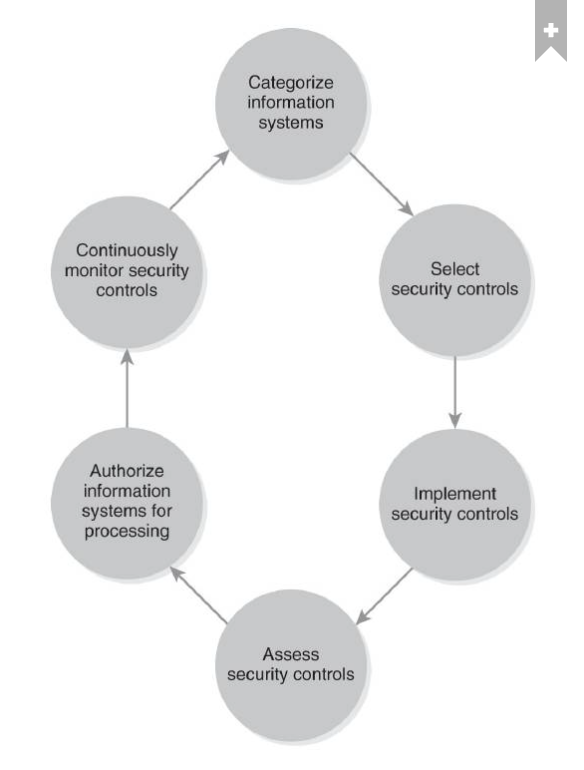
- NIST guides agencies at each RMF step
- FIPS 199, Standards for Security Categorization of Federal Information and Information Systems, helps them categorize their IT systems
- serves as the starting point for an agency’s information security program
- helps them separate their IT systems into categories based on risk
- then apply security controls to their IT system based upon their category
- Under FIPS 199, agencies must first assess the impact on IT systems because of a loss of confidentiality, integrity, or availability
- security category expresses that impact
- defines three security categories:
- Low
- loss of confidentiality, integrity, or availability has a limited adverse effect on the agency, its information assets, or people
- results in minor damage to assets
- Moderate
- loss of confidentiality, integrity, or availability has a serious adverse effect on the agency, its information assets, or people
- results in significant damage to assets
- High
- loss of confidentiality, integrity, or availability has a severe or catastrophic adverse effect on the agency, its information assets, or people
- results in major damage to assets
- Low
- next must decide which controls to use
- NIST created two documents to help with this
- FIPS 200, Minimum Security Requirements for Federal Information and Information Systems
- SP 800-53, Revision 4, Security and Privacy Controls for Federal Information Systems and Organizations
- defines the minimum thresholds, or baselines, for each category
- OMB requires that agencies use these documents
- documents require agencies to specify controls in 17 areas
- FIPS 200:
- Access control
- Awareness and training
- Audit and accountability
- Certification, accreditation, and security assessments
- Configuration management
- Contingency planning
- Identification and authentication
- Incident response
- Maintenance
- Media protection
- Physical and environmental protection
- Planning
- Personnel security
- Risk assessment
- System and services acquisition
- System and communications protection
- System and information integrity
- FIPS 200:
- NIST created two documents to help with this
- OMB requires federal agencies to test their security controls
- NIST SP 800-53A, Revision 4, Assessing Security and Privacy Controls in Federal Information Systems and Organizations: Building Effective Assessment Plans
- RMF requires agencies to authorize their IT system for processing
- means that an agency must test its systems and approve its operation
- based on a review of the risk of operating the system
- must specifically accept the risks of operation before allowing an IT system to operate
- agencies must continuously monitor their security controls
- must document any changes to their IT systems and assess them for new risks
- FIPS 199, Standards for Security Categorization of Federal Information and Information Systems, helps them categorize their IT systems
Central Incident Response Center
- government must have a federal IR center
- must:
- Give technical support to agencies about handling information security incidents
- Compile and analyze data about information security incidents
- Inform agencies about current and potential threats and vulnerabilities
- Inform agencies about threats, vulnerabilities, and incidents to be considered as part of the agencies’ risk assessment process
- Consult with NIST and agencies with NSSs about information security incidents
- Agencies must report all information security incidents to the National Cybersecurity and Communications Integration Center (NCCIC)
- aka US-CERT
- Under FISMA, an incident is an event that:
- actually or imminently jeopardizes the integrity, confidentiality, or availability of information or an information system
- constitutes a violation or imminent threat of violation of law, security policies, security procedures, or acceptable use policies
- reporting an incident:
- must share as much information about the incident as possible and requires:
- The impact the incident has had on the agency
- Whether any information has been lost, compromised, or corrupted
- The estimated amount of time and resources that are needed to recover from the incident
- When the incident was first detected
- The number of systems, records, and users impacted
- The network location of the incident
- Contact information if the NCCIC/US-CERT needs more information
- must report within 1 hour of discovering an incident
- must share as much information about the incident as possible and requires:
National Security Systems
FISMA requires federal agencies to secure NSSs using a risk-based approach.
- National security systems (NSSs) are IT systems that hold military, defense, and intelligence information
- includes systems that are for:
- Intelligence activities
- Command and control of military forces
- Weapons or weapons-control equipment
- Use cryptography to protect national security
- Critical to military or intelligence missions
- Must be kept classified for national defense or foreign policy
- includes systems that are for:
- Committee on National Security Systems (CNSS) oversees FISMA activities for NSSs
- has 21 voting members
- include officials from the National Security Administration (NSA), Central Intelligence Agency (CIA), and Department of Defense (DoD)
- DoD member leads the committee
- includes several subcommittees and panels
- has 21 voting members
- must follow CNSS policies
- FISMA permits the directors of the DoD and CIA to develop additional information security policies for NSSs within their own agencies
- OMB must report to Congress on FISMA compliance for NSSs
Oversight
- OMB and the DHS share responsibility for FISMA compliance
- OMB oversees FISMA-related budgetary issues
- can withhold funding from agencies that fail to follow FISMA
- OMB must issue a report to Congress each year on the government’s FISMA compliance
- DHS has had the power to ensure that agencies are meeting their FISMA obligations
- can create rules and other guidance that these agencies must follow
- called binding operational directives
- keeps track of how all federal agencies are complying with FISMA
- annually reviews their cybersecurity programs
- can create rules and other guidance that these agencies must follow
Authority to Operate
After an organization passes an audit, the federal agency they’re working with grants it an authority to operate (ATO).
- ATO is specific to each agency
- Company needs an ATO from each agency they work with